The post LUXIA 375 MONACO: one hundred miles aboard an incredible sport coupé appeared first on Yachting News.
]]>Luxia has recently launched two models that have already drawn considerable interest from owners, who have had the chance to experience the quality on offer firsthand. The 375 GTS and the 375 MONACO are a clear demonstration of how it’s possible to bring something new to the market in terms of both style and onboard comfort.
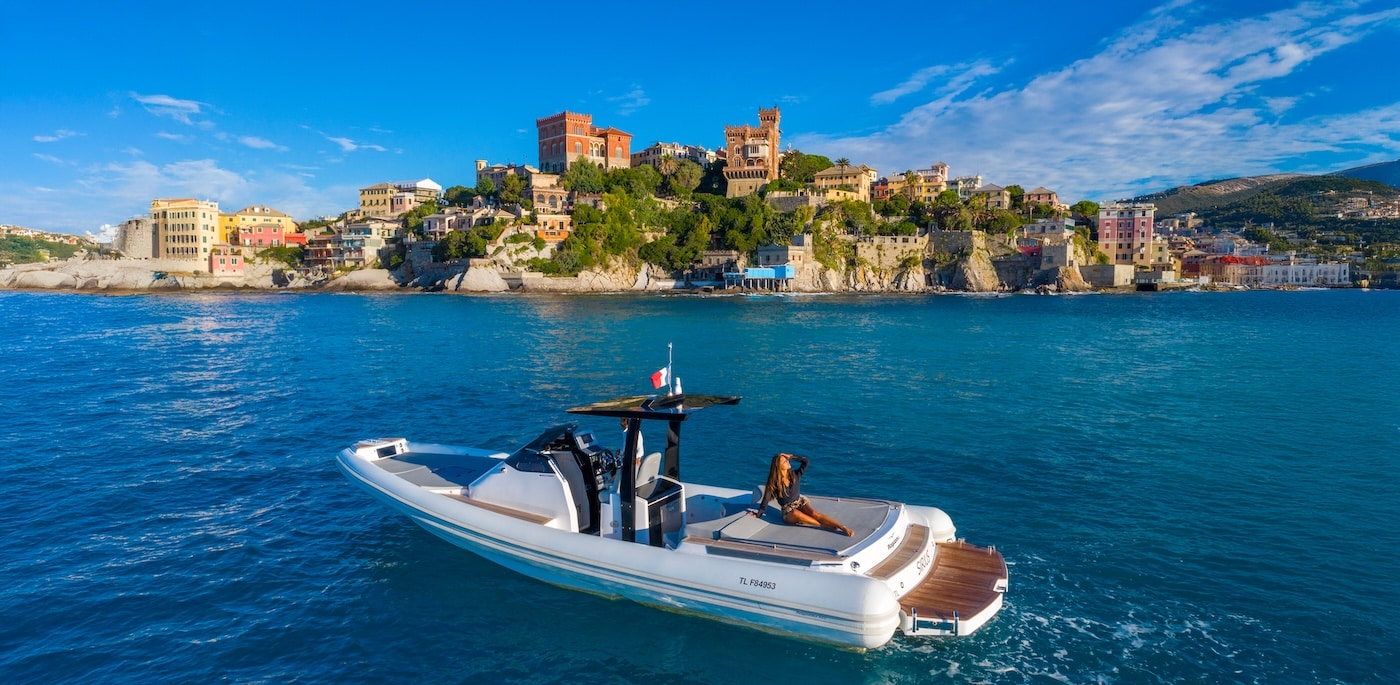
We tested the 375 MONACO which, with its unique design, marks a new era for open boats— a true rebel that refuses to compromise. Clean lines, coupé-style exteriors, and a whole lot of attitude.
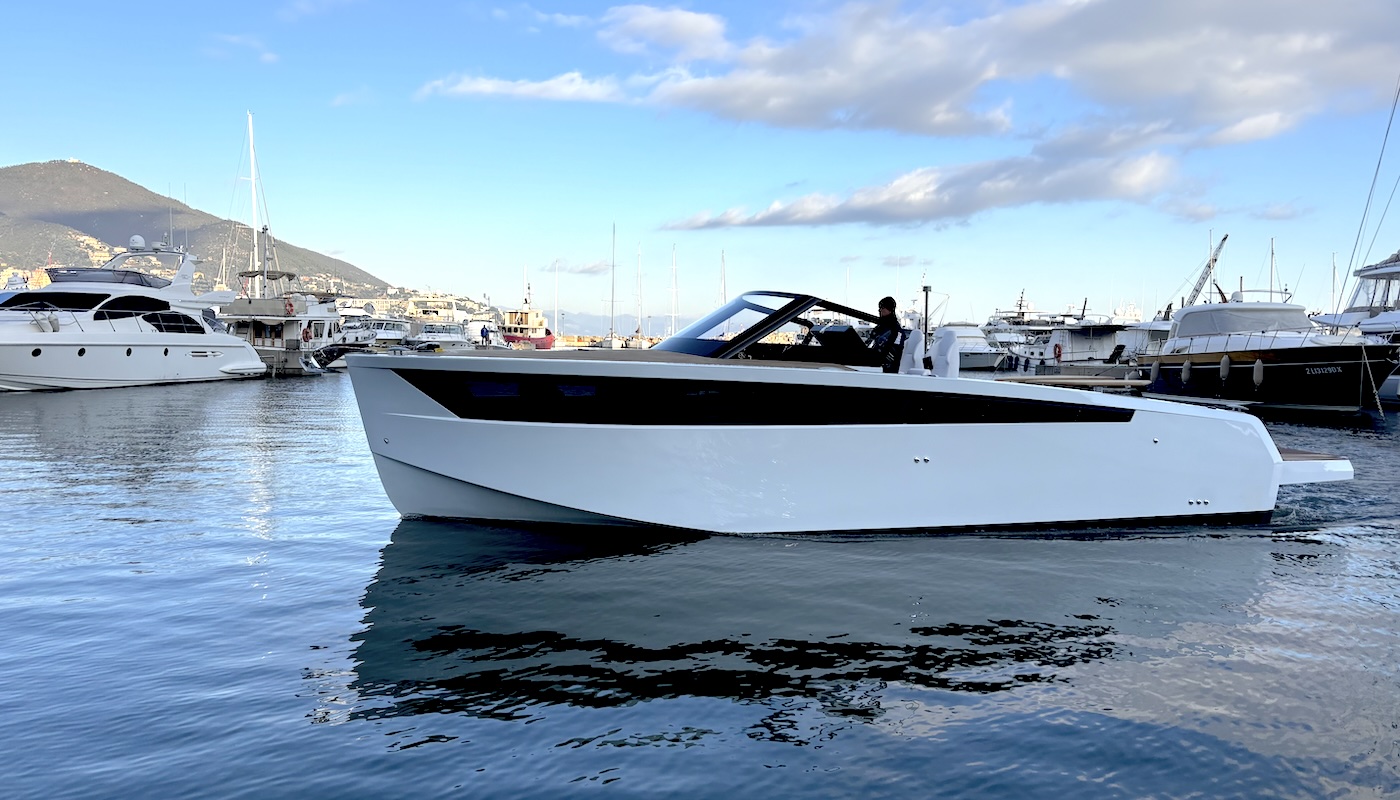
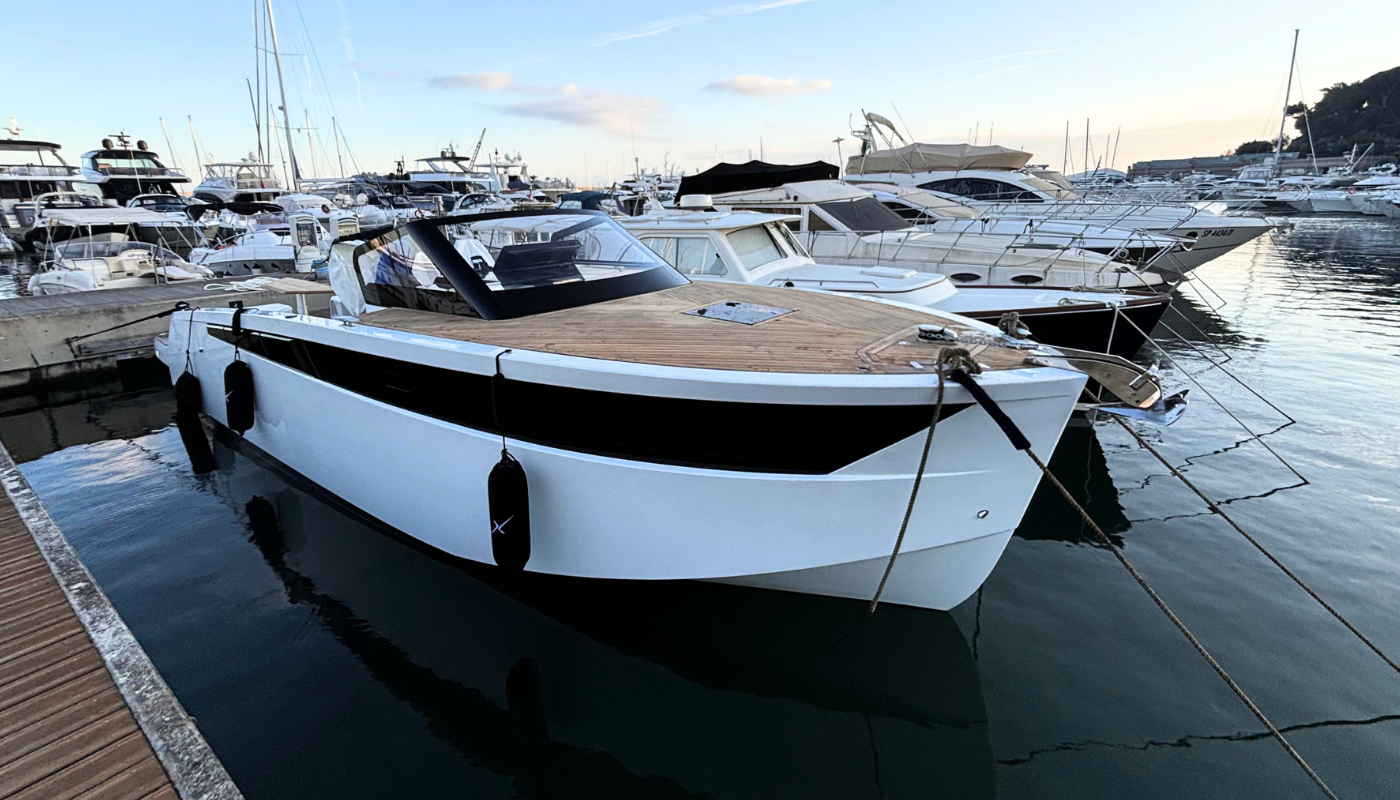
The 375 MONACO makes an impression at first glance. Its hull promises stability and fun, with a no-frills approach that underscores its purebred sporting spirit.
The Luxia 375 Monaco in detail
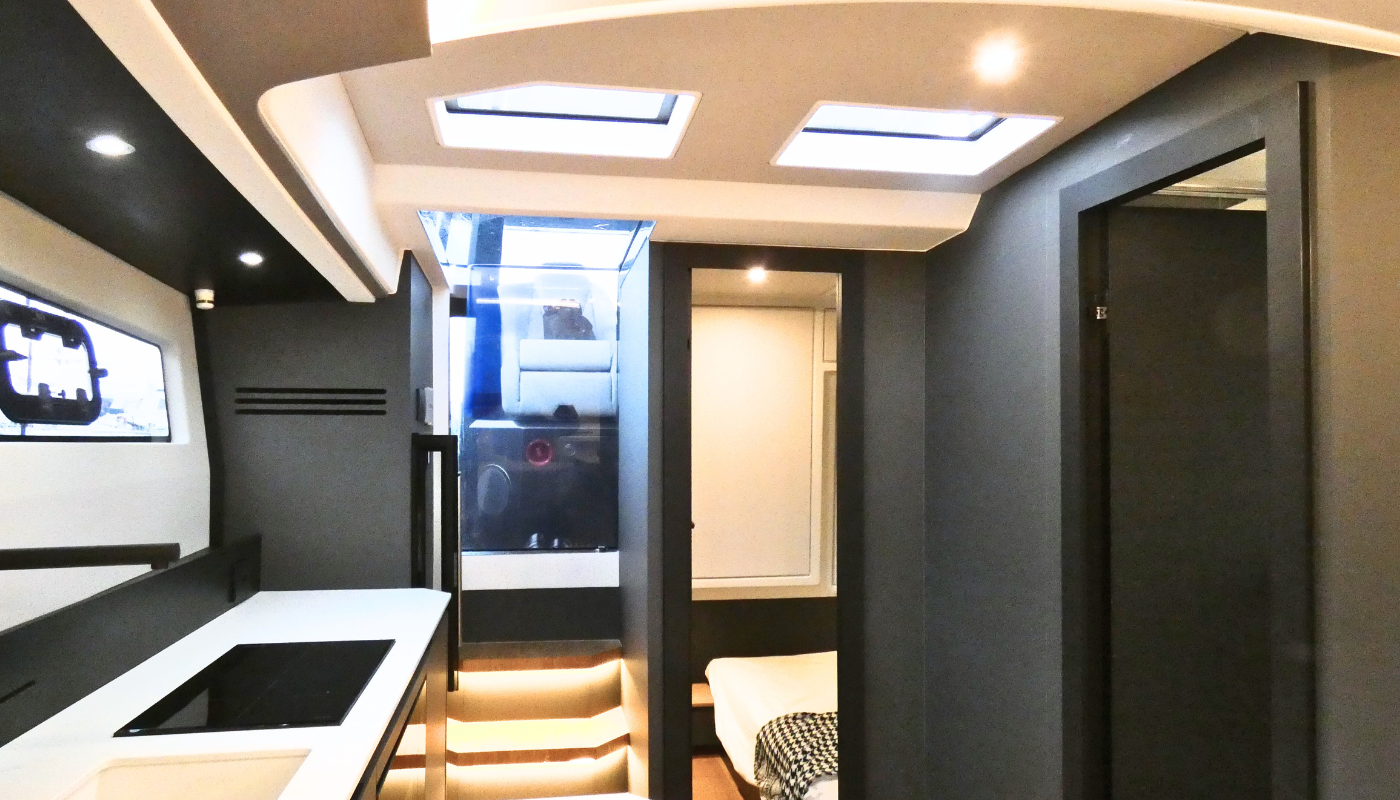
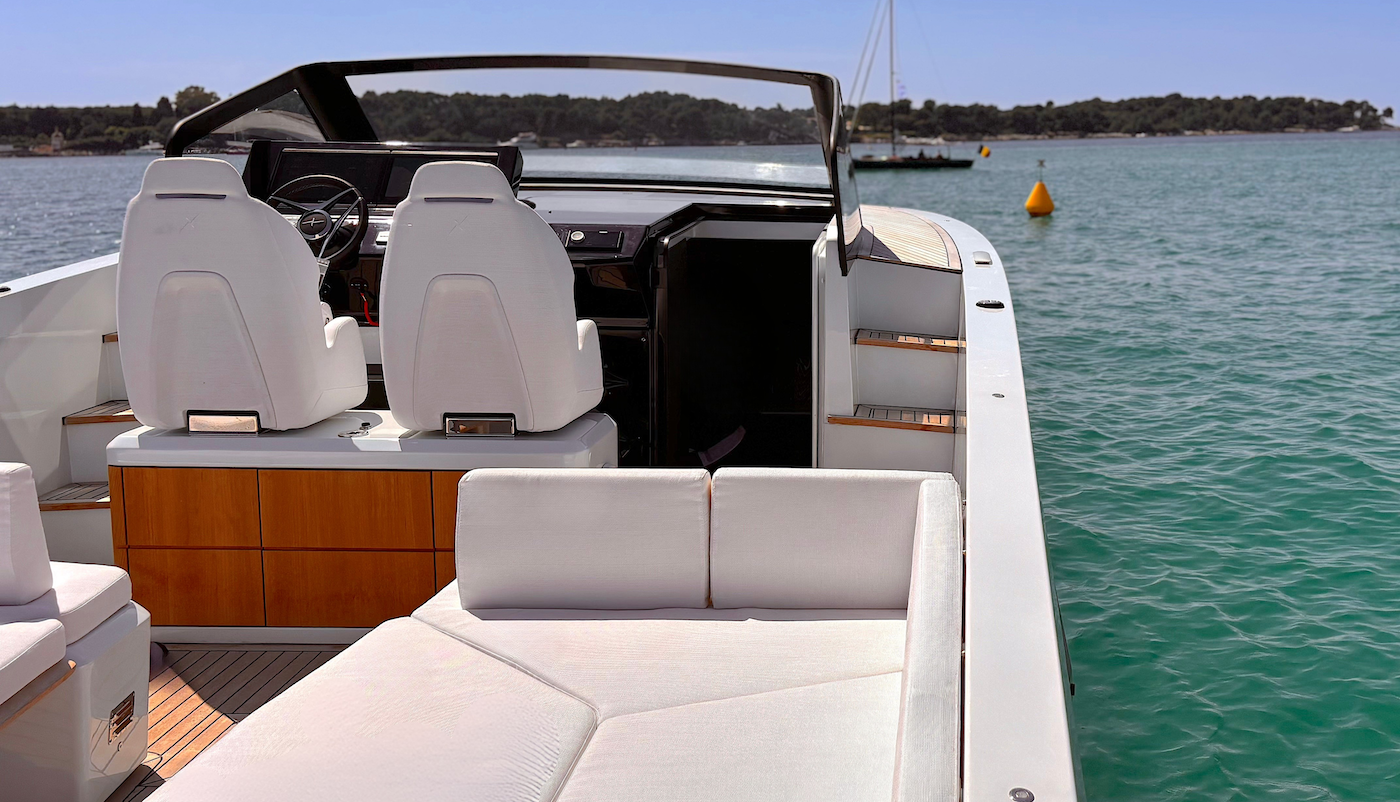
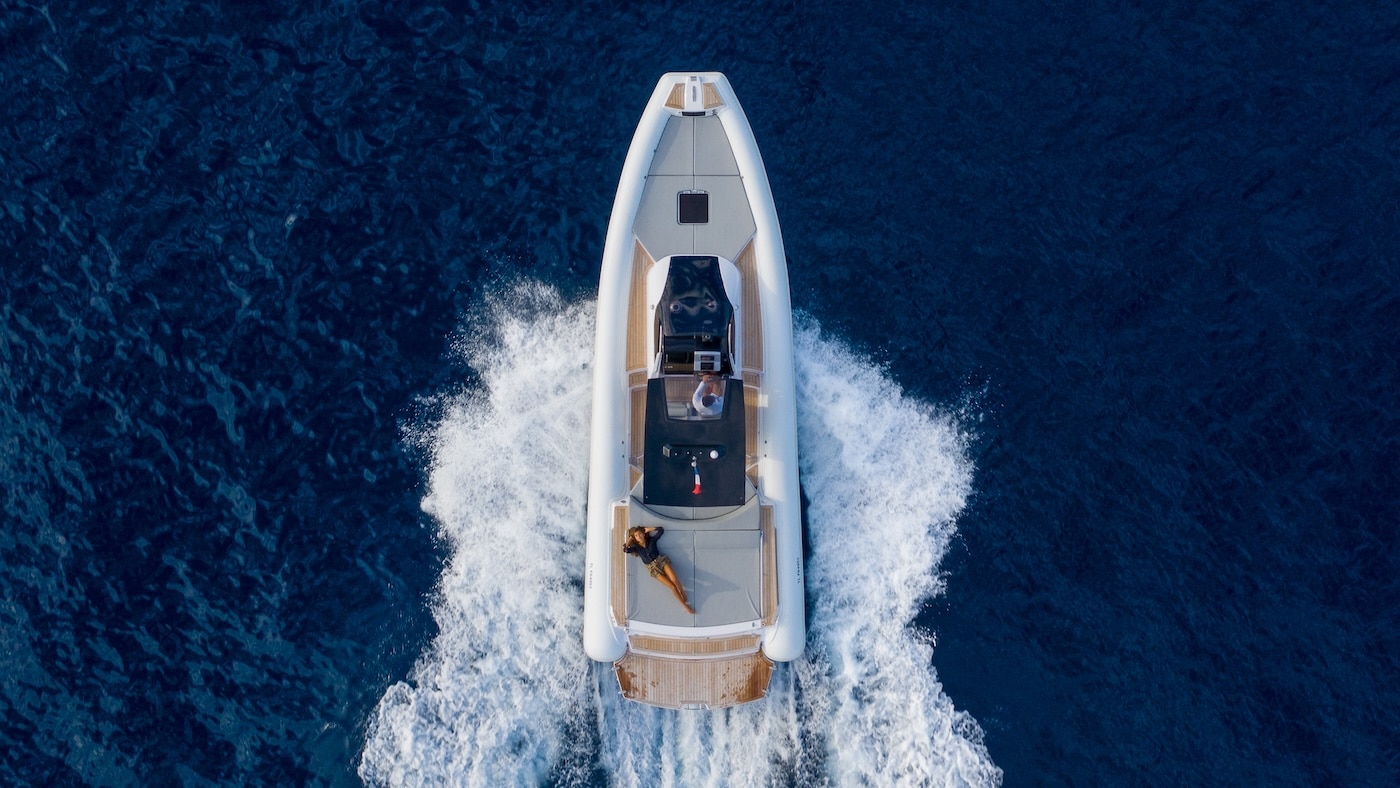
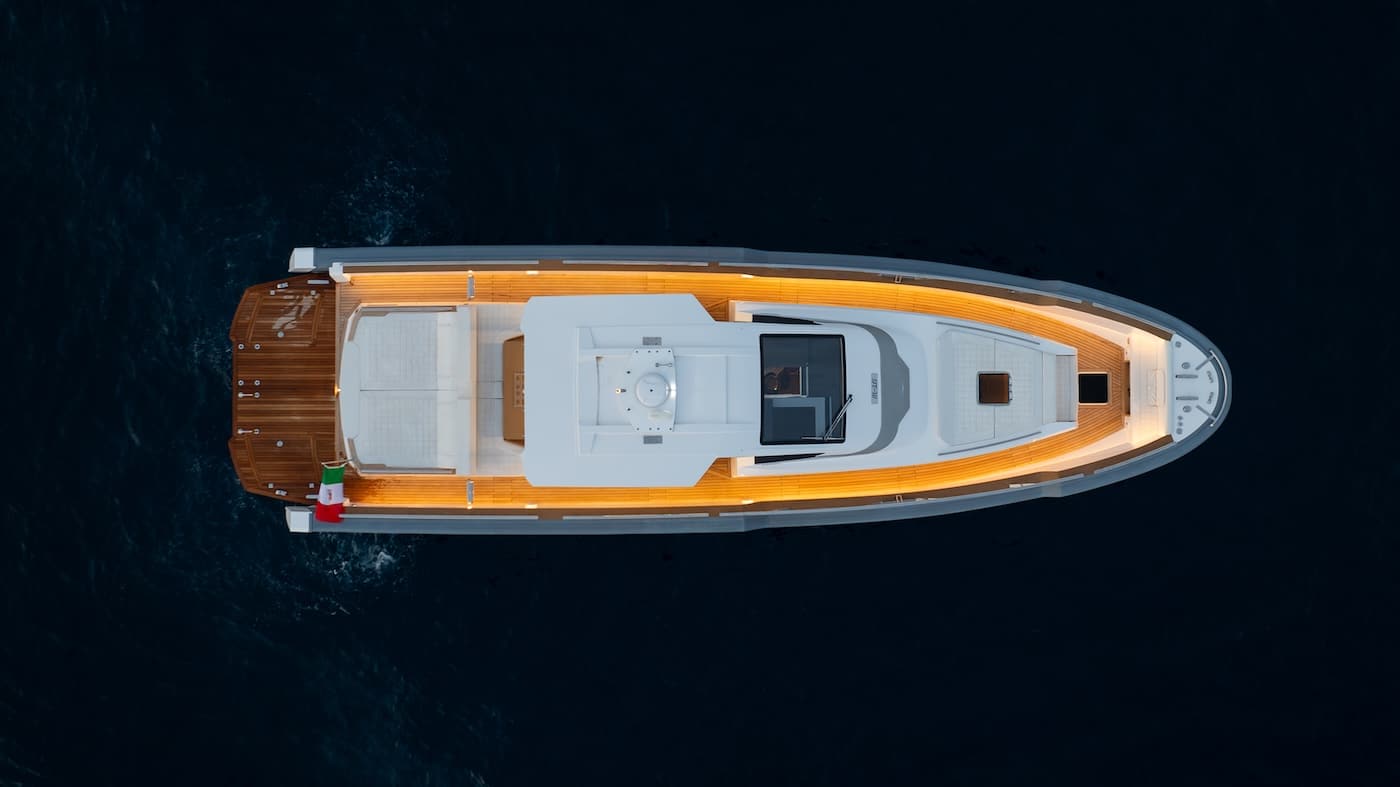
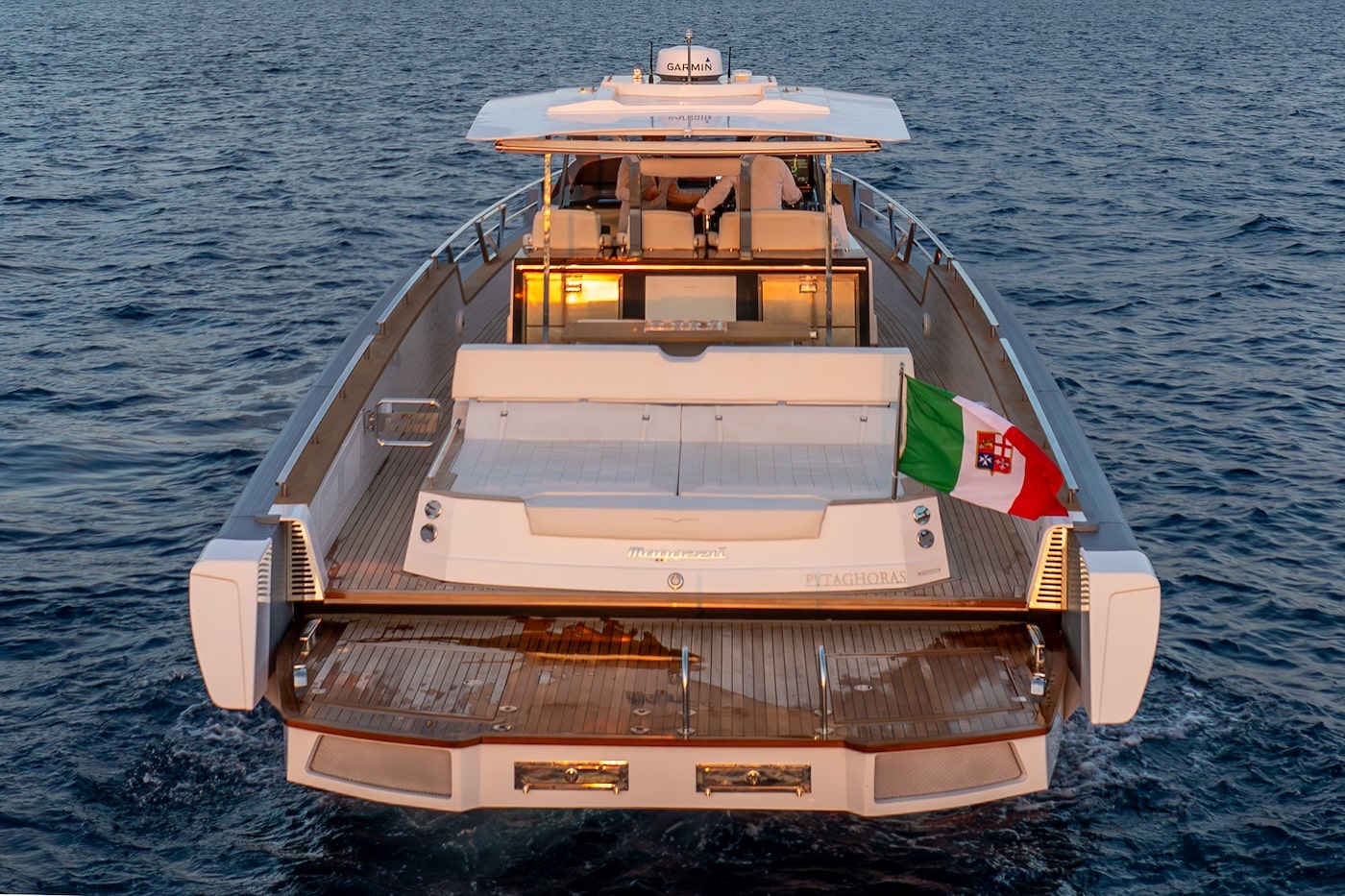
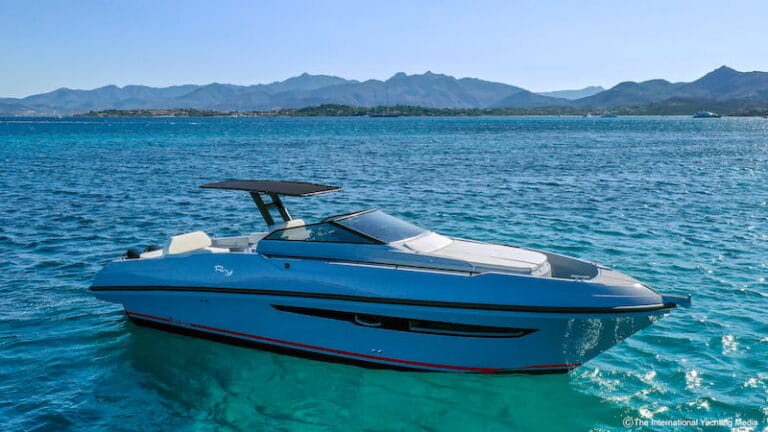
At the stern, a large swim platform significantly expands the deck space and creates a truly generous environment. This is further enhanced by the boatyard’s decision to equip the model with two large chaise longues served by two separate tables, which can be lowered to form one big sunbathing area comfortably accommodating up to six guests. The central walkway provides ample room to move around, while amidships, a low cabinet houses the fridge and icebox, topped by two helm seats featuring a truly distinctive design.
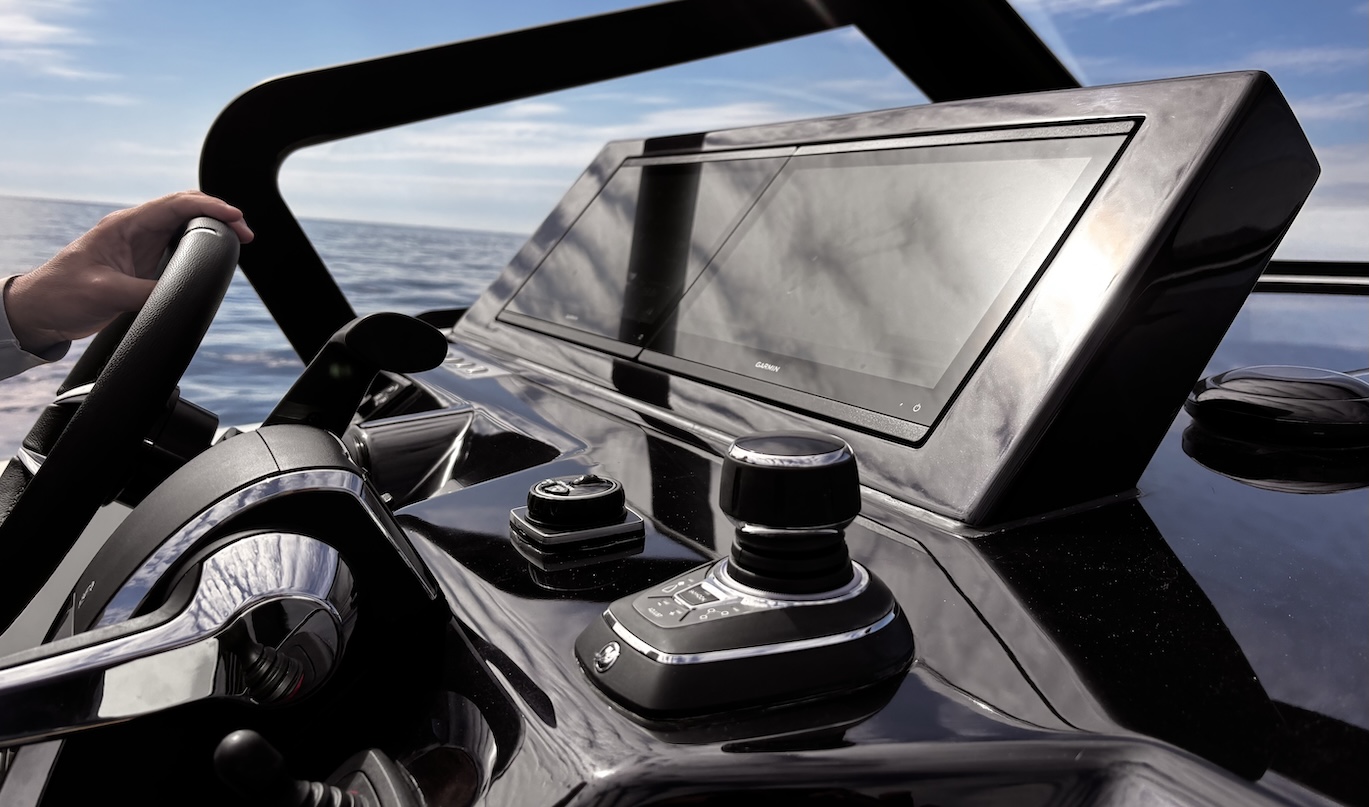
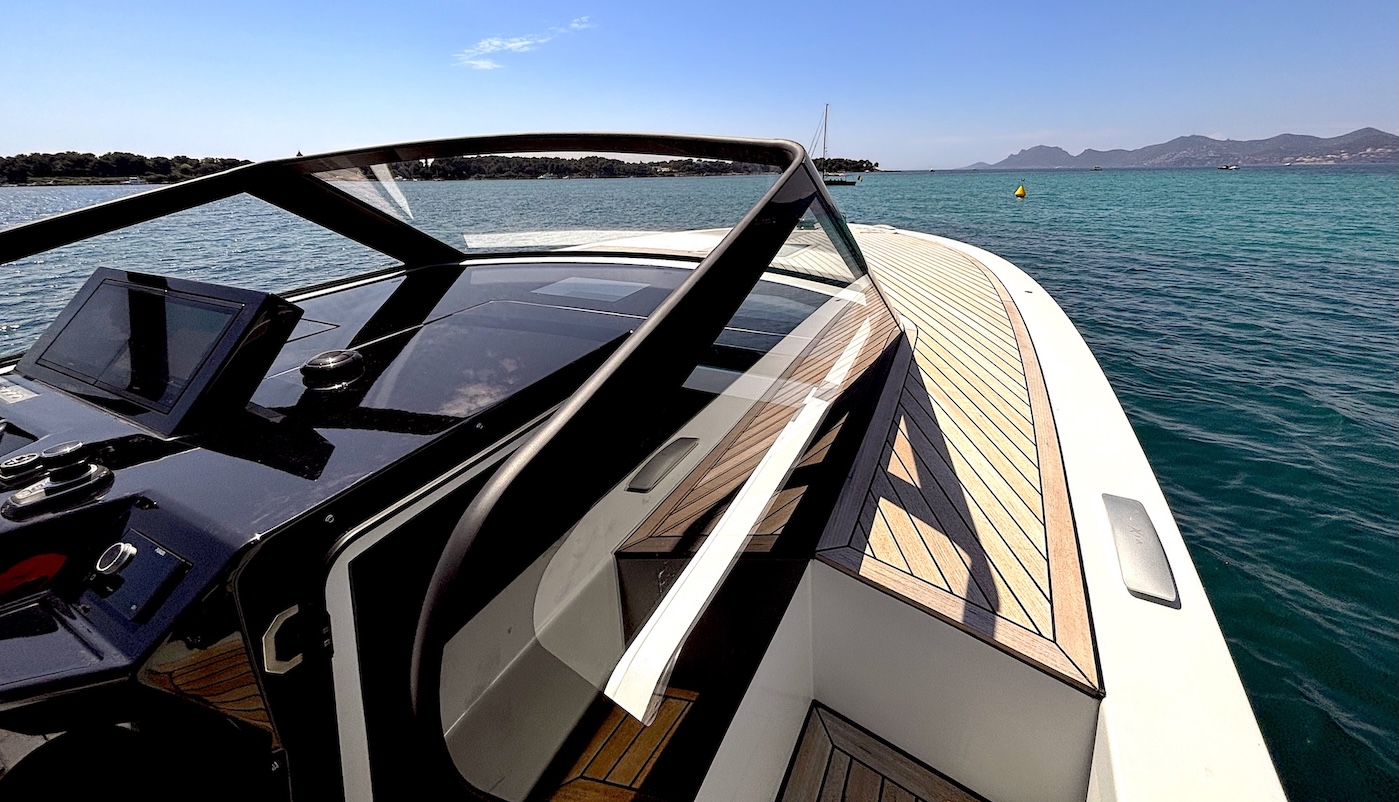
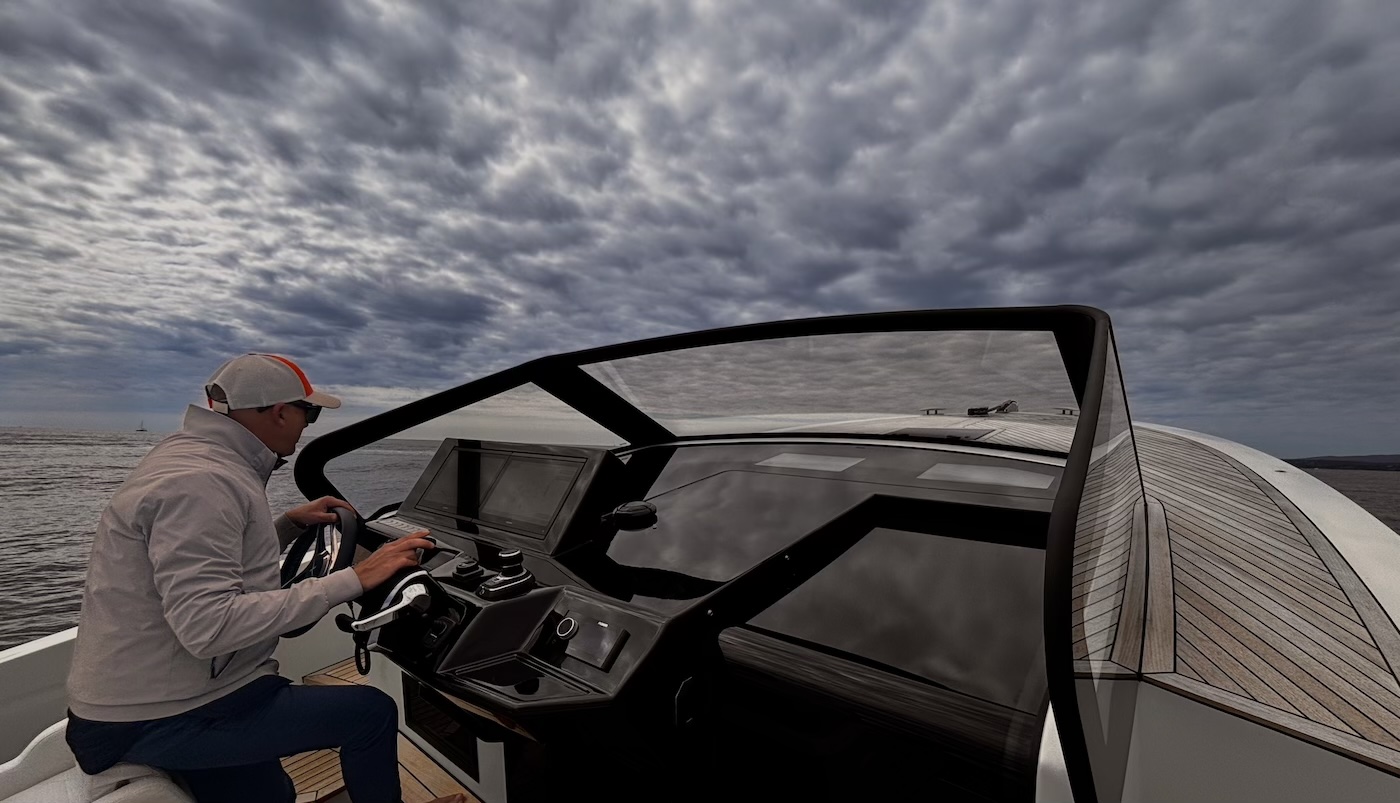
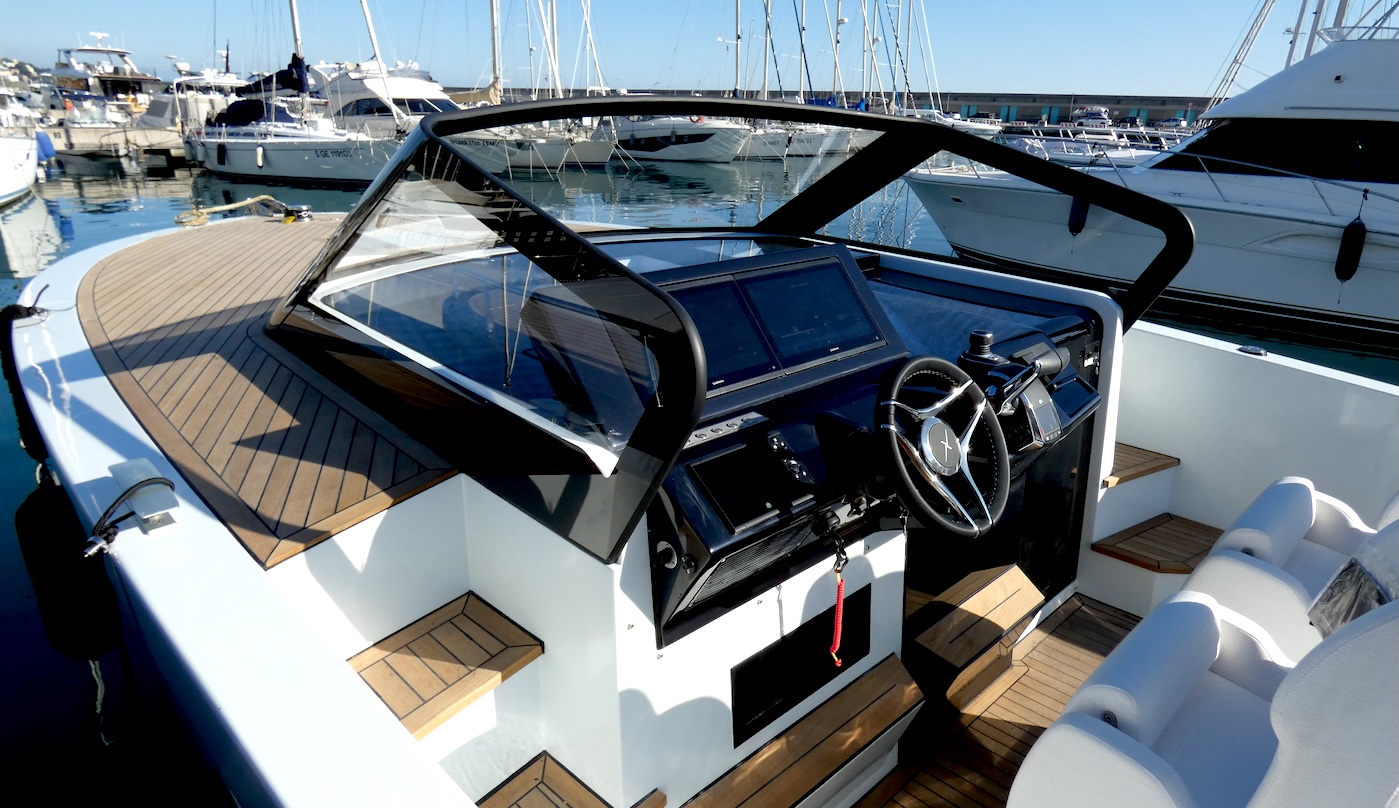
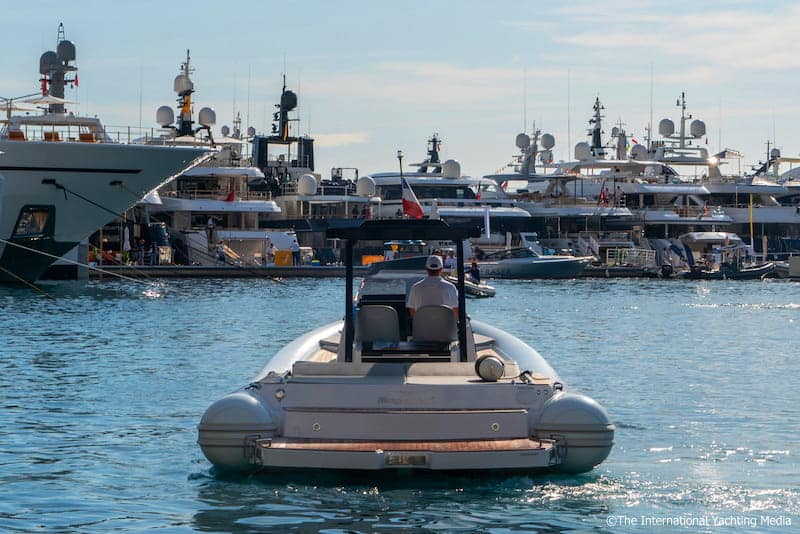
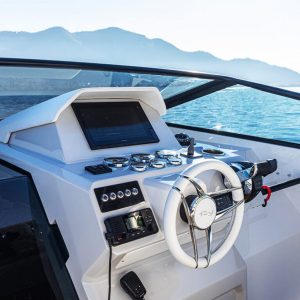
The helm station is impressive, with two large GARMIN displays that allow you to control almost every aspect of the boat thanks to extensive onboard domotics. The driving position is perfect whether you prefer to sit or stand, offering complete visibility with no blind spots whatsoever. The black moldings of the large windshield contrast beautifully with the hull’s triple-layer pearlescent white paint, creating a striking visual effect.
375 MONACO Sea Trial
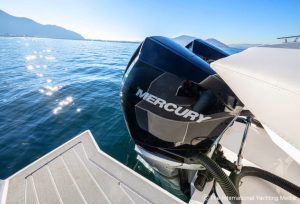
We set off from the port of Saint Tropez around 10 a.m., estimating that at an average speed of 22 to 23 knots, we should reach Varazze in just over five hours. The sea is calm, although the forecast predicts a slight change for the worse around noon. The fuel tank is at 80%, which means we have 640 liters of fuel on board. This 375 MONACO model is powered by two Mercury 270 hp sterndrive engines, which are lightweight and ensure exceptionally low fuel consumption. We leave our berth, and thanks to the integrated joystick, I have no trouble casting off—even though the channel is fairly narrow, the boat pivots almost on the spot and requires very little space. I ease out of the bay at a reduced speed, as there’s a good amount of boat traffic in the gulf.
Just outside the Gulf of Saint Tropez, I throttle up to reach a cruising speed of 23 knots at around 3,500 rpm. I check the monitor and see fuel consumption holding steady at around 100 liters per hour. The boat is genuinely fun to drive, the controls are responsive, and the steering reacts instantly. Thanks to the highly efficient hull, the 375 MONACO cuts through the water cleanly with no need for steering corrections. The windshield offers great wind protection, with proper aerodynamics even at higher speeds. In just under an hour, I enter the Bay of Cannes and decide to stop near the Lérins Islands, dropping anchor in front of a small cove known as “La Piscine” for its crystal-clear waters.
It’s a truly beautiful day, and the 375 MONACO remains stable on the water—even though this particular unit isn’t equipped with a stabilizer, as per the owner’s choice. After a quick snack, we weigh anchor and get back on course. We pass abeam of Monaco around 1:00 p.m., and in no time, the sea changes its mood. At first, there’s a light wind with a few waves, but then the conditions worsen and the waves pick up. Within 15 minutes, I find myself having to constantly adjust the course to avoid the biggest swells. The sea continues to build, and we’re soon facing waves about a meter and a half high off the starboard bow. I reduce speed and bring the engines down to 2,800 rpm, advancing at around 10 knots. The boat stays dry and responds very well to my commands. After about half an hour, the sea turns white with foam, and unsure of what conditions lie beyond Capo Mele, I decide to pull into Cala del Forte to refuel and consider whether to continue or spend the night.
We dock at the quay and fill up the tanks. Even in the marina, the wind has picked up—blowing at around 25 to 28 knots, with gusts hitting 30. It’s surprising, given that the forecast didn’t predict anything this intense.
By around 3 p.m., the situation returns to normal. The sea calms down and the wind completely dies. We decide to head back out. Lines are cast off, and as soon as we exit the harbor, I set a course of 105° to pass Bordighera, cruising at 15 knots with the engines at 3,100 rpm and fuel consumption at 75 l/h. The boat quickly settles back into its pace, the sea is now completely flat, and I take the opportunity to test the top speed of the 375 MONACO. I push the throttle up to 3,880 rpm and see 32 knots on the GARMIN display, with total fuel consumption at 120 l/h. I throttle back slightly and settle into a comfortable 25-knot cruise. Within an hour, we’re abeam of Capo Mele. The navigation continues smoothly. I adjust the heading to 60°, as the wind picks up again on the starboard beam. I work the Zipwake system to keep the 375 MONACO on a steady plane. Abeam of Albenga, I make the final course correction to 28° and head straight for Varazze. We have just under 25 miles to go, and everything is running smoothly. I hold a steady 22 knots and enjoy the lively return leg. Around 5:30 p.m., we enter the Marina di Varazze, and within minutes, we’re tied up at the dock.
Conclusions
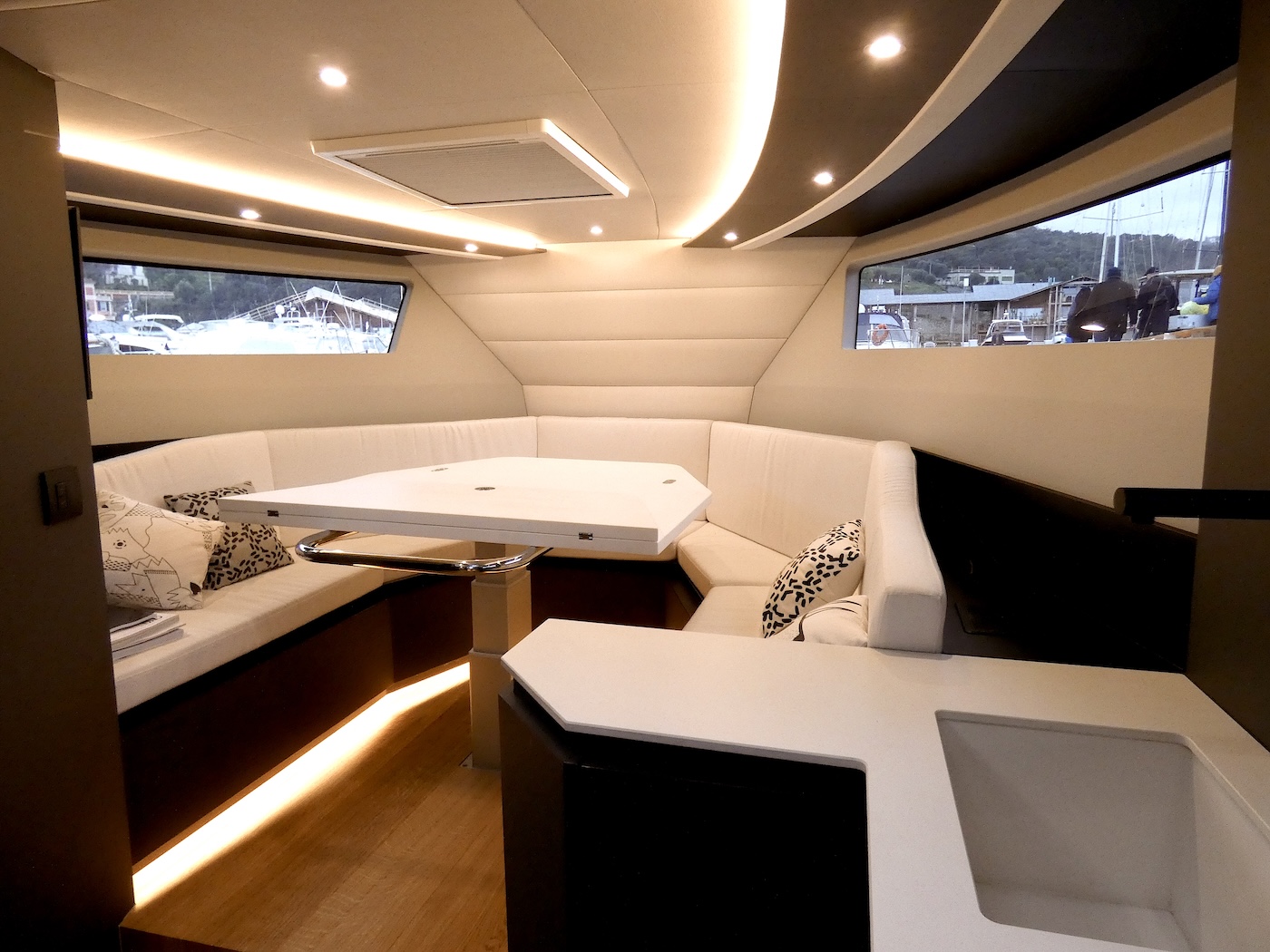
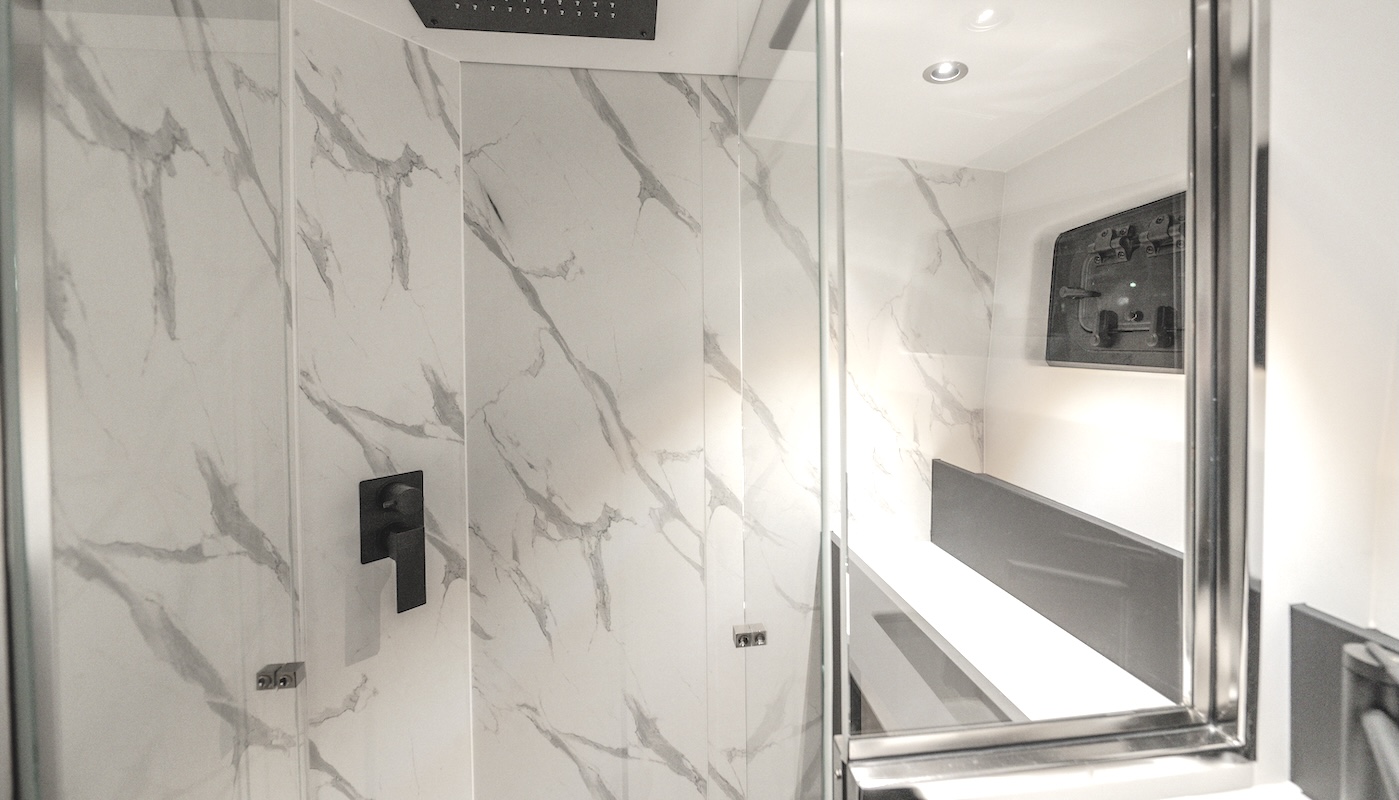
The 375 MONACO delivers plenty of thrills—not just thanks to its distinctive look, but also for how easy it is to handle in any situation. It strikes the perfect balance between power and stability. This is a boat that’s just as suited for relaxed days at anchor in a quiet bay as it is for longer cruising holidays, thanks to its surprisingly spacious and comfortable layout—despite its overall length is just 11.5 meters.
Test Data
RPM | Speed | Consumption in gal/h | gal/nm |
600 | 2.6 | .42 | 0.16 |
1000 | 4 | 0.73 | 0.18 |
1200 | 6 | 2.21 | 0.36 |
1500 | 7.2 | 3.69 | 0.5 |
2000 | 8.7 | 7.39 | 0.84 |
2500 | 9.7 | 12.44 | 1.29 |
3000 | 13.8 | 20.07 | 1.45 |
3500 | 25 | 26.41 | 1.05 |
3880 | 31 | 31.7 | 1.03 |
375 MONACO Technical Specs
LOA | 11.50 m |
LH | 9.99 m |
Max beam | 3.48 m |
LWL | 9.27 m |
Draft | 0.55 m |
Displacement (full load) | 8500 kg |
Unladen Displacement | 7.000 kg |
The post LUXIA 375 MONACO: one hundred miles aboard an incredible sport coupé appeared first on Yachting News.
]]>The post Aquila 42 Coupe: the catamaran that will revolutionize the market is a game-changer. Sea trial. appeared first on Yachting News.
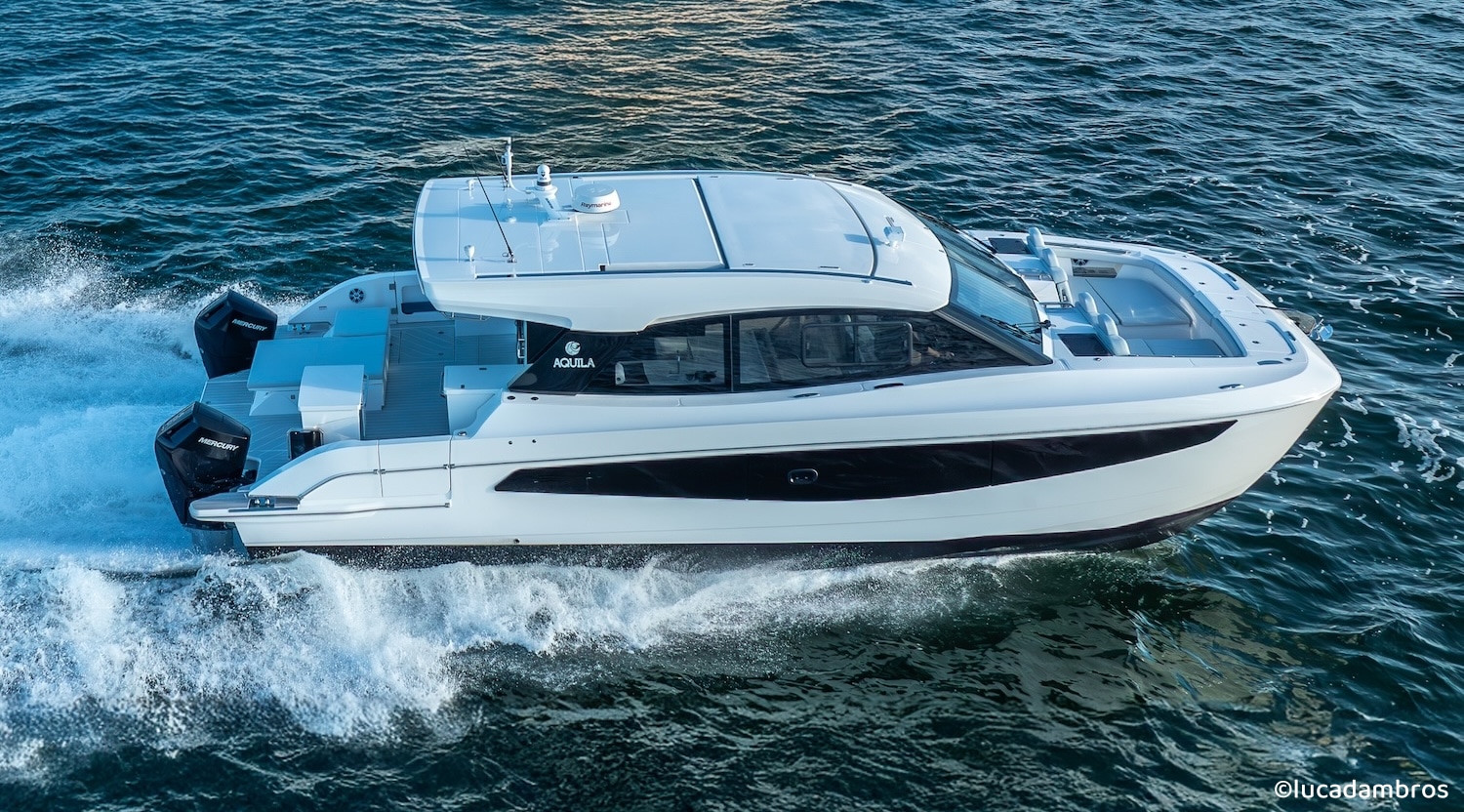
]]>It’s not every day that we witness the birth of an entirely new type of boat, but with the introduction of the Aquila 42 Coupe, the boating industry is taking a significant leap forward. As sleek as a sporty yacht, as comfortable as only a catamaran can be, and equipped with an innovative foil system, this multihull is setting a new market standard.
So, it’s easy to understand why, when I was invited to test the new Aquila 42 Coupe on a 300-nautical-mile journey from Clearwater to Miami, I immediately said yes. After all, very few shipyards are willing to conduct such long and demanding sea trials, giving those on board the incredible opportunity to experience a boat in real-world conditions. What’s more, the route for the Aquila 42 Coupe’s sea trial is nothing short of spectacular.
On the first day, we’ll cruise across the Gulf of Mexico ( renamed the Gulf of America from January 20), following Florida’s west coast for 150 nautical miles until we reach Marco Island. The next day, we’ll continue along the peninsula to the Everglades, rounding Cape Sable—the southernmost point of the continental United States—before weaving through the labyrinth of islands, islets, and shallow waters of the Florida Keys. Our journey will end in Key Largo, where we’ll anchor off Pumpkin Key for the night, after covering another hundred nautical miles.
On the morning of the third day, we’ll set off early to reach Miami just in time to bring the Aquila 42 Coupe to the Miami Boat Show, where it will make her world premiere.
Aquila 42 Coupe Sea Trial
Day 1
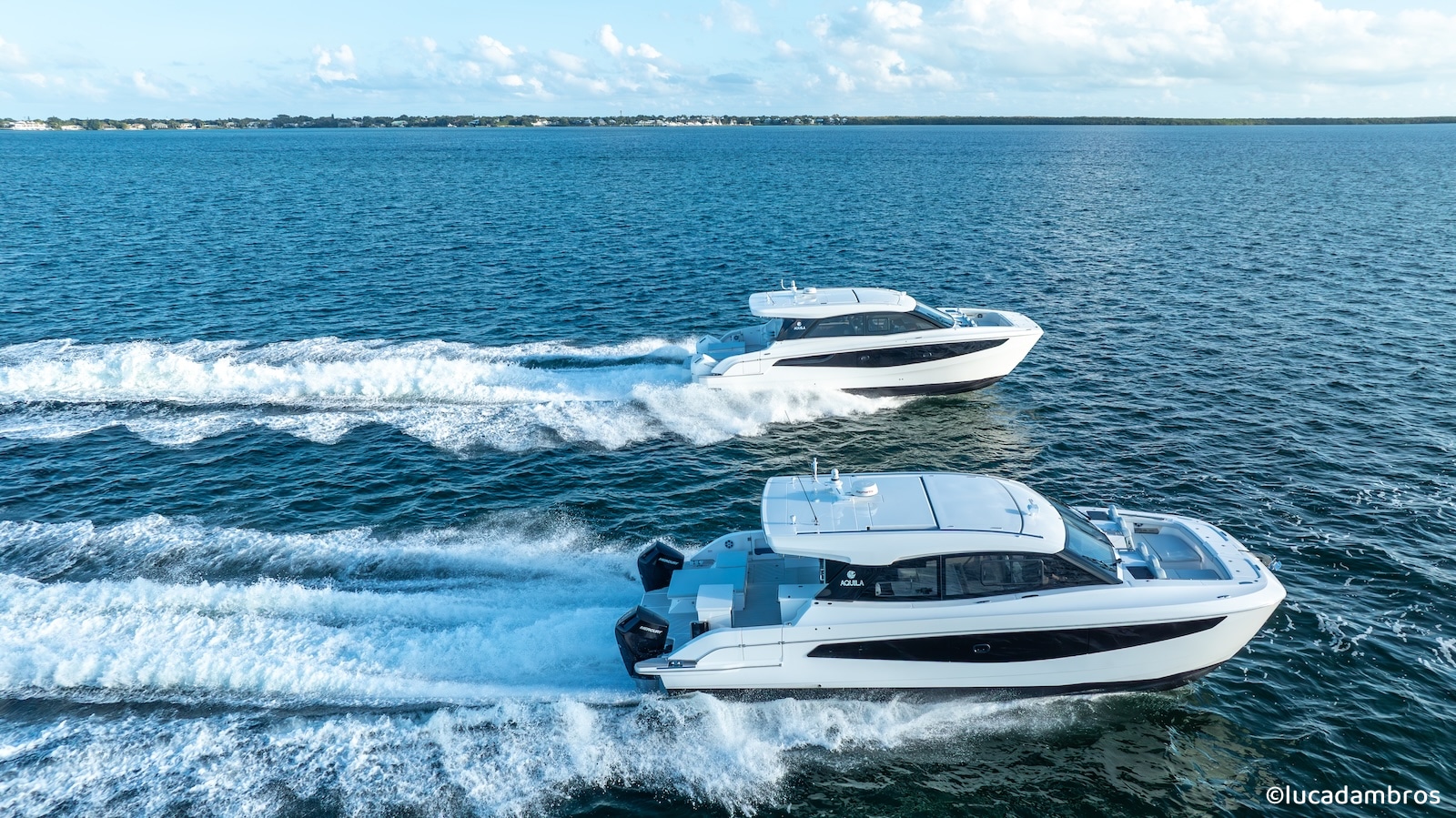
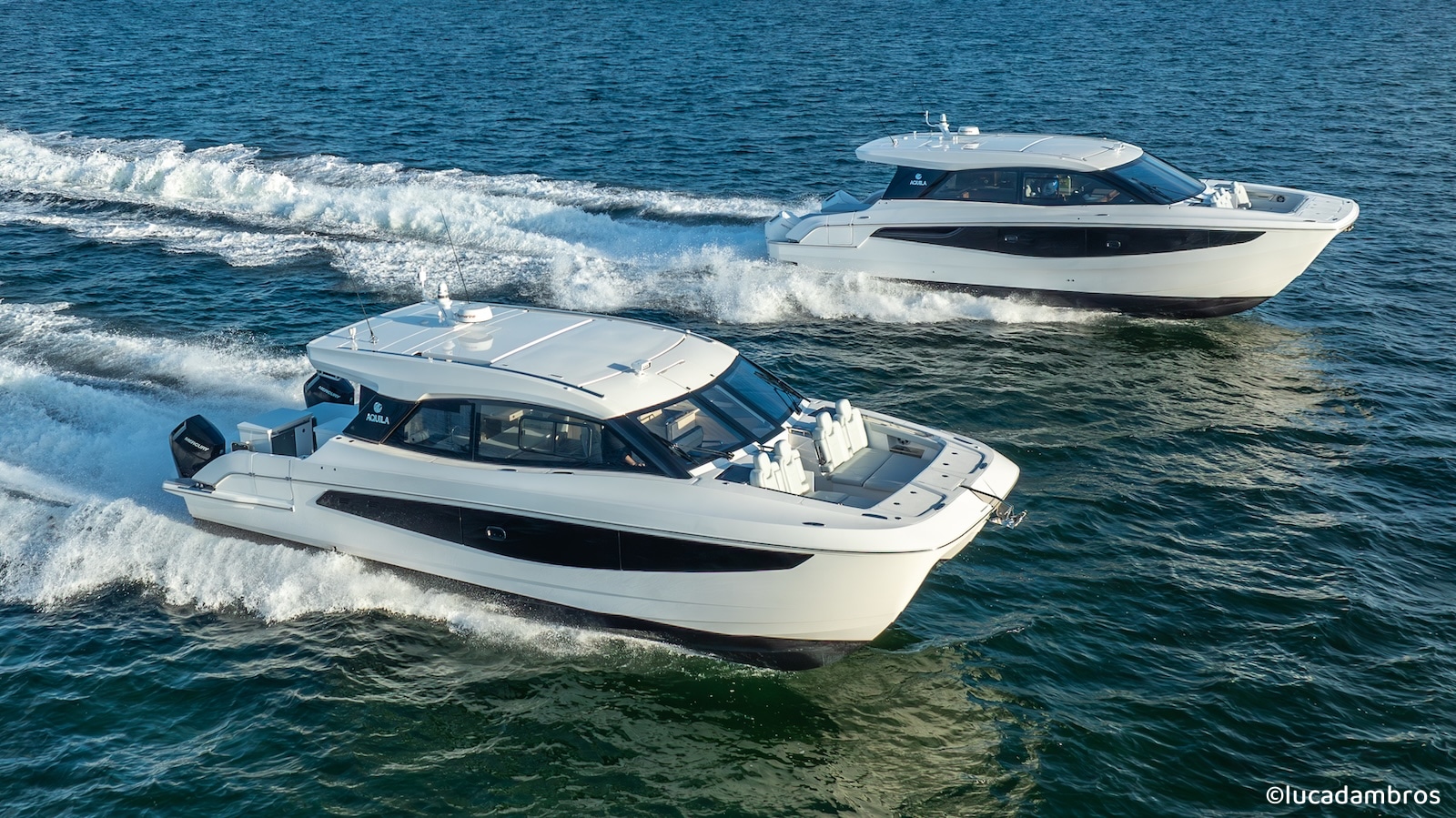
To fully grasp the extent of the innovation that the Aquila 42 Coupe brings, you really have to experience it firsthand. The large central foil connecting the two hulls is fixed and specifically designed to maximize efficiency when cruising between 30 and 50 miles per hour (roughly 25 to 40 knots), which makes a huge difference compared to traditional navigation. Using it is incredibly simple: once the boat gets up on plane, adjusting the trim not only changes the boat’s trim but also affects the foil’s angle of attack, slightly lifting the hull and reducing its effective weight by about 50%.
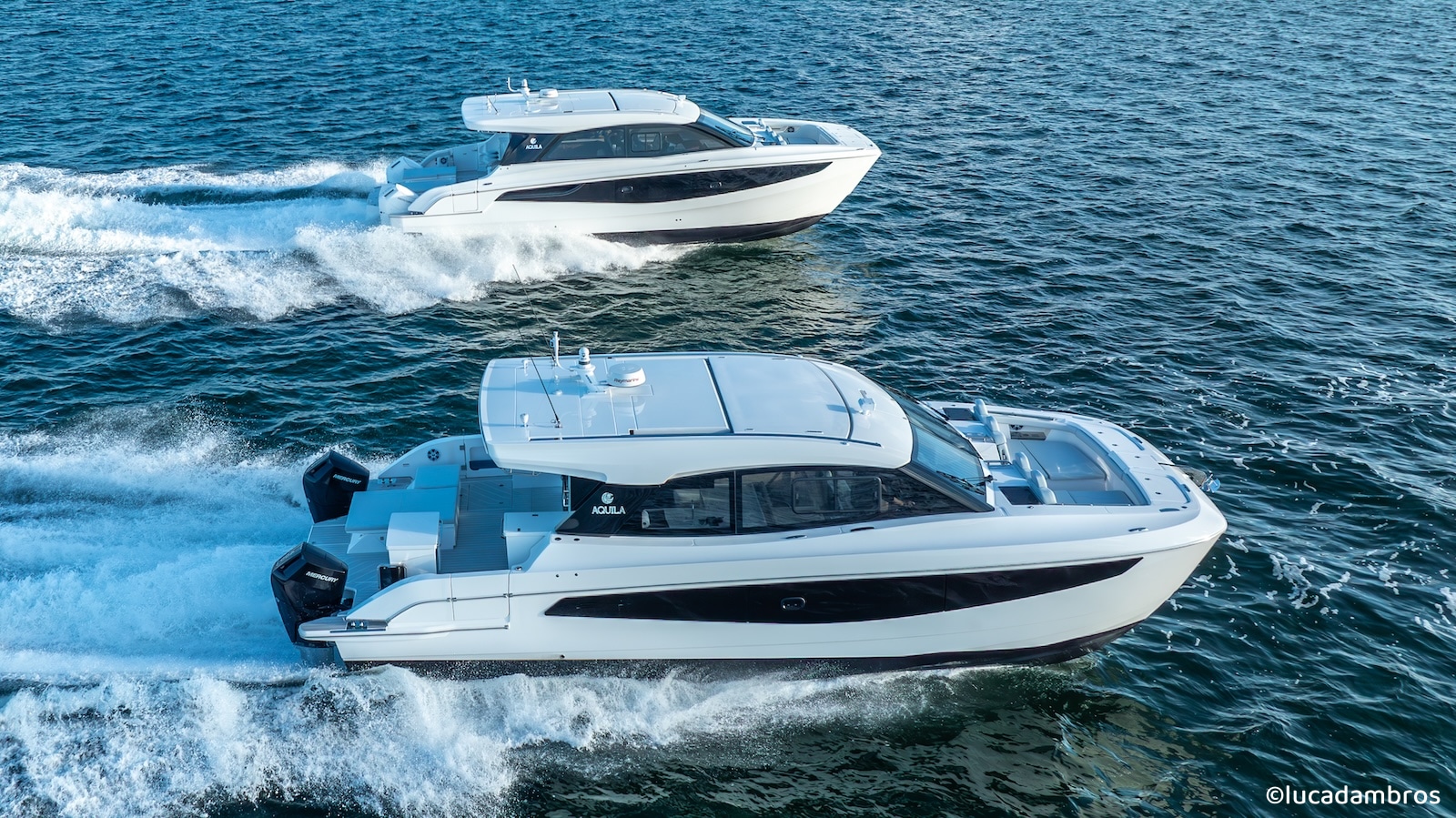
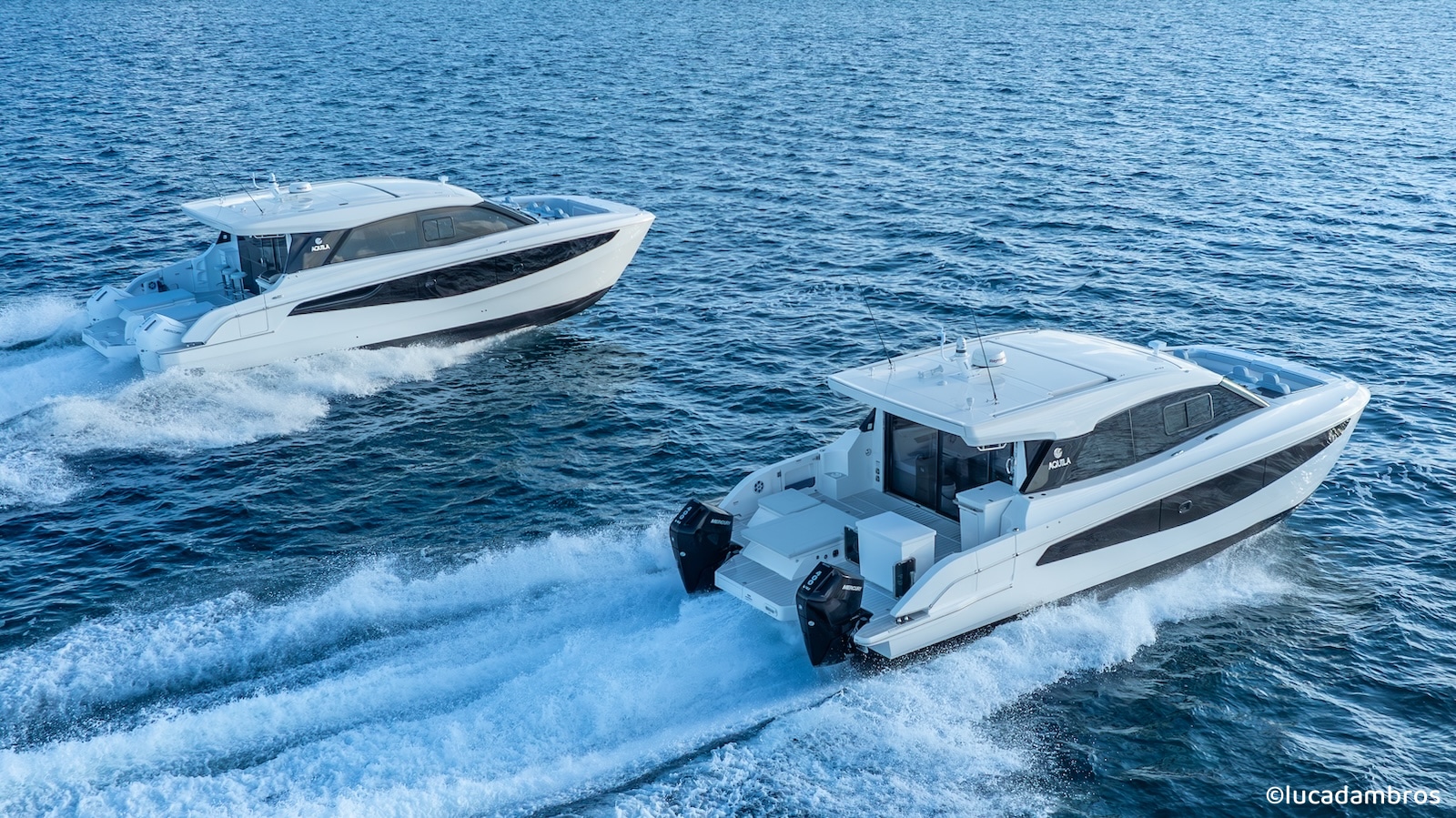
This system works perfectly with the latest-generation outboard engines mounted at the stern: a pair of Mercury Verado V10s, each delivering 400 horsepower. At speeds over 30 miles per hour (almost 27 knots), they consume just 4.2 liters per nautical mile—or, if you prefer, only 1 gallon per land mile.
This is a significant result, as it clearly demonstrates the efficiency of a system capable of reducing fuel consumption and emissions by 40-50% compared to a traditional yacht of the same size.
But it’s only once you’re on board the Aquila 42 Coupe that you truly appreciate the benefits of this system. As soon as the boat planes—today, with a steep head sea—the impact of the waves nearly disappears, almost as if we were riding on a boat equipped with shock absorbers.
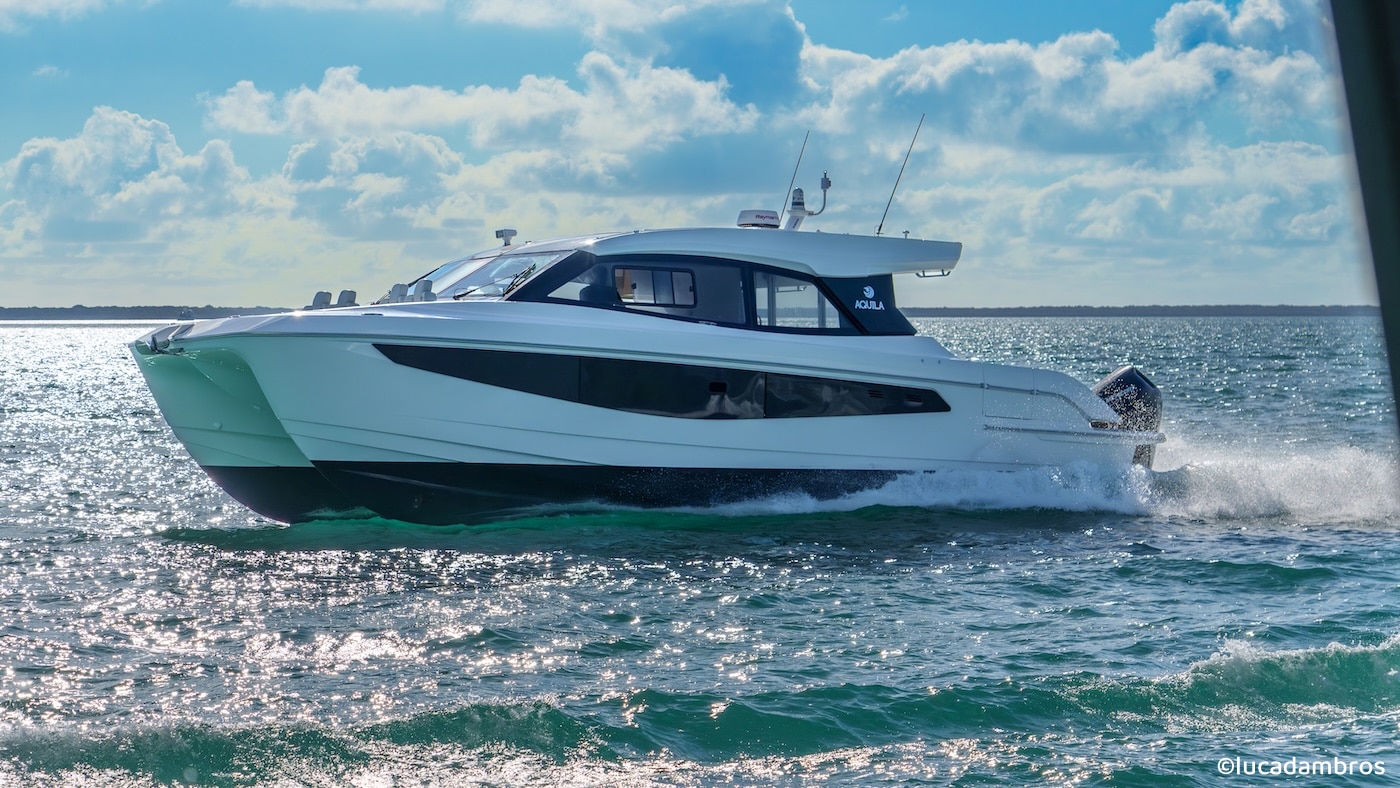
Maybe that’s why, taking turns at the helm with Jure Zule—my travel companion and Head of Product Development at Aquila Power Catamarans—the first 150 nautical miles fly by. The time passes pleasantly as we chat and even take a break to rest in my cabin. Despite cruising at over 30 knots, the Aquila 42 Coupe offers a level of comfort well above average.
We arrive at Marco Island just as the sun begins to set. Navigating through the channel into the inland waters, we smoothly reach our mooring. Thanks to the outboards and joystick steering system, docking is a piece of cake, and in no time, we’re securely tied up.
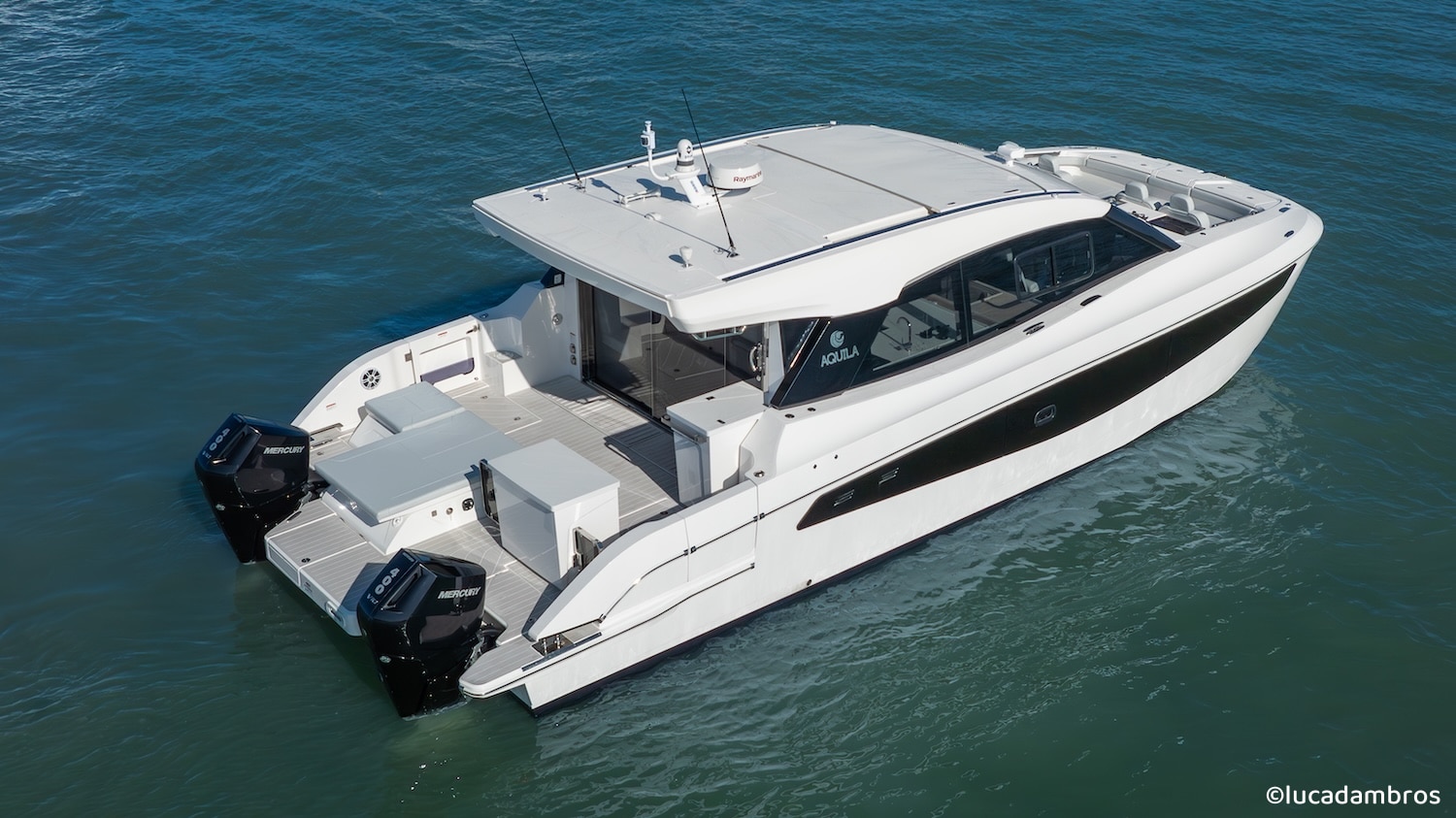
After tidying up the boat and preparing the cabins for the night, we go out for dinner. The onboard spaces are simply huge—not just the main deck, which, thanks to its nearly 5-meter beam, offers the same space as a 50-foot monohull, but also the two large cabins, which, to my amazement, are essentially two master suites, each with a private bathroom and separate shower.
Storing my luggage is a breeze. I have two wheeled camera bags, a trolley packed with clothes for two weeks, and my backpack—yet everything disappears instantly into the low cabinets in the cabin. There’s still plenty of storage space left, both in the upper cupboards and in the countless compartments this Aquila 42 Coupe has to offer.
After dinner, we return to the boat, and I head straight to bed. Another intense day awaits us tomorrow.
Day 2
Waking up on this catamaran feels a bit like discovering you’re staying in a seaside villa. I get out of the massive bed and step straight into the shower, which is so spacious that I can even dry off inside before stepping out. I shave as if I were at home, and then I’m ready for coffee. Climbing the four steps up to the main deck, I take in the sight of the expansive linear galley, fully equipped with everything I could possibly need.
The large windows of the Aquila 42 Coupe offer an incredible connection to the outside. As the sun rises, everything is bathed in a deep red glow—what a spectacle…
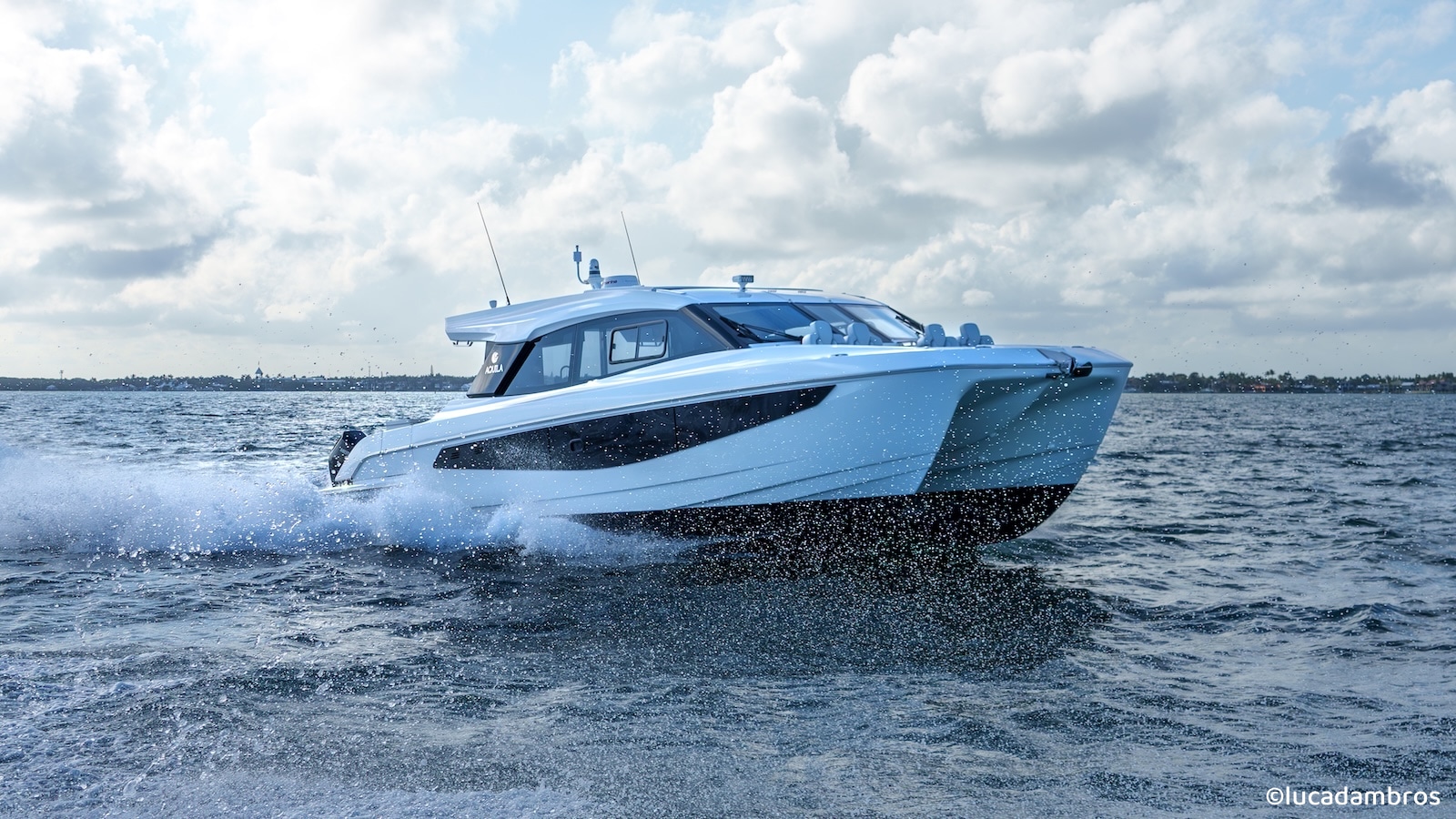
We set off shortly after, and once we reach the open sea, we’re greeted by a decent swell—naturally, according to Murphy’s Law, right on the bow. I take the helm, bring the catamaran onto plane, adjust the trim, and just like the day before, the magic happens again. Thanks to the large central foil, the boat lifts slightly off the water, dramatically reducing the effects of the waves.
Every now and then, we hit a bigger wave, and much like a monohull, the Aquila 42 Coupe lifts its bow before settling back down smoothly, with no harsh impacts—its seakeeping abilities are truly impressive.
After about 30 miles, the sea finally calms. We’re offshore near Everglades National Park, where the water is dotted with countless small buoys left by local fishermen. It’s the perfect excuse to test the catamaran’s turning capabilities—so, without slowing down, I spin the wheel hard to starboard!
The Aquila 42 Coupe doesn’t flinch—it tilts ever so slightly and delivers an incredibly tight turn. The sensation is completely different from a monohull: the centrifugal force increases, the turning radius is tight, but the boat stays perfectly level, as if it were gliding along a pair of invisible tracks holding it firmly to its curved trajectory.
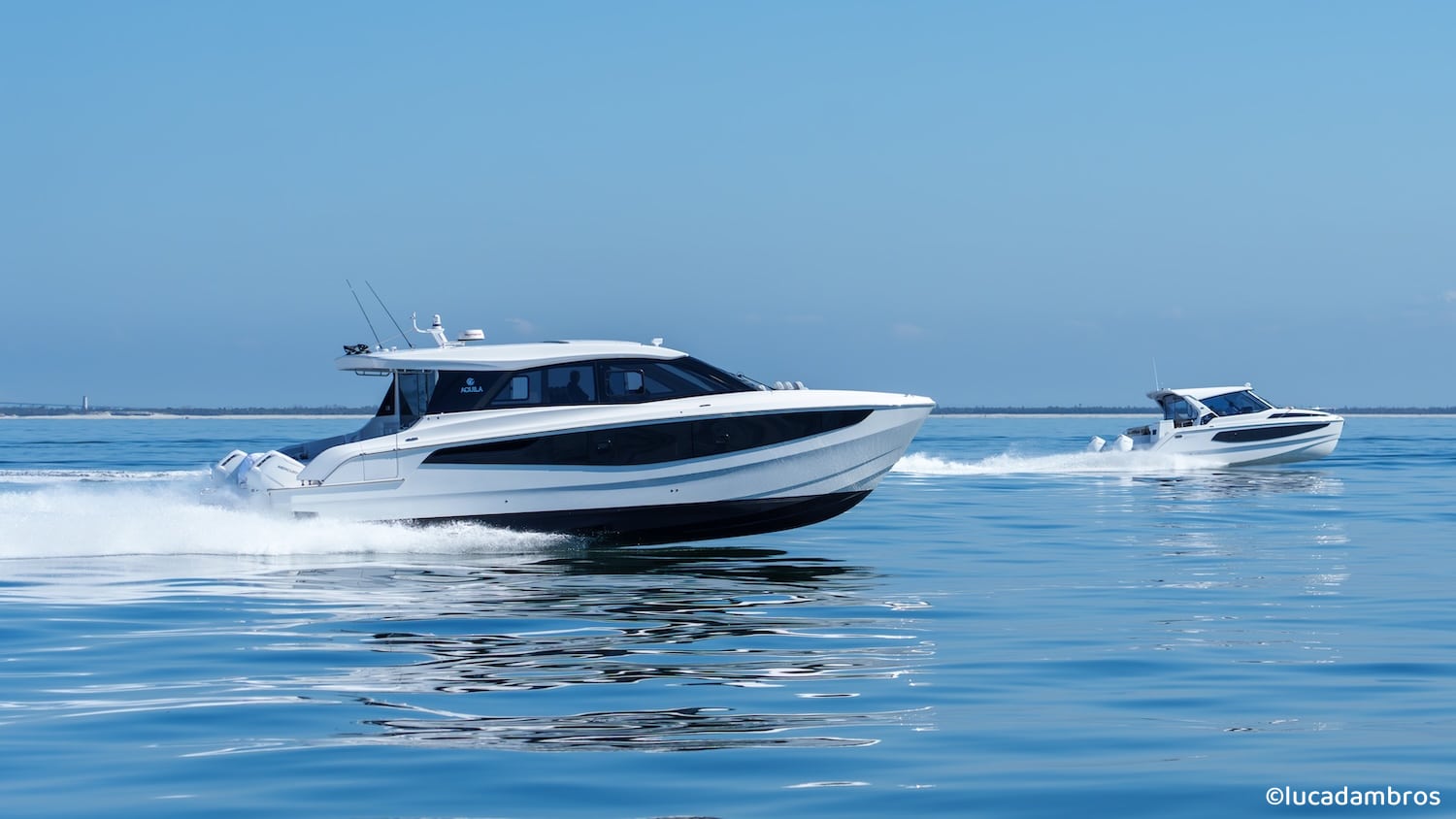
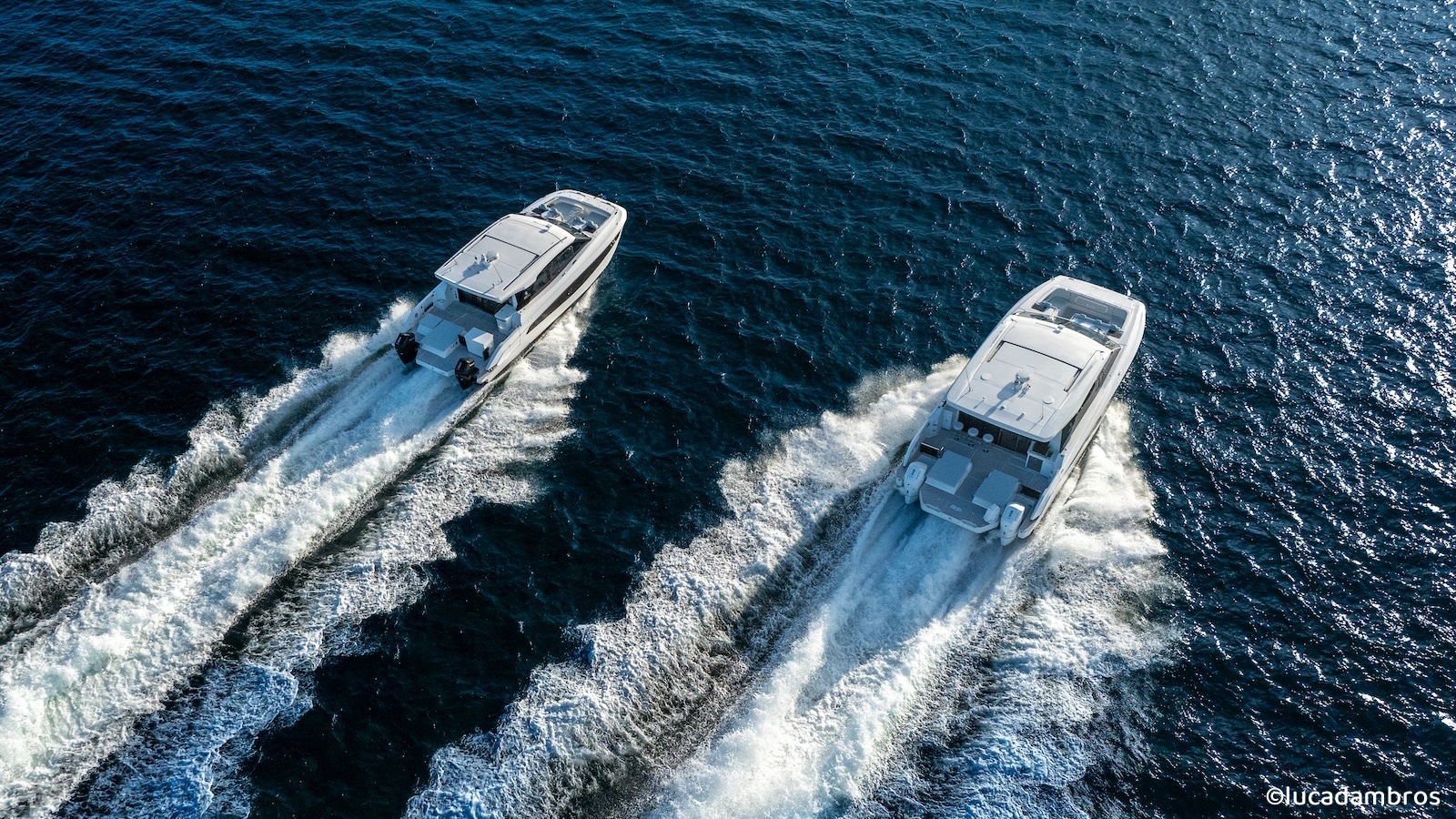
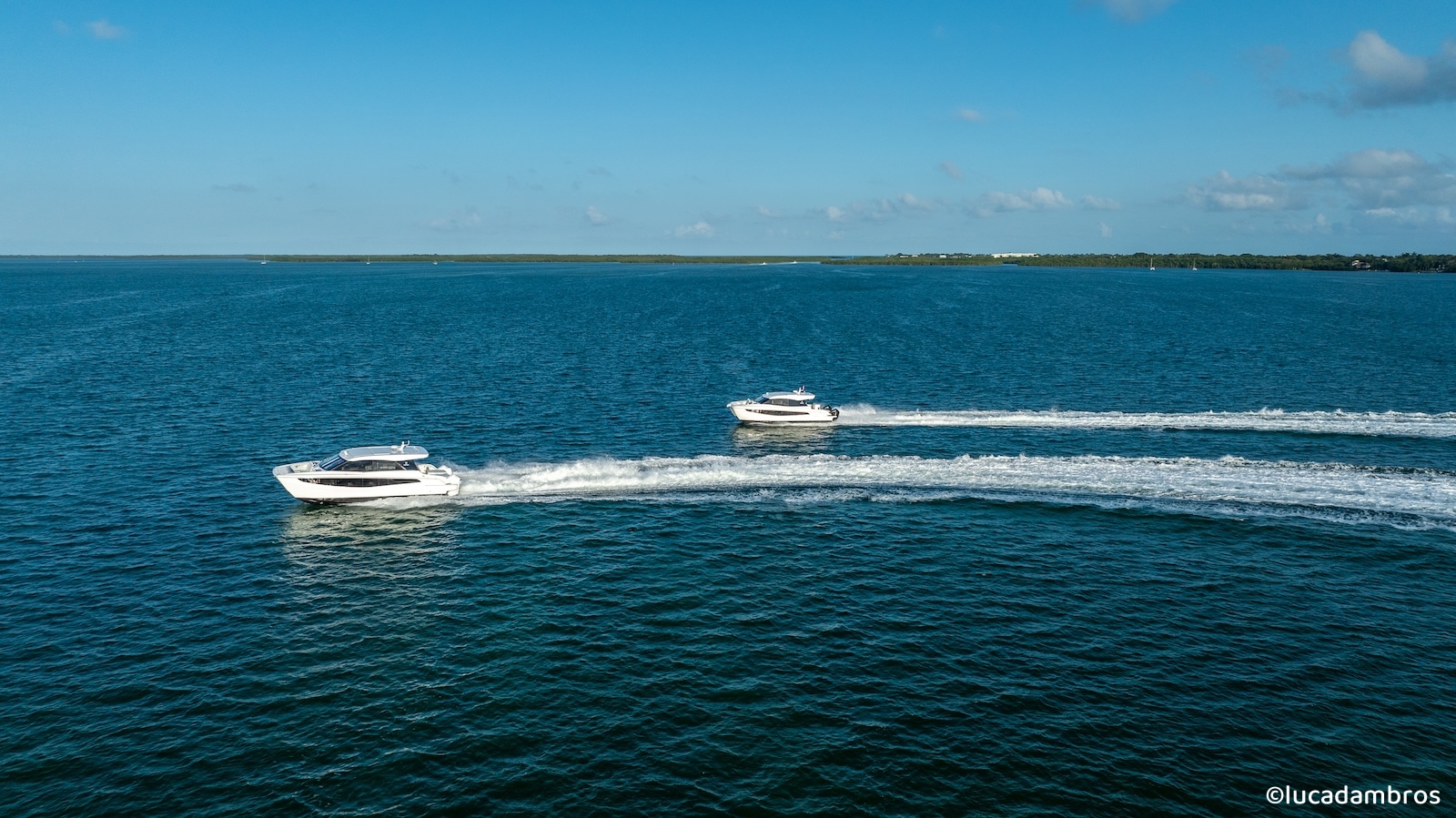
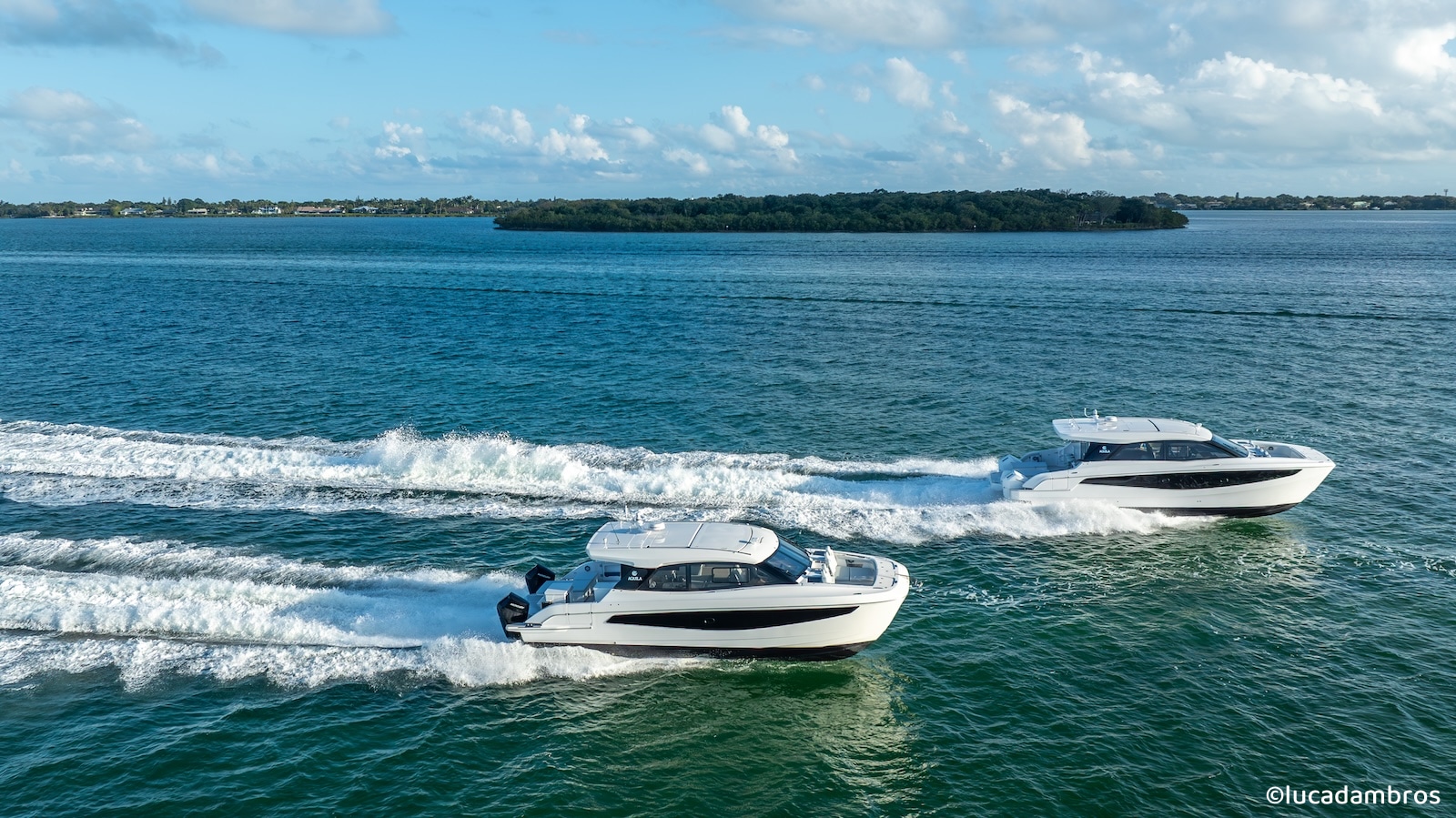
I countersteer, and once again, the catamaran responds promptly and without hesitation. The level of safety on the Aquila 42 Coupe is truly impressive. I straighten out and hand the helm over to Jure. We’re cruising alongside other Aquila Power Catamarans, and this is too good a photo opportunity to pass up. I head below deck to grab my camera gear, start shooting, and then pause for a moment—I realize we’re cruising at over 40 knots, yet the boat barely moves. I go back to taking photos, completely at ease. I am on one of the most stable yachts in the world.
Evening
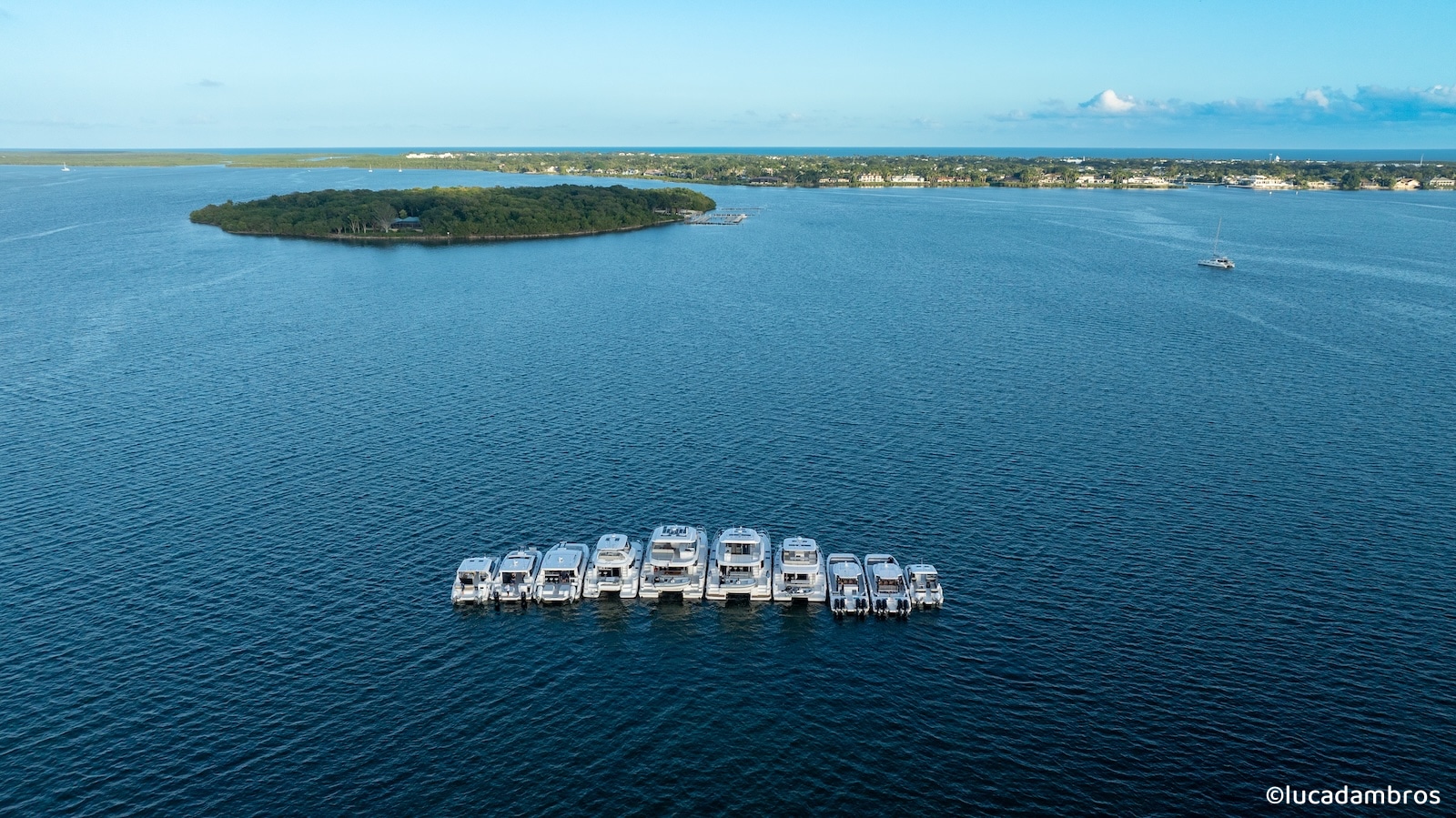
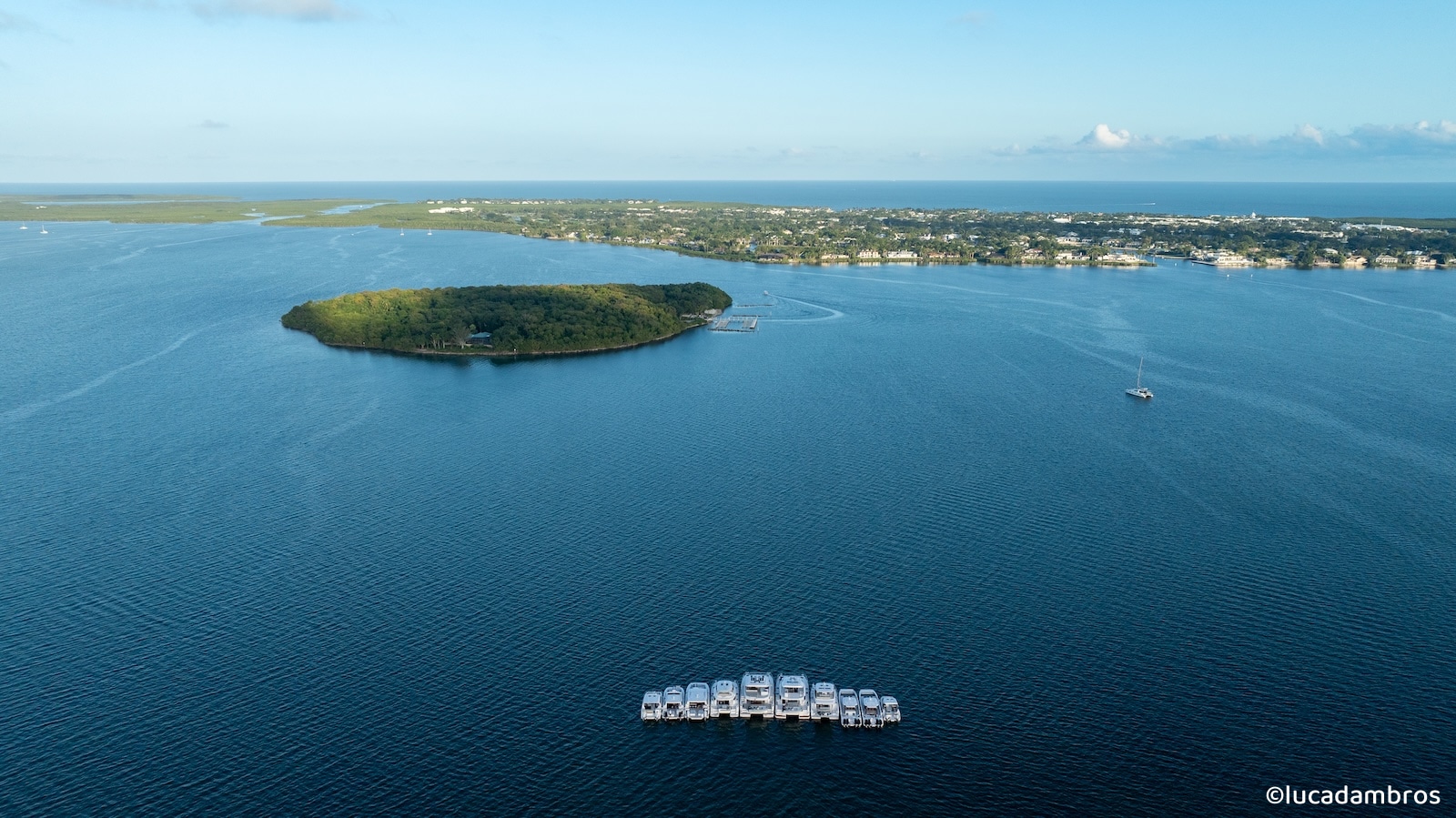
We arrive in Key Largo in the late afternoon, meeting up with the rest of the fleet to anchor off Pumpkin Key for the night.
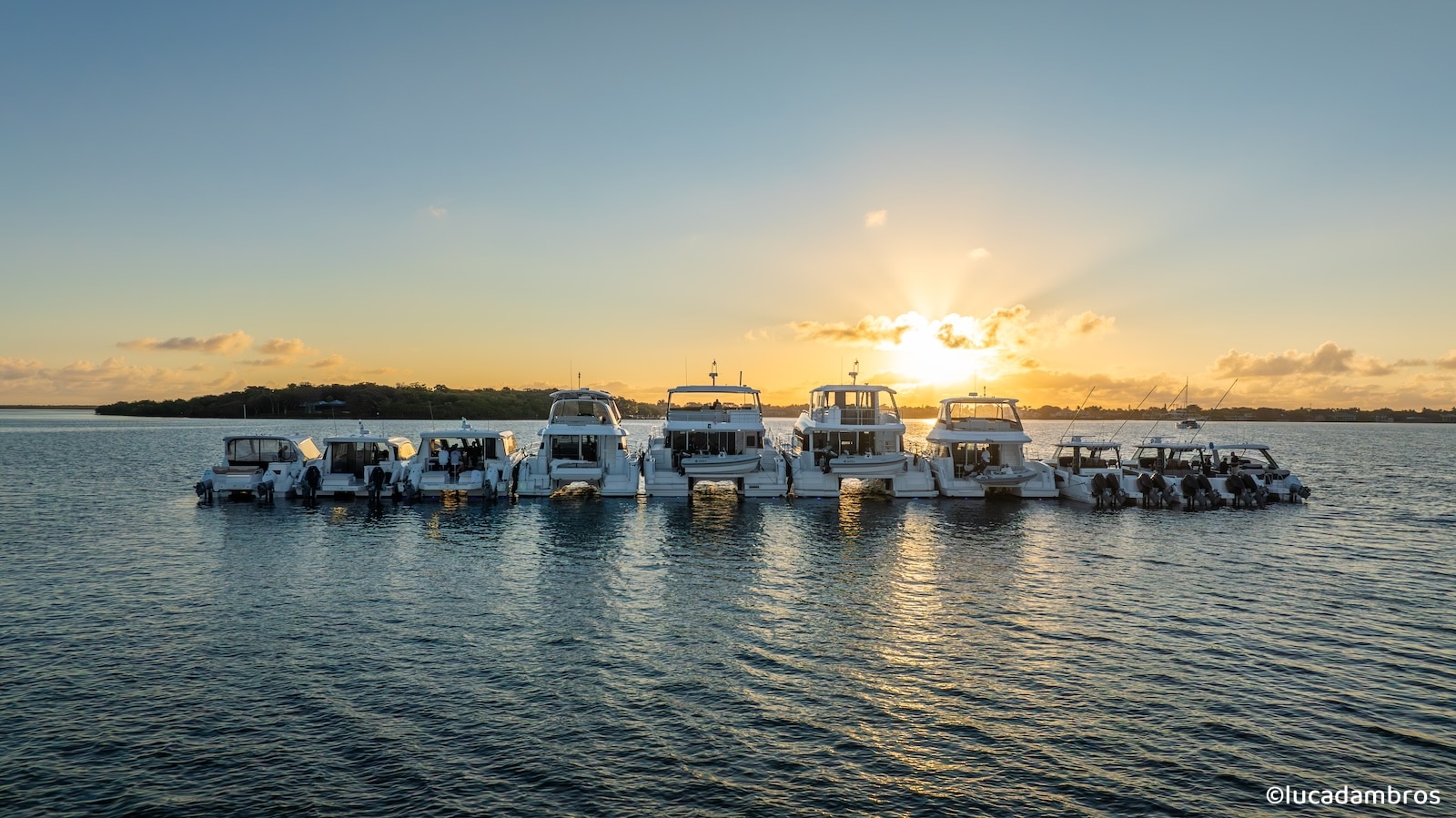
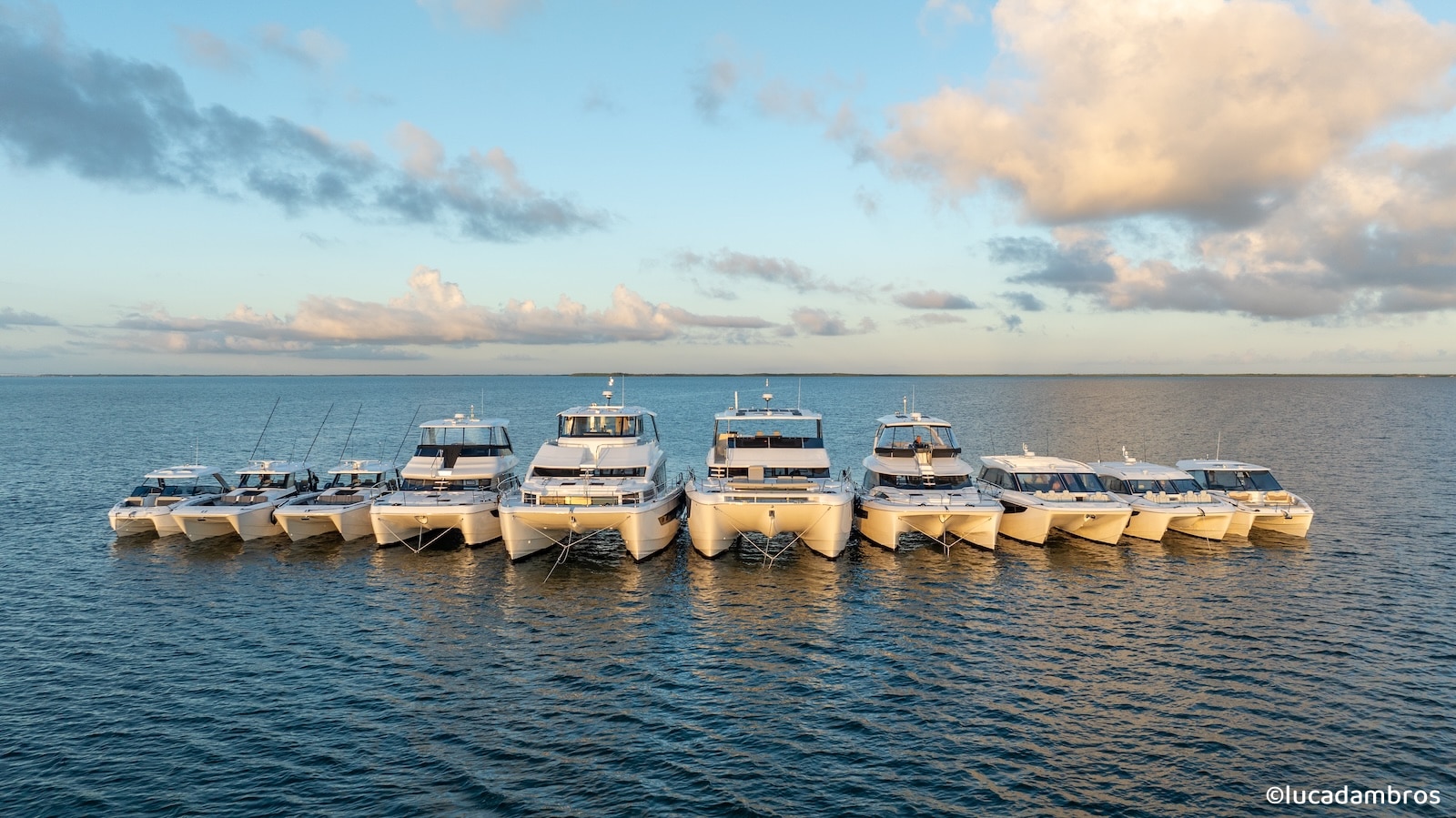
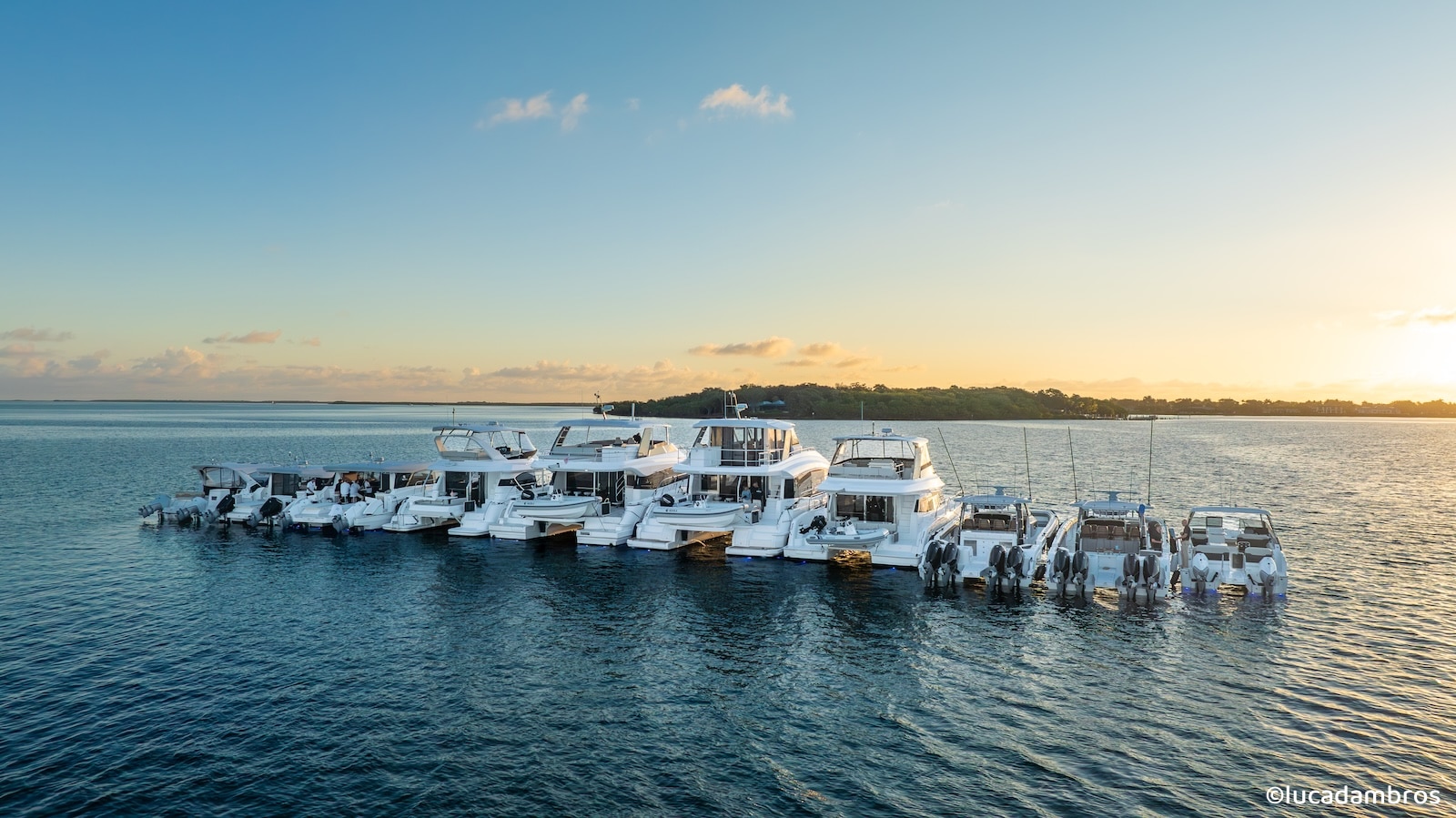
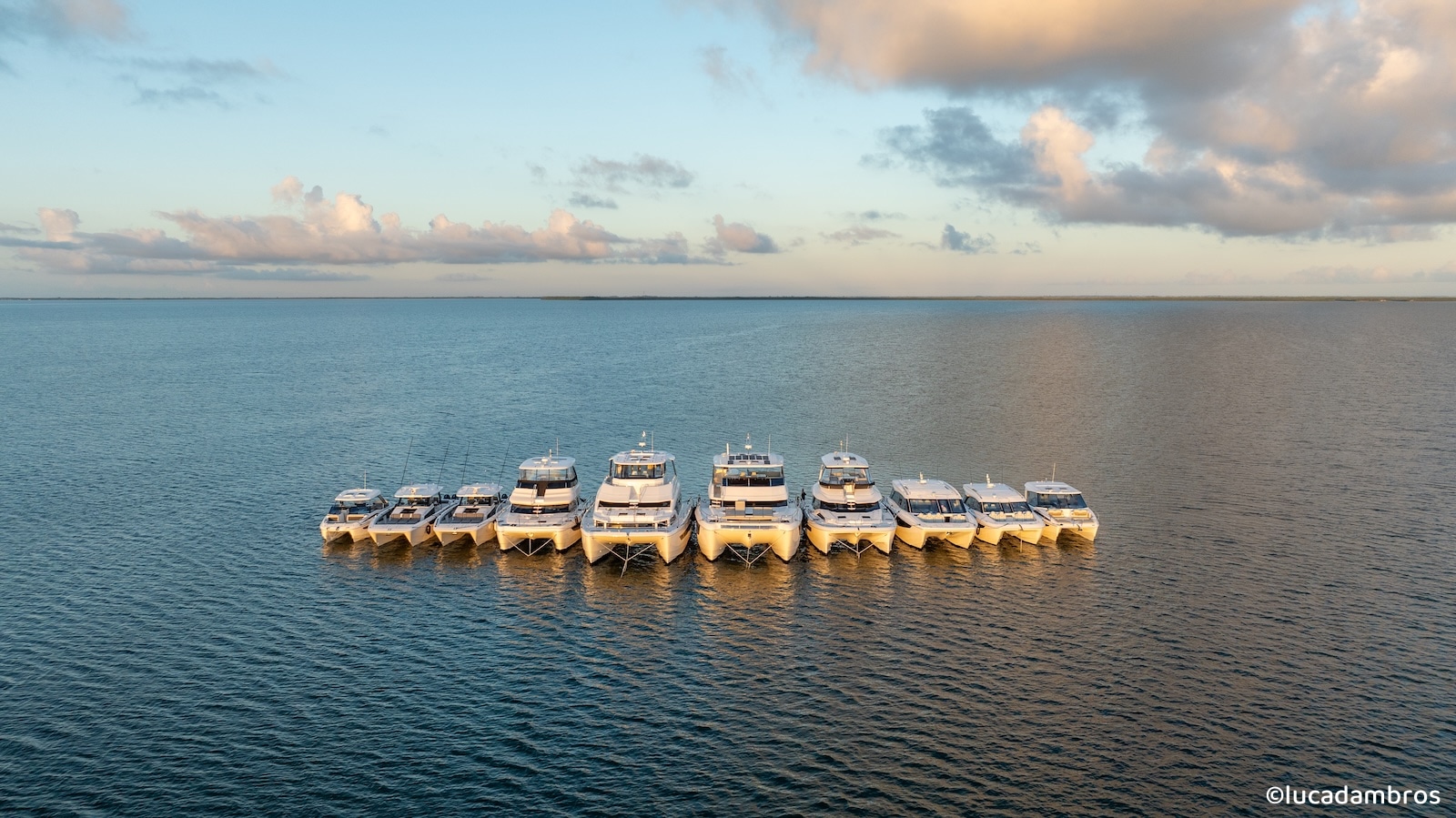
It’s impressive how effortlessly ten catamarans raft up together—the whole process takes no more than half an hour. As the sun starts to set, I rush to my cabin, grab my drone, and launch it immediately. These are the kind of shots I simply can’t miss.
The evening at anchor is simply fantastic. We start with sushi, expertly prepared by Lex at the stunning bar of the Coupe 46, then move on to a burger barbecue set up on the flybridge of the Aquila 54. I hop from one catamaran to the next just by walking across them—the hulls are rock solid on the water, without the slightest hint of rolling.
Life on a multihull is truly something else…
The post Aquila 42 Coupe: the catamaran that will revolutionize the market is a game-changer. Sea trial. appeared first on Yachting News.
]]>The post Magazzù MX – 11 Coupé : 100 miles on board a myth appeared first on Yachting News.
]]>We already knew that the Magazzù MX-11 Coupé was a beautiful and elegant boat, a glance is enough to realize that. But that she was also able sail under any sea conditions was something we had to test.
For our sea trial, we chose to “fly” from Genoa to Monaco on board this “super RIB” which didn’t bat an eyelid even when faced with two meter high waves and which, after almost 100 miles at sea, left us the desire to cover at least as many.
100 miles on board the Magazzù MX – 11 Coupé
The Genoa Boat Show is coming to an end and the last day is running out. The Magazzù MX – 11 Coupé is waiting for us to be transferred to Montecarlo where she is scheduled to take part to a new boat exhibition together with many other mega yachts.
It’s late to cover all the 100 miles that separate us from our destination, so we decide to spend the night at the Marina di Varazze. We hasten to load and stow all our bags (they are not few since we have been out for three days) and, after a refueling stop, we are ready to set sail.
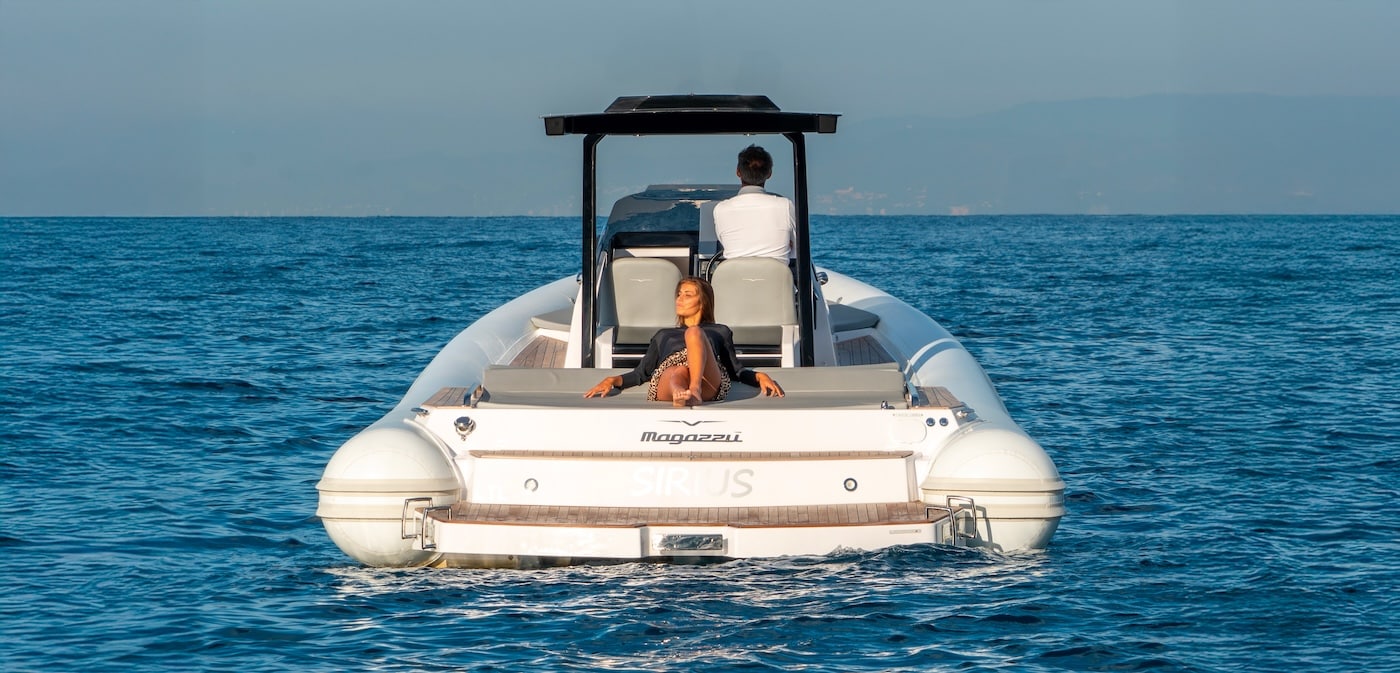
The sea is perfect and, sailing at a speed of 30 knots, we reach our first destination in less than an hour. The only difficulty consists in dodging the many boats which enter and leave the port. It has been a long day at the boat show and, after an unmissable fish dinner, we go to sleep.
The following day, we meet on the dock of the Marina di Varazze just before dawn. We start the two Volvo Penta V8 engines, 350 HP each, and switch the navigation lights on. The fuel tanks of the Magazzù MX-11 Coupé are full.
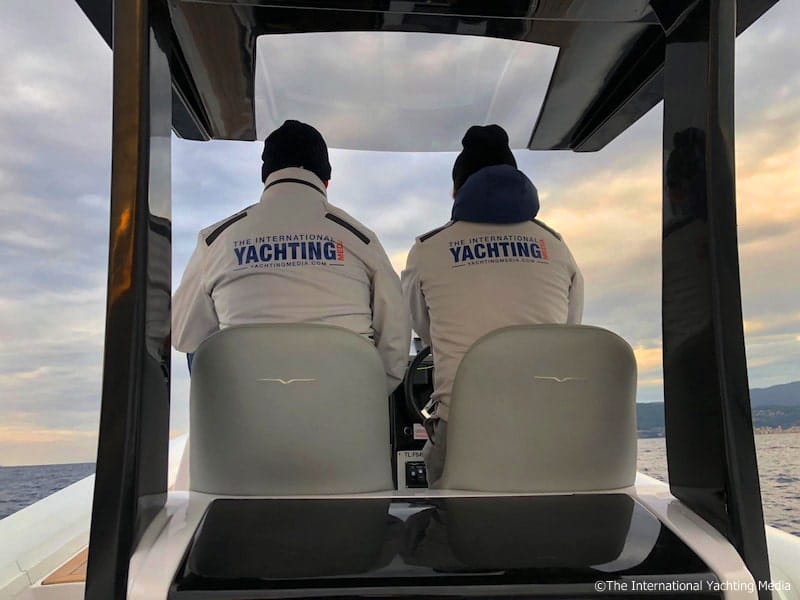 There are three of us on board and, after retracting moorings, we enjoy the most evocative moments of the day. The light of the rising sun timidly starts to illuminate a sea that, at the mouth of the port, offers only a few waves coming from afar.
We accelerate and head for Monaco. The shortest route envisages to coast every cape that stands between us and our destination. Weather forecasts exclude that the situation remains quiet and call for a rough-very rough sea with residual waves coming from the west.
As we leave the protection in the stretch of coast that divides Varazze from Celle, the sea, indeed, starts to get rough. We therefore decide to opt for a speed of around 25-27 knots which might enable us to sail in total safety in the waves that we imagine to meet. In fact, it’s still dark and we don’t see the horizon well. This is also the ideal speed for long-range transfers, the one that allows not to consume too much fuel.
I’m not at the helm, mine is not the first turn but, from the bow and in the shadow, I see a high wave coming. I think it is 1.5-2 meters high. We are sailing fast, so I bend my legs to brace for impact and….and nothing, we land softly, just a few meters after the wave, as if there is an airbag between the hull and the surface.
It seems incredible but we have just performed a really nice “jump”.
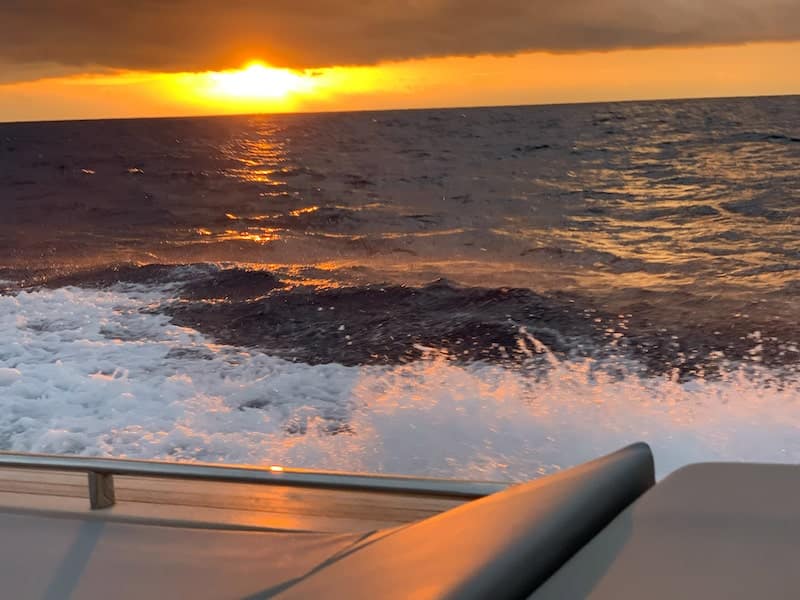 We don’t slow down even not on the following waves which become higher and higher in the waters of Savona. The behaviour of the Magazzù MX-11 Coupé does not change and our backs remain relaxed.
Claudio Magazzù, who represents the second generation of the shipyard together with her sister Tina and his brother Renato, is on board with us. Claudio is an aeronautical engineer and gives us some explanations as to why this boat reacts so well to the impact with the water.
One of the reasons is that the hull “steps” which cut across the hull line are deep. Their function is to support the hull when the boat is on plane, deflecting water from the hull surface and letting air come in. This principle results into the creation of some air cushions that make the impact with the hull significantly softer.
The “steps” of the MX-11 are deep and specially designed to maximize this effect and we are appreciating their efficiency.
The sun rises as we sail close to Savona. The mountains, now visible, are covered by a thick cloud layer, which suggests that the north wind is coming.
At Capo Noli, the horizon is fully visible and the sea gets worse. Here, the bottom level is higher, the intervals between waves become shorter and the wave motion is more confused. I don’t waste time and I take the helm. I want to see how the boat does in such conditions.
So, I fasten the safety lanyard and, given the good performance achieved so far, I dare. I think I can go on sailing at 20 knots at least, so I adjust the throttle accordingly.
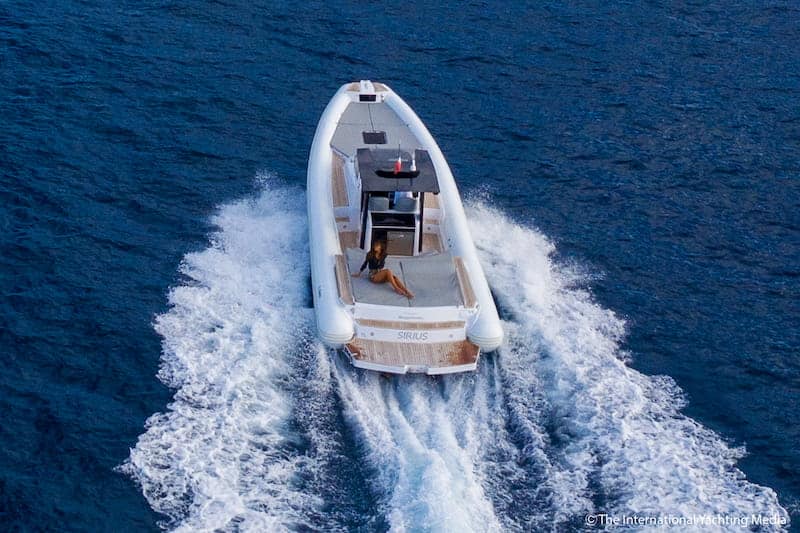 Just the time to reach the right speed and trim and a wave appears in the bow. It is steep and I don’t know if it is the first one of a long series.
The movement I exert on the helm goes automatically, I try to face the wave from the loof. In such conditions and at this speed, the Magazzù MX-11 shows an excellent course stability but, as the helm moves and the angle of incidence of the hull changes, the situation becomes different.
The boat becomes as manouvrable and responsive as a go-kart.
Claudio makes a very clear comparison, the one between airliners and fighters which, after all, travel like us through fluid dynamics. The former are designed to be stable yet hard to maneuver; the latter, instead, are made deliberately unstable in order to be able to maneuver in very tight spaces.
The secret is to find the right balance between the two things and this Maxi Rib, thanks to its special hull design, has really succeeded in doing that.
Having calibrated my feeling with the boat, I can have fun playing with waves. I go up and down with great naturalness without never slowing down and, despite having to maneuver, I do not deviate from the ideal route. I spend an hour this way, I don’t get tired. I’m still having fun.
Meanwhile, the north wind blowing from the mountains finally starts to lower the waves and now, I can speed up to cover our last miles at 35 knots.
Comfort is great, I do not feel the cold air on my chest and, protected my the steering console, I enjoy my comfortable driving position. The deck remains perfectly dry, despite the wind.
My two travel companions start to enjoy navigation, one sitting in the stern, the other lying on the cabin bed: he is even sleeping, totally undisturbed.
 Sailing this way is a true pleasure; in fact, I leave the helm only at the last minute and reluctantly. I inspect the exteriors of the boat and I notice that no cushion has moved during the travel. I try to raise the cushions of the stern sun pad to see how they are secured to the structure and I realize that they are fitted with a functional system of sliding rails which efficiently prevent them from flying away.
We finally arrive in Monaco. The city is ready to host the Super Yacht Show. In a quay crowded with many incredible yachts, we leave the keys to the driver who, with the Magazzù MX – 11 Coupé, will accompany many of the boat show visitors.
Looking at the clock, we make the last point of the our travel: three hours of navigation, at an average speed of 25 knots. Not bad in such sea and weather conditions. I even feel rested and ready to face a long day at the boat show.
This MX-11 Coupé is a great inflatable boat, I’m sorry to leave her.
The Magazzù MX – 11 Coupé
The starting point for a description of this boat is inevitably represented by its lines. Sleek and elegant, they are never too aggressive. The Mx-11 Coupé is not only eye-catching but is also able to continue to draw attention with a delicate balance of forms, colours and materials.
Another important strength lies in the attention that the shipyard has devoted to the design and creations of the details, including the smallest ones. To realize that, it is sufficient to stop and observe some special solutions like the side stainless steel gratings for engine ventilation, whose holes recall the logo of the shipyard.
The MX-11 Coupé combines a fascinating look, excellent seaworthiness and wide living spaces, both on and below deck, where we can find a comfortable cabin equipped with separate bathroom.
 These characteristics make this Maxi RIB the ideal option both to pamper the guests during a luxury day outing and to give unforgettable cruises to a couple that, after having caught the eyes of all while entering the port, can now stay on board, wrapped by the charm that only a Magazzù yacht can offer.
Moreover, the MX-11 we have tested is equipped with a beautiful carbon hard top that can extend towards the stern. This allows to cover even the central part of the cockpit and, therefore, the area that houses the wet bar positioned just behind the console, the removable dining table and the C-shaped seat placed next to the stern sun pad.
The result is a luxury open-space lounge where the guests can enjoy full protection from the sun. If, on the contrary, you want to sunbathe, the Magazzù MX-11 Coupé offers two sunbathing platforms. The forward one has a classic configuration with a very large pad.
The aft one, instead, deserves a separate discussion. Within just 11 meters, in fact, Magazzù has managed to create a true beach area, where the stern platform and the sun pad form an area where the contact with the sea is precious, elegant and unique.
Conclusions
The attribute ” Coupe” perfectly adapts to the MX-11 since this boat is luxury, sporty, easy-to-steer and elegant. If she was a car, she would certainly be a Bugatti.
If we could, we would even add the acronym “GT” because the boat also proved to be very comfortable and funny at sea, despite the harsh conditions and the long distance we covered.
Moreover, considering that the Magazzù MX-11 is also a cabin cruiser, we could define her as a true all-around that has no problems ix excelling in the multiple uses which she is designed for.
Even if the first reason why people choose Magazzù is that they fell in love with these boats at first sight.
The post Magazzù MX – 11 Coupé : 100 miles on board a myth appeared first on Yachting News.
]]>The post Magazzù M16: 100 miles of rough seas on a superboat appeared first on Yachting News.
]]>Magazzù M16: here’s how the new flagship performs when conditions get tough
Magazzù has always been the undisputed icon of high-end maxi-ribs—fascinating inflatables that stand out for their beauty and reliability at sea. These strengths deserved to be thoroughly tested during the world premiere of its new flagship: the brand-new Magazzù M16.
MAGAZZÙ M16 Sea Trial
“These are prohibitive conditions for most boats”.
This is what I think as I climb aboard the new Magazzù M16. We’re at the commercial port of Genoa, and the 17-meter maxi-rib has just been unloaded from the ship that brought it here directly from Palermo, the historical headquarters of the legendary Sicilian shipyard.
We have to face 100 miles of sea to reach Cannes, a route that will subject us to progressively more challenging weather and sea conditions, with a final stretch that, at least on paper, looks extremely difficult.
The naval engineering of this maxi-rib was meticulously developed by Alfredo and Renato Magazzù, two professionals who need no introduction. Their invaluable experience reaches its peak with this project, as for the first time in the shipyard’s history, a hull was specifically designed for IPS propulsion and, as a result, has no steps.
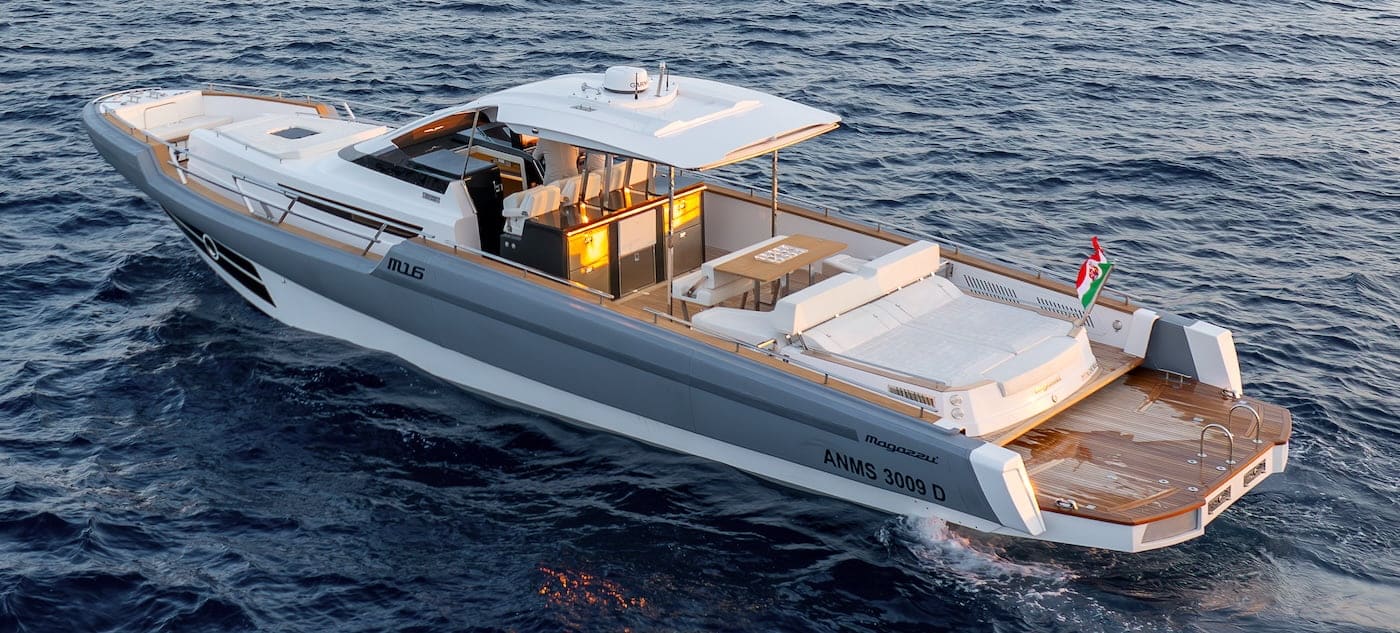
Onboard with me is Claudio Magazzù, designer and creator of the new M16. I’ve navigating with him many times before; he’s an experienced skipper who really enjoys navigating his own creations, and believe me, this is not a common trait…
As we leave the port, we immediately encounter long waves that, as Murphy’s law would have it, come directly from the bow. I take the helm and push the throttles forward, while the Magazzù M16, powered by its twin Volvo Penta D8-IPS-800 engines (600 HPeach), easily gets up on plane without noticeably changing its trim.
This characteristic impresses me. Boats equipped with IPS drives usually tend to sink the stern considerably, due to their pulling propellers—a rather annoying behavior that this maxi-rib seems immune to.
I settle at around 30 knots, and the bow of the Magazzù M16 slices through the long waves with ease. Onboard, the comfort is excellent, definitely above average. A glance at the display reveals we are consuming only 6.2 liters of fuel per mile, which is quite impressive for a nearly 17-meter, 20-ton boat (with full fuel tanks)!
Since the sea still allows it, I push the throttles all forward. The acceleration is powerful, and the GPS numbers rise quickly. The Magazzù M16 comfortably reaches just over 38 knots. I adjust the trim and, to my surprise, we surpass 40 knots! It’s the first time I’ve seen this happen (and I’ve tested many boats) with an IPS-powered craft.
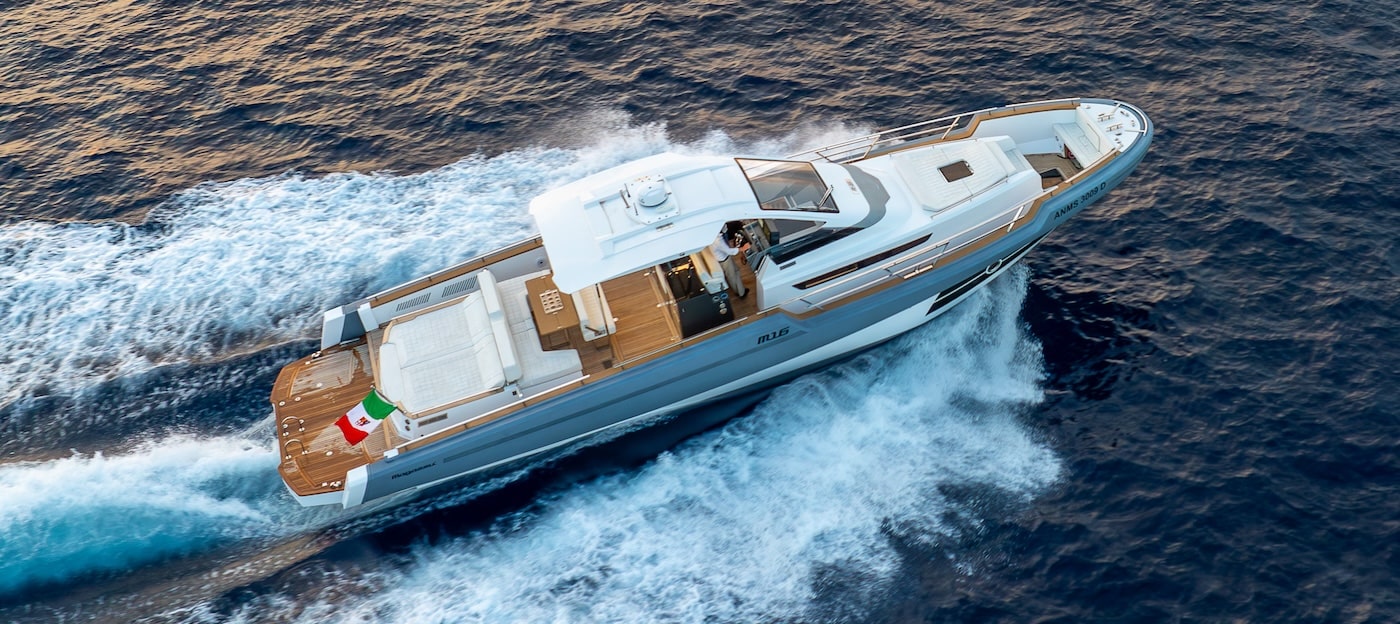
I slow down and settle around 30 knots, then quickly steer to the left. The maxi-rib leans into the turn, entering a tight curve, as if it were on rails. I counter-steer to the right, and once again, with agility unimaginable for a boat of this size, I find myself pressed against the new side by the centripetal force.
The new Magazzù M16 is a highly responsive and reactive boat. It’s a maxi-rib that can definitely deliver adrenaline when you ask for it.
As we continue on our route, just as predicted, once we’re off the coast of Loano, the wind picks up, and the waves start shifting to the quarter and growing larger. They gradually increase, and by the time we reach Imperia, they exceed two meters in height.
The Magazzù M16, however, continues cruising smoothly at around 28-30 knots. It tackles and overcomes the waves with a comfort that feels almost supernatural—no jolts, no hesitation. Sure, we have to steer carefully in these conditions, but for now, there’s no need to slow down.
The final 20 miles are the toughest. The sky turns black, and the wind picks up even more. The waves are now truly massive, well over three meters high. Their crests break, and the wind carries the white spray onto the deck.
In such conditions, I inevitably have to change my steering style. I reduce speed and start using the throttles. It’s necessary to slow down when descending into the trough, then accelerate while climbing these mountains of water. The rudder is also crucial in this situation—waves hitting from the quarter tend to push the stern, so I need to anticipate and counteract them, then return to course.
However, calm reigns aboard the Magazzù M16. Cruising at an average speed of around 23-24 knots, with the necessary adjustments, we handle the situation in total safety, all while maintaining an extraordinary level of comfort. This boat never slams into the waves.
We finally round Cap d’Antibes, entering the shelter of the islands. The sea begins to calm, the waves gradually shrink, and they turn into long, rolling swells.
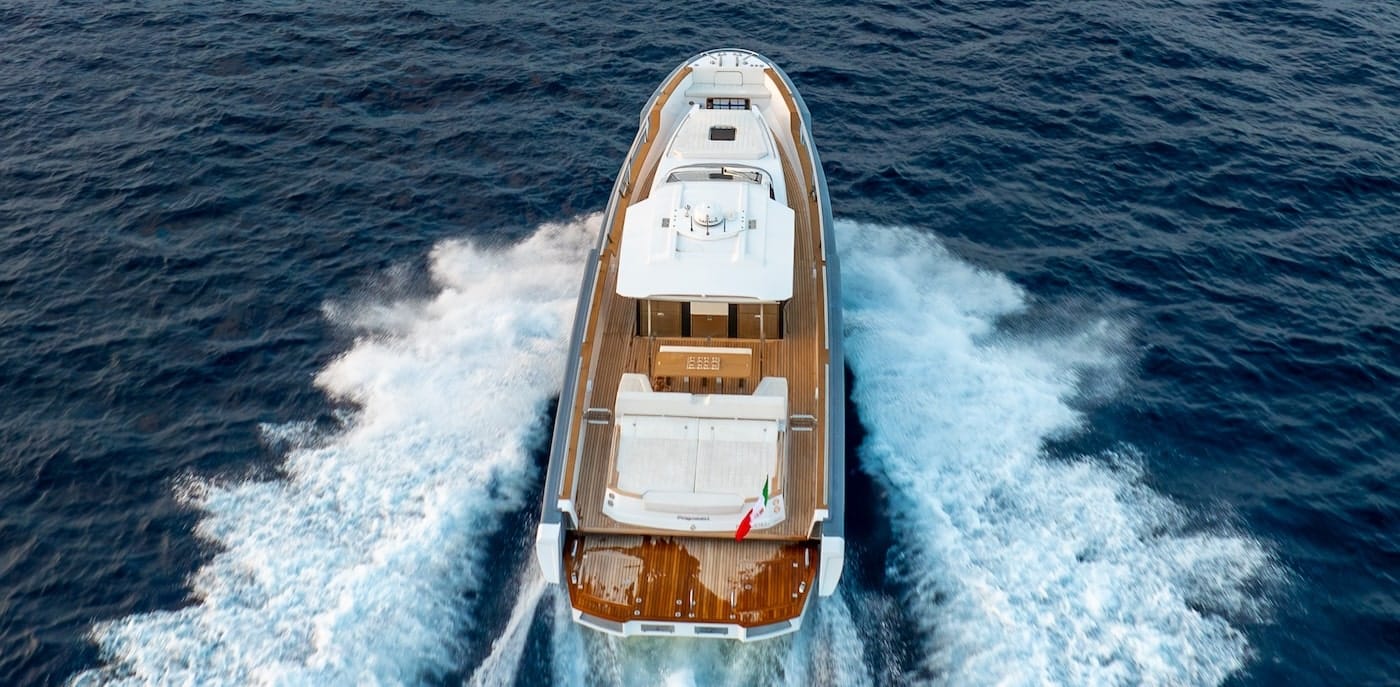
A blue motorboat, around 12 meters long, pulls up alongside us, clearly eager to race. I glance at Claudio—he smiles—and I push the throttles down once more. The Magazzù M16 shoots forward, quickly reaching 40 knots, completely unfazed by the long waves it cuts through with ease.
We cruise side by side with the motorboat for a few seconds, but then a larger wave appears. The motorboat plows into it, suddenly slowing down and sending up a towering column of water six or seven meters high.
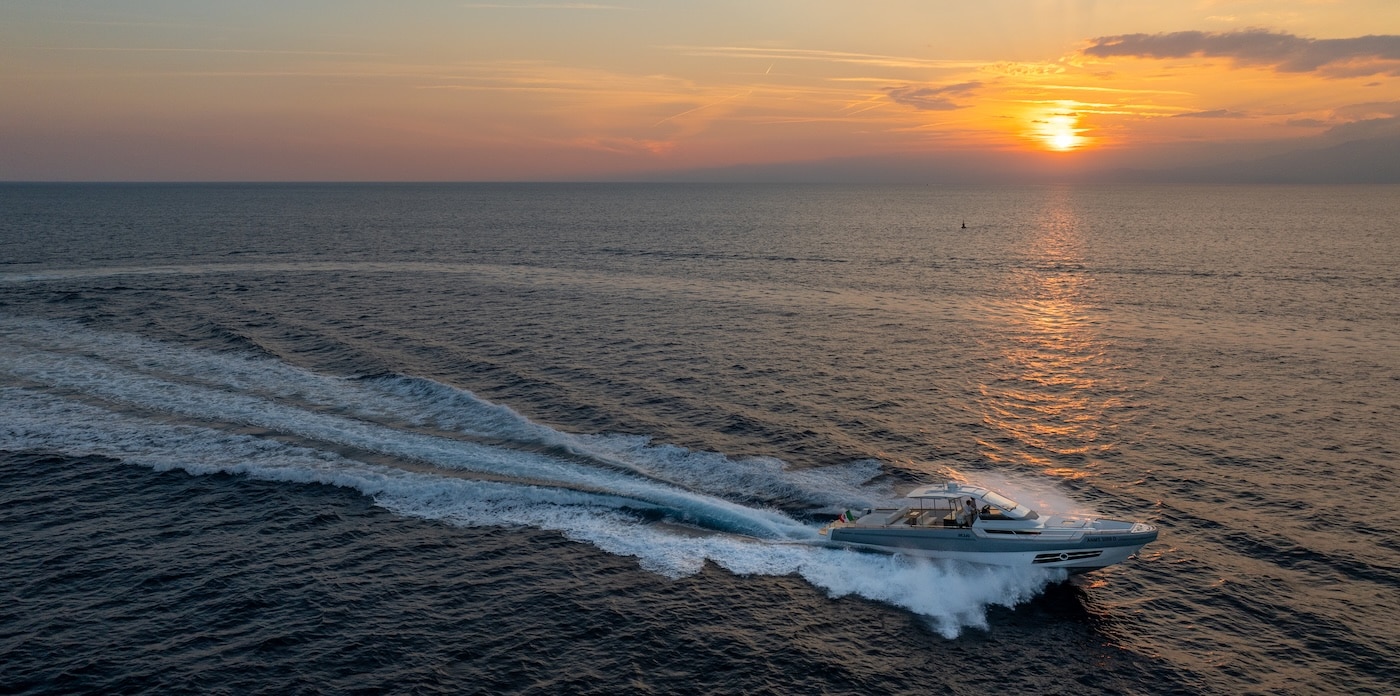
Despite this, we continue our ride with large smiles on our faces, as this incredible boat glides freely and calmly over the water. We keep speeding along until we reach the low-speed zone near Cannes, where we are forced to slow down.
As we cruise slowly, I think back to my initial reflection: “These are prohibitive conditions for most boats”. And I can’t help but note that, clearly, I was absolutely right…
TEST DATA
| RPM | SPEED | L/H | L/NM |
| 600 | 5.8 | 5.8 | 1.0 |
| 1,000 | 8.5 | 18.7 | 2.2 |
| 1,250 | 9.6 | 31.7 | 3.3 |
| 1,500 | 11.0 | 58.3 | 5.3 |
| 1,750 | 13.4 | 81.7 | 6.1 |
| 2,000 | 19.0 | 110.2 | 5.8 |
| 2,250 | 24.2 | 145.2 | 6.0 |
| 2,500 | 28.2 | 172.0 | 6.1 |
| 2,610 | 30.3 | 187.9 | 6.2 |
| 2,750 | 32.2 | 202.9 | 6.3 |
| 3,000 | 36.9 | 239.9 | 6.5 |
| 3,250 | 40.3 | 266.0 | 6.6 |
The Magazzù M16 in detail
Let’s start by saying that no two Magazzù boats are the same. The shipyard, indeed, works in a semi-custom mode, extensively personalizing each rib based on the owner’s tastes.
The model we tested, which reflects the specifications chosen by its discerning owner, not only features IPS propulsion but also boasts interiors specifically customized to meet their needs. As we descend to the lower deck, we are greeted by a dinette, equipped with an L-shaped sofa and table to starboard and a matching sofa to port, comfortably seating 5 to 6 guests.
From here, a corridor leads to two spacious bathrooms, each with separate showers and seating areas. Continuing forward, we find the master cabin which, equipped with a king-size central bed, is literally filled with wardrobes and cabinets, offering ample storage space.
Heading aft, we discover the second cabin of the Magazzù M16 that, despite being located beneath the cockpit, still offers more than enough headroom for comfortable sleeping. In this case too, the bed is generously sized.
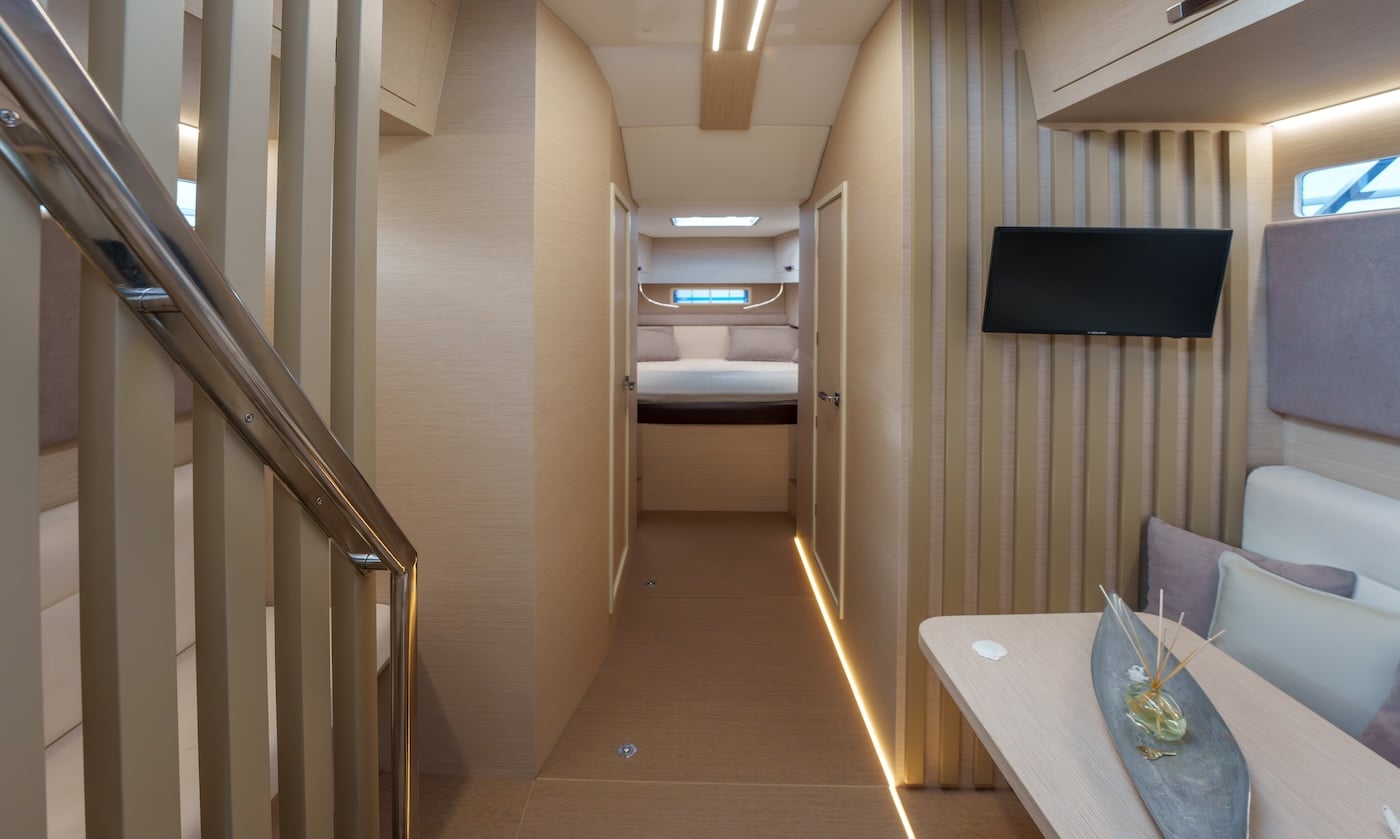
The post Magazzù M16: 100 miles of rough seas on a superboat appeared first on Yachting News.
]]>The post Prestige M8: first-class navigation from Monfalcone to Venice appeared first on Yachting News.
]]>Prestige M8: catamaran or superyacht? Sixty miles aboard a revolutionary boat
Our readers are well aware that The International Yachting Media loves to carry out long-distance trials. Indeed, this is truly the only way to go beyond mere performance data and understand the true essence of a boat. You will therefore understand why we did not miss the opportunity to board this beauty to sail from Monfalcone to Venice, on the occasion of the boat show held in the most fascinating city in the world.
Prestige M8: an unforgettable route
It’s early morning when we arrive at the Monfalcone shipyard; the air is crisp even though we know it will be an extremely hot day. The Prestige M8 awaits us at the dock, ready for the journey ahead.
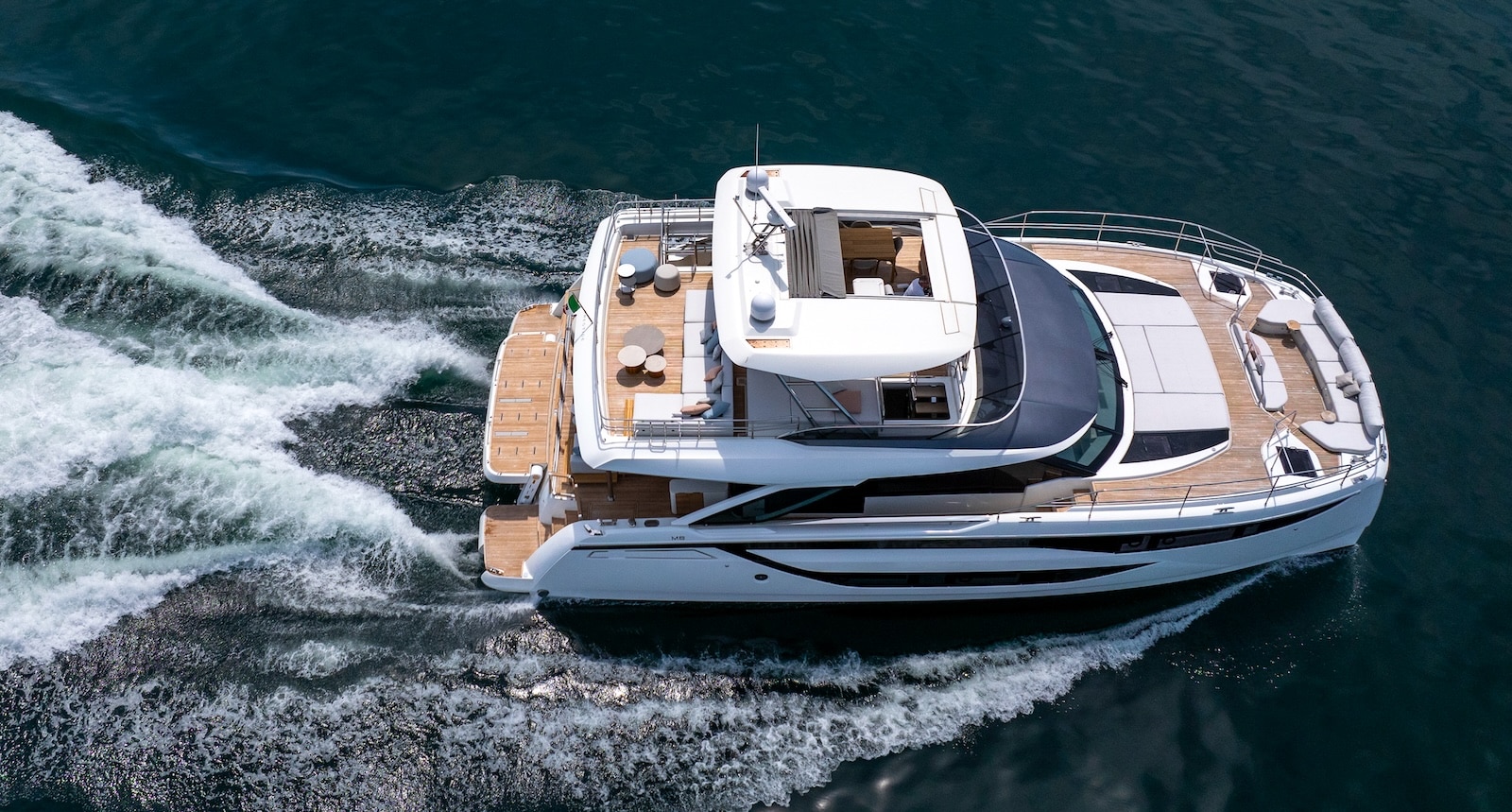
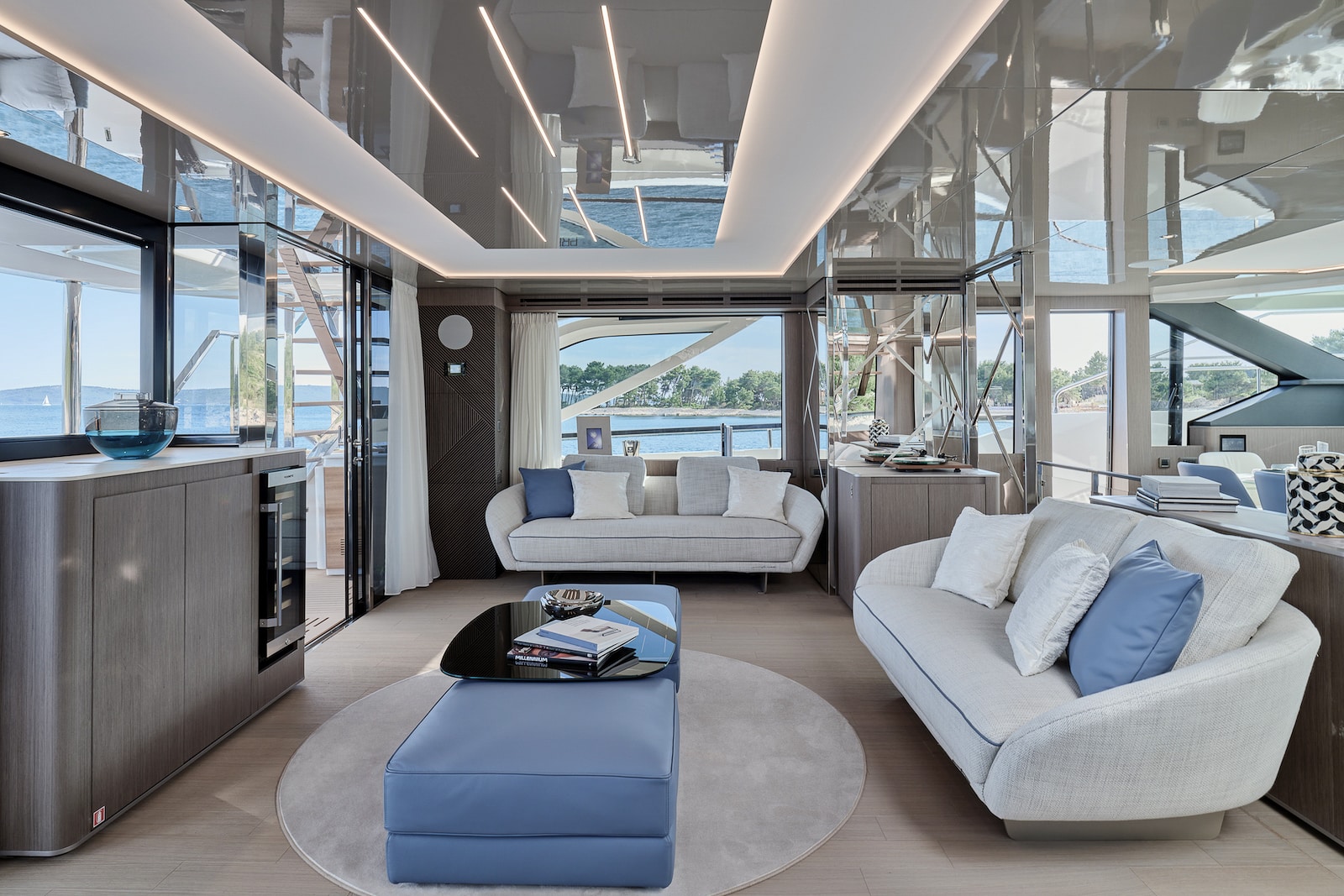
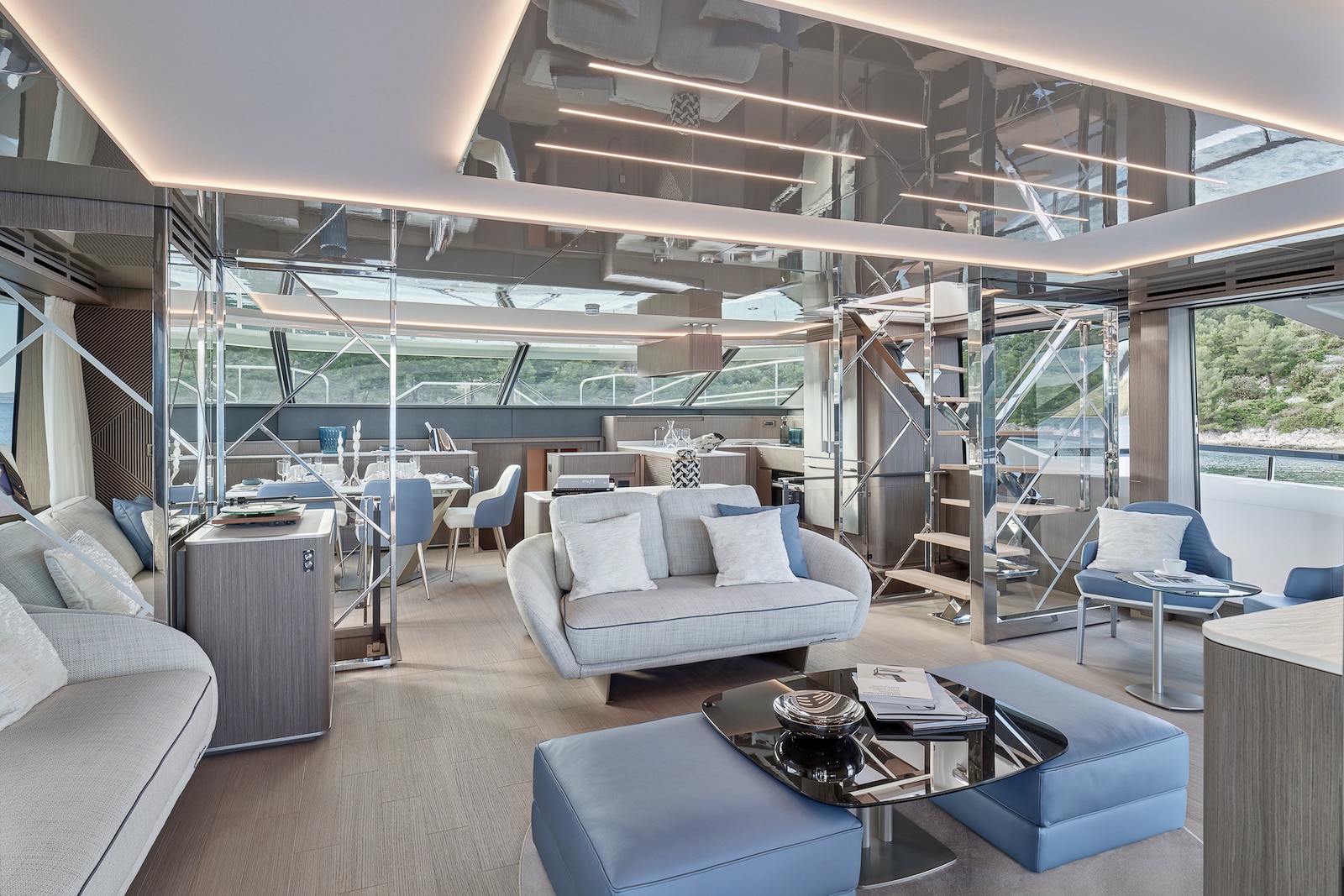
From the shore, this catamaran continues to amaze me; on one hand, it impresses with its size, while on the other, it still manages to be a boat with a sleek and light aesthetic. Even the considerable height of its freeboard seems to disappear, almost hidden by the sinuous lines skillfully designed by Camillo Garroni.
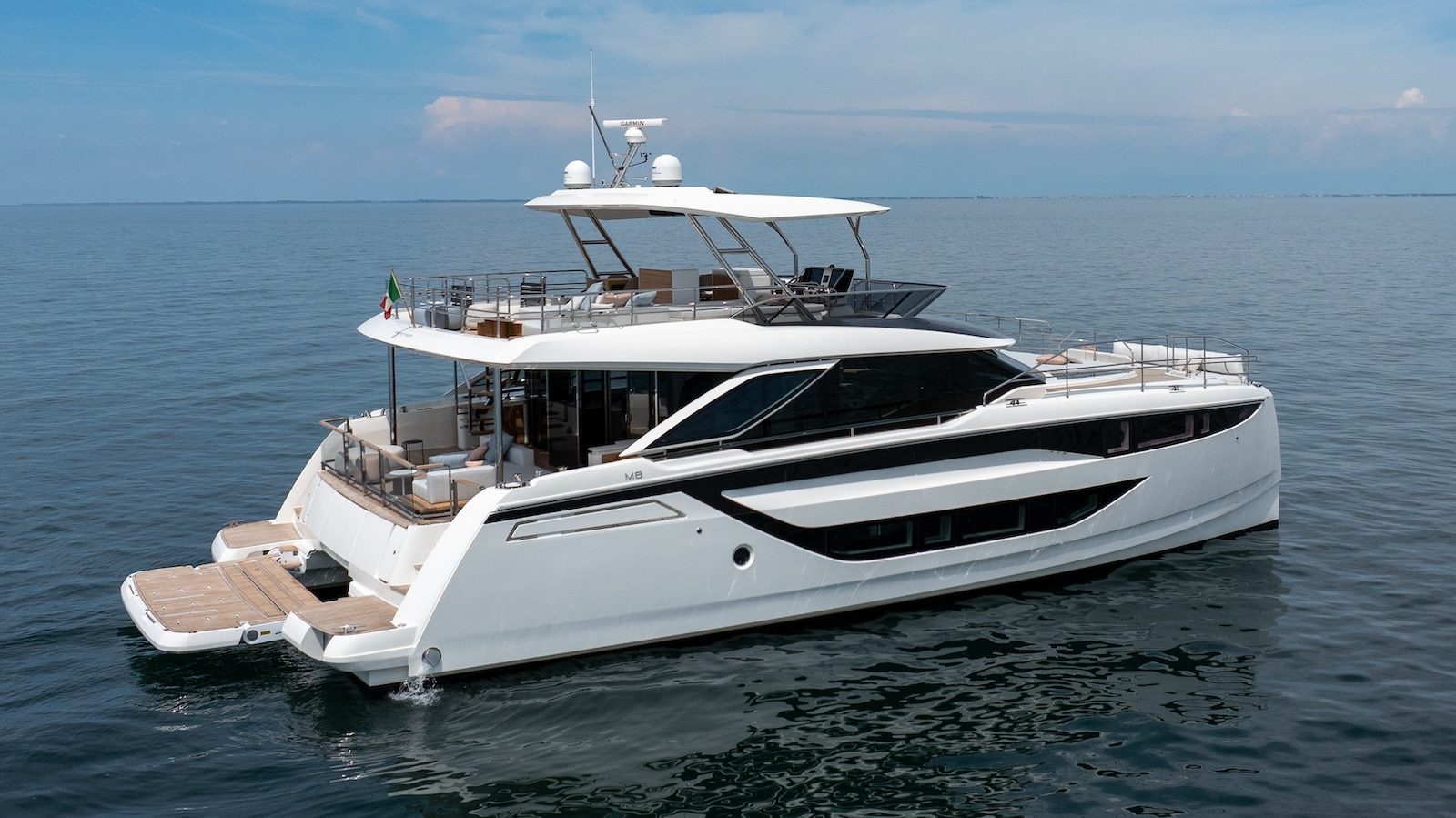
It’s hard not to be dazzled by this mix of beauty and grandeur. At twenty meters in length and nine meters in maximum beam, the Prestige M8 definitely falls into the superyacht category rather than just being a boat. Moreover, it has the great advantage of being operable by its owner with a standard boating license.
Once on board, we stow away the photography equipment and prepare for departure. We are in relatively tight waters, but with the maneuverability of a catamaran, we are never in trouble. In a second, we are out and already navigating in the channel that leads us to the open sea.
Navigating. This word takes on a special dimension aboard the Prestige M8. With this boat, you truly navigate. It moves lightly and decisively on the water, in a way that must be experienced to be fully understood.
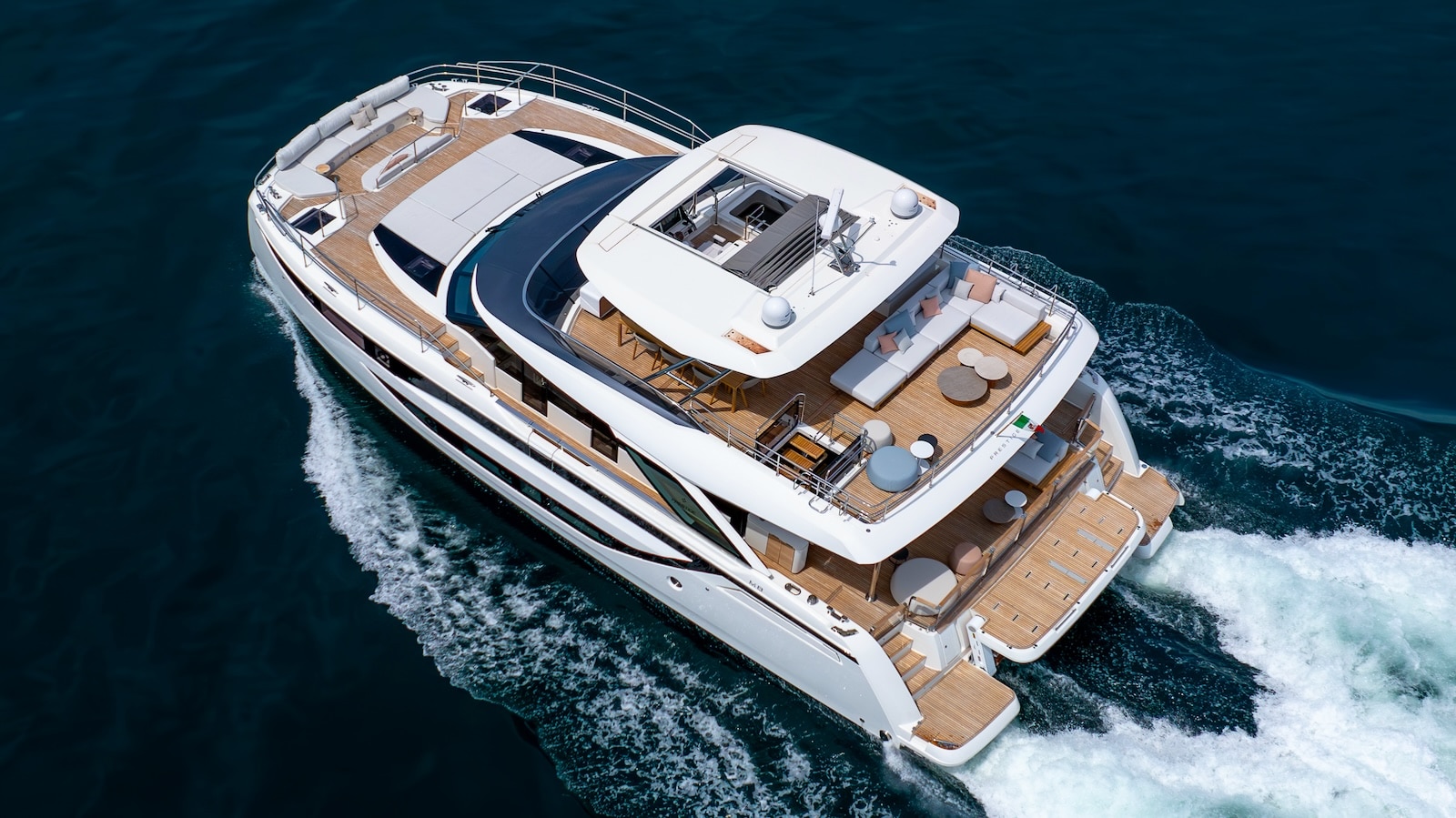
Are you familiar with rolling? Here, for example, you almost forget about it. Resting on its two hulls, the Prestige M8 rocks very little, and when it does, it does so much more slowly and progressively.
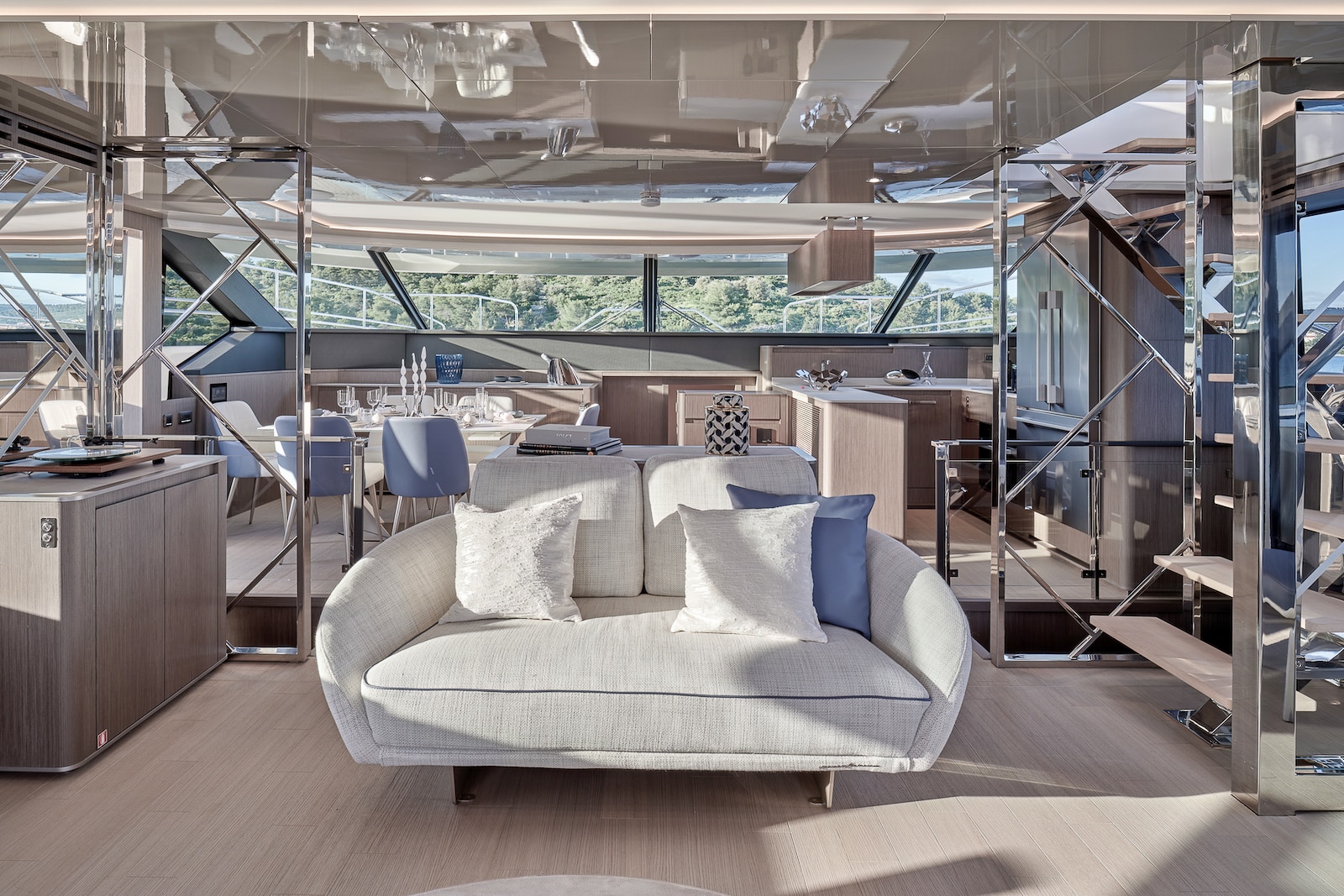
With this boat, you navigate in first class, and even speed takes a back seat. At 10 knots, you glide over the water with an embarrassing ease and lightness. At this pace, you can enjoy the scenery and silence, whether seated in one of the flybridge chairs or, if you prefer, in the front row of that charming forward lounge. All this happens while the Prestige M8 covers miles with very low emissions, with its two Volvo D8 engines consuming just over 30 liters per hour and running so quietly you can hardly hear them as they power this 50-ton superyacht.
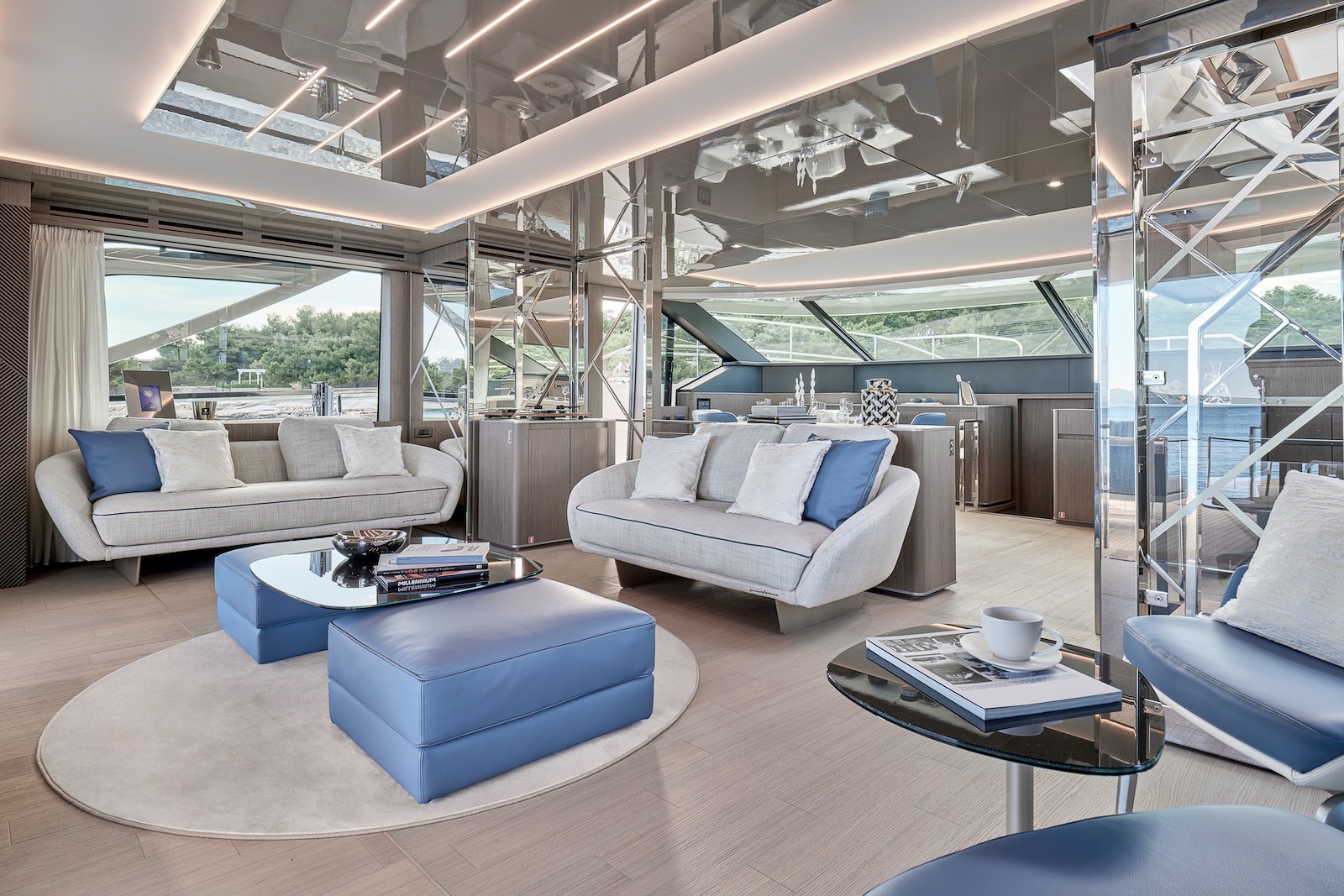
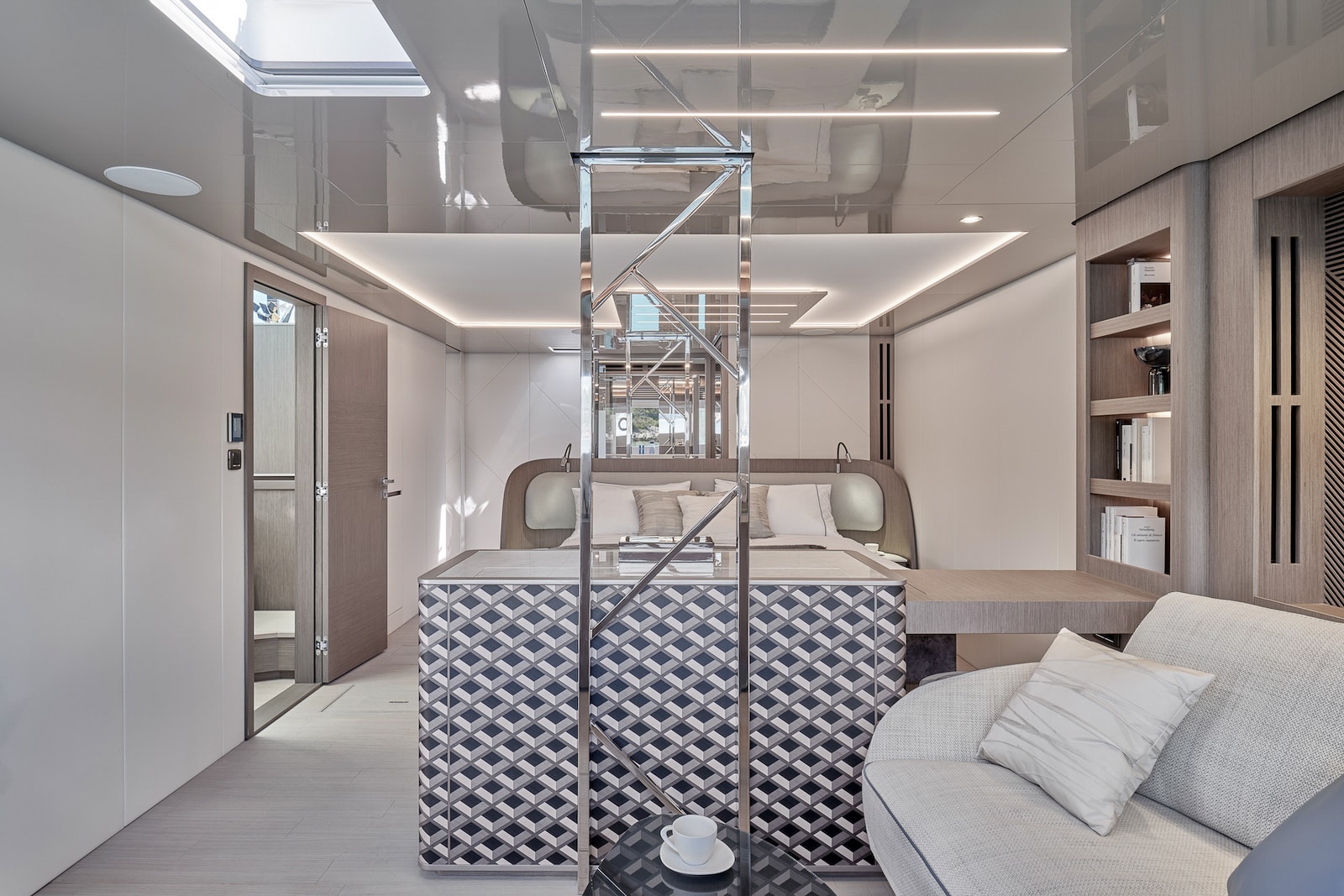
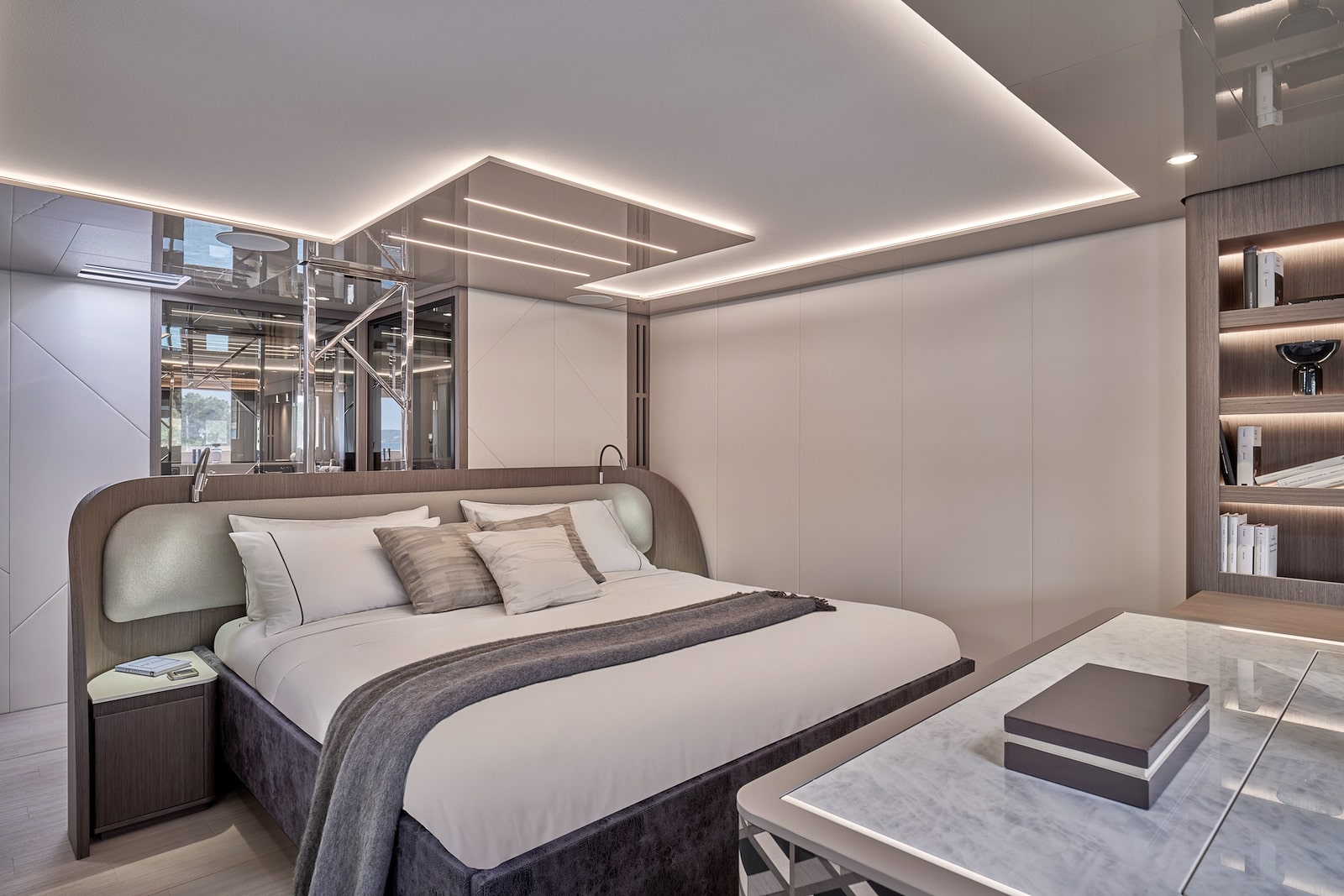
We stop in the middle of the sea to take some drone shots. The Prestige M8 certainly doesn’t need a stabilizer; we float almost motionless, while I struggle to find a place to launch my flying camera. There’s too much space here, something I’m not used to. This superyacht indeed offers just under 300 square meters of living areas, including an owner’s suite of more than 30 square meters, while the flybridge alone occupies more than 50 square meters! In short, you experience the sea in total luxury here, and the number of people you can invite on board for evening cocktails is practically unlimited.
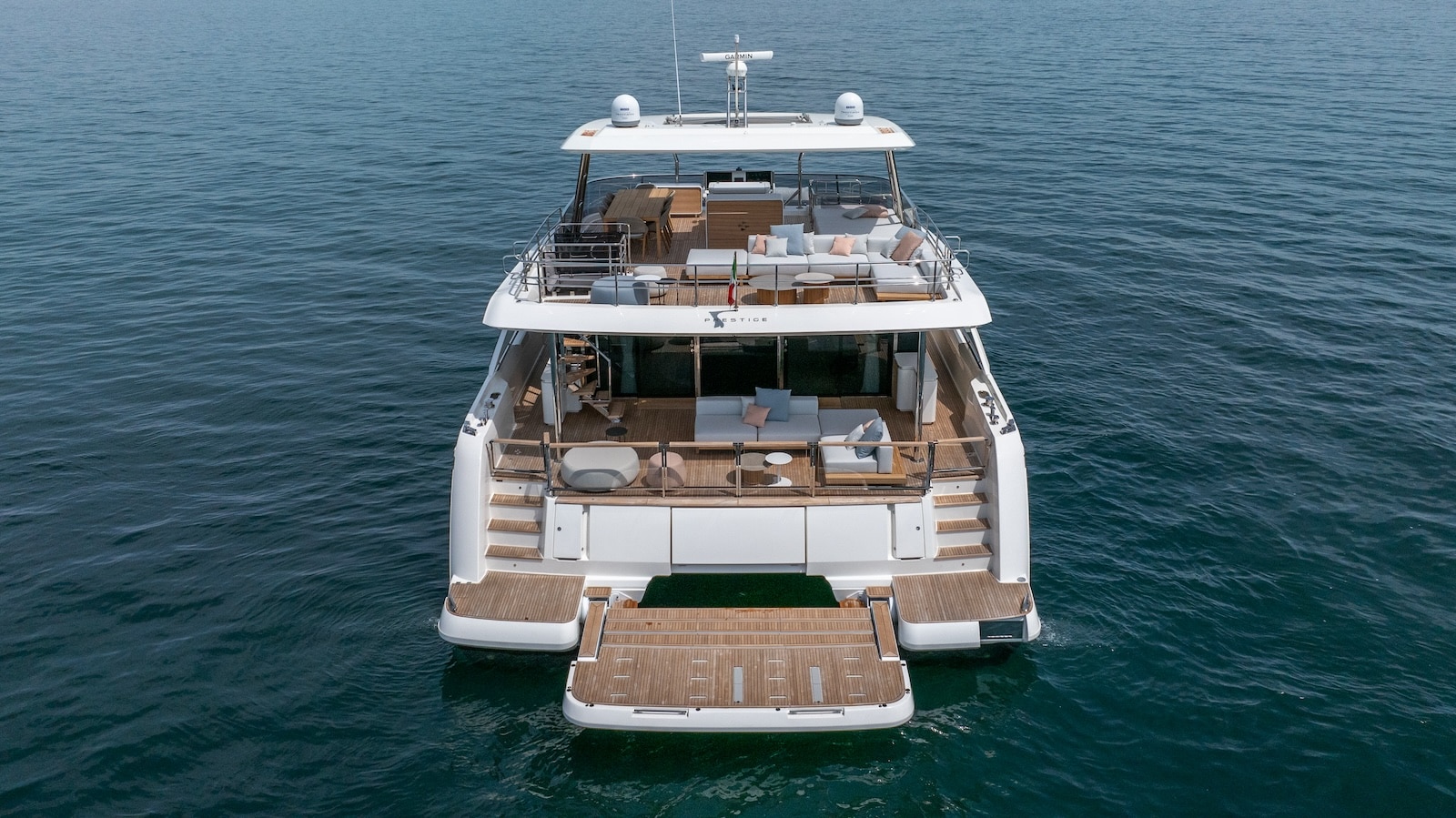
We set off again; it’s getting a bit late, and we still have about forty miles to go and need to arrive at the show at a set time. The captain accelerates, and in an instant, we are at 16/17 knots. The Prestige M8 slices through the water without changing its trim, and the distances are halved.
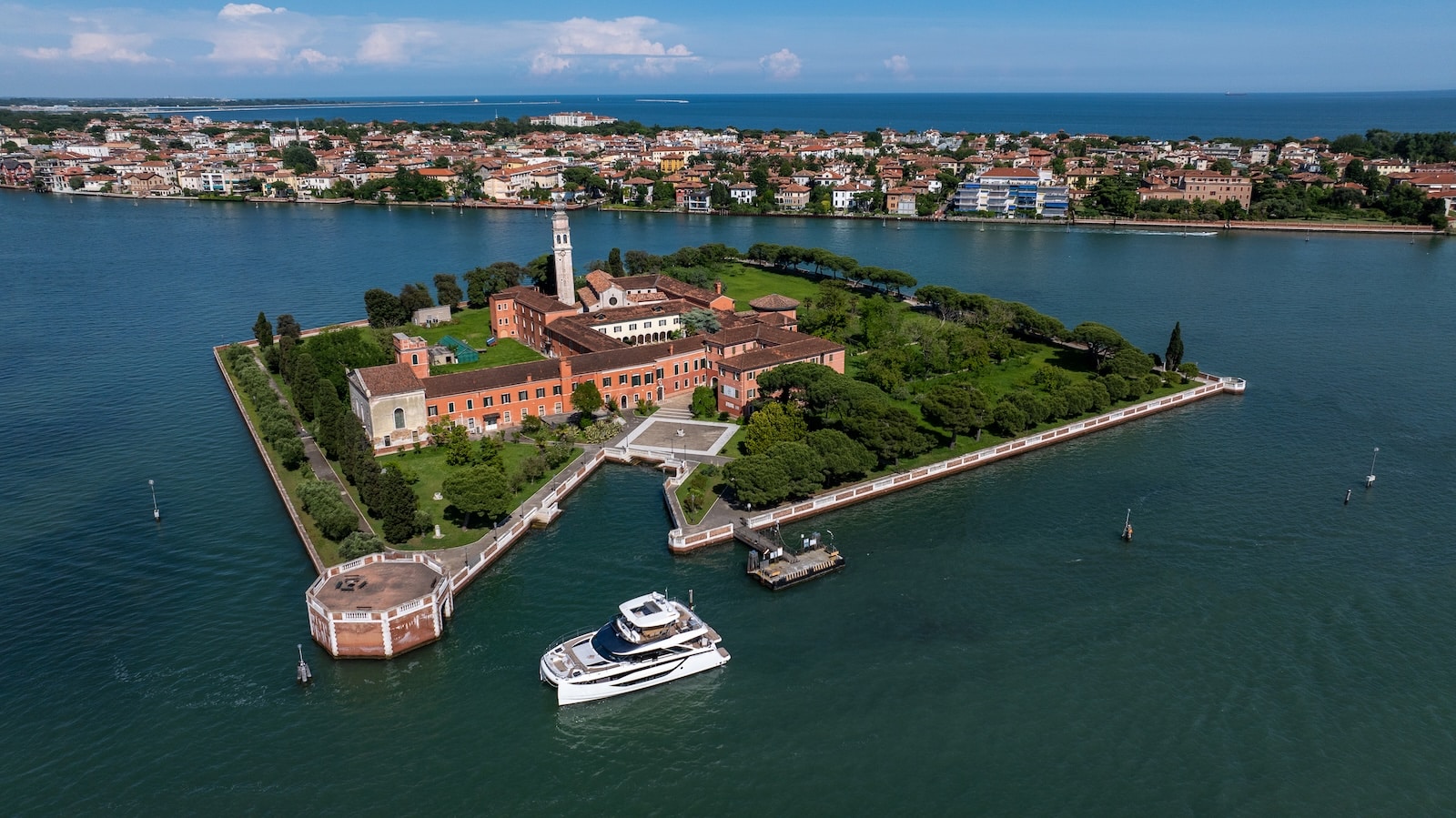
We enter Venice right on time, first rounding the Punta dei Sabbioni lighthouse and then passing the Mose flood barrier. With a draft of just over one and a half meters, we can go practically anywhere we want—a great advantage. In summer, superyachts are usually forced to stay offshore, anchored in dark waters, unable to approach the clear waters of the bays. But with the Prestige M8, even this assumption no longer holds. With this boat, you can get right up to the beach and then… there’s no rolling, and you live in the luxury of a villa with a pool, with a view that changes every day.

We head over to take some shots at San Giorgio and Piazza San Marco. It’s early afternoon, and the traffic is crazy. Ferries and motorboats create violent waves that make all passing boats roll and pitch. But this is not a problem for us. Calm and serene, from the flybridge of this yacht, we can gaze in awe at the wonders of the most beautiful city in the world without risking the glasses on the table.
We reverse course, visiting the Lazzaretto Vecchio, one of my favorite places, before heading, or rather pointing our bows, towards the Arsenale, where the boat show awaits us.
We enter slowly among the many boats already on display, and in an instant, all eyes turn to us. Yes, I know, we are aboard one of the most beautiful boats of recent years, and it should be expected, but you never get used to it. After all, boats are not, fortunately, a rational purchase. They are bought because you fall madly in love with them, and believe me, with the Prestige M8, this is a real risk.

Conclusions
Prestige M8 is a unique motor catamaran. It perfectly synthesizes all the advantages of a large superyacht with the ease of handling of a traditional yacht. Beautiful, luxurious, and incredibly captivating, it is the forerunner of a new series of boats destined to replace many of the trawlers currently on the market over time.
Characterized by an unmatched navigational capability, it is a yacht designed for demanding and refined owners who want to fully immerse themselves in the sea experience without sacrificing maximum comfort.
For those who want to delve deeper and go beyond mere emotions, our pages also feature a comprehensive conventional sea trial which you can read simply by clicking here: PRESTIGE M8, REINVENTING THE MOTOR CATAMARAN.
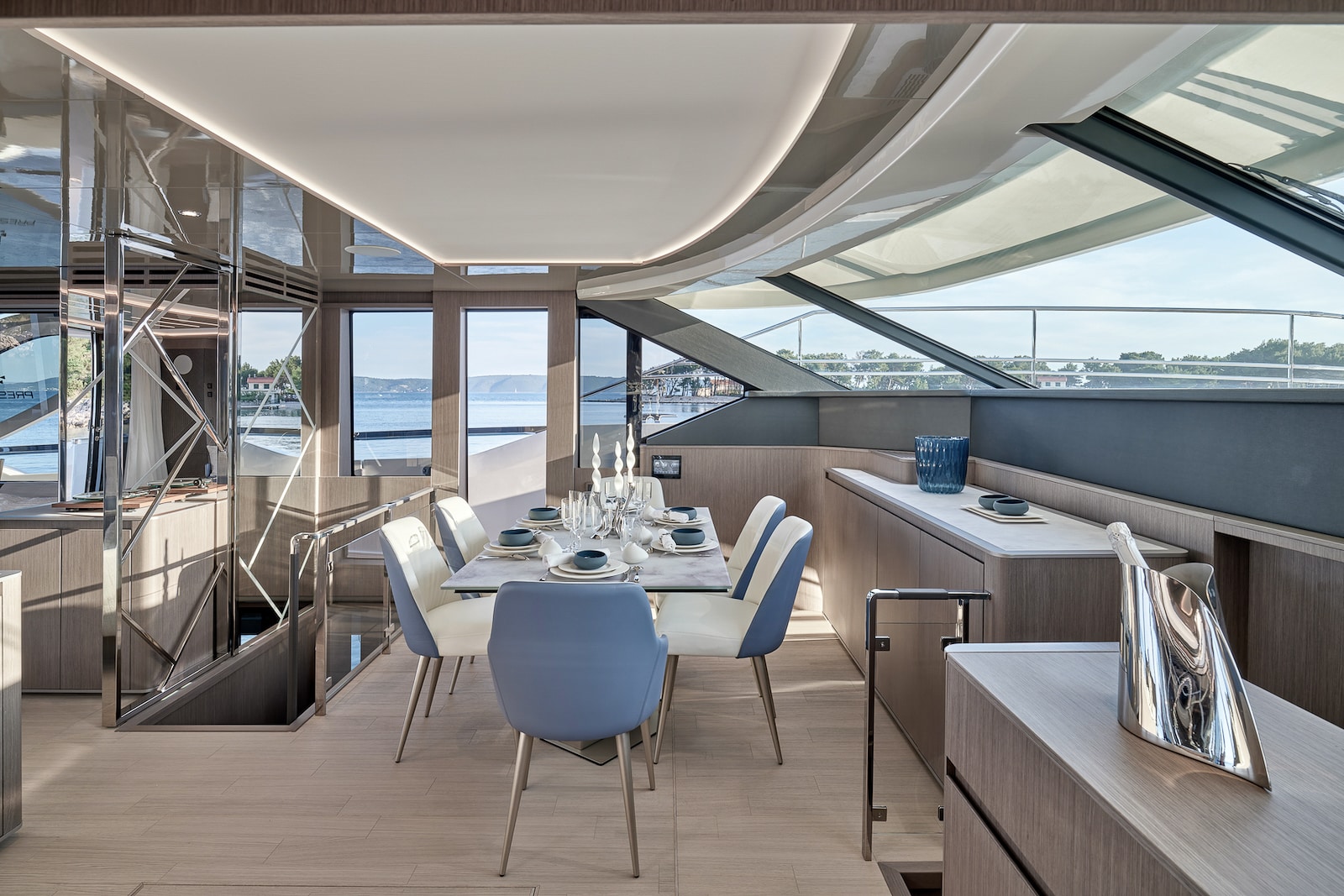
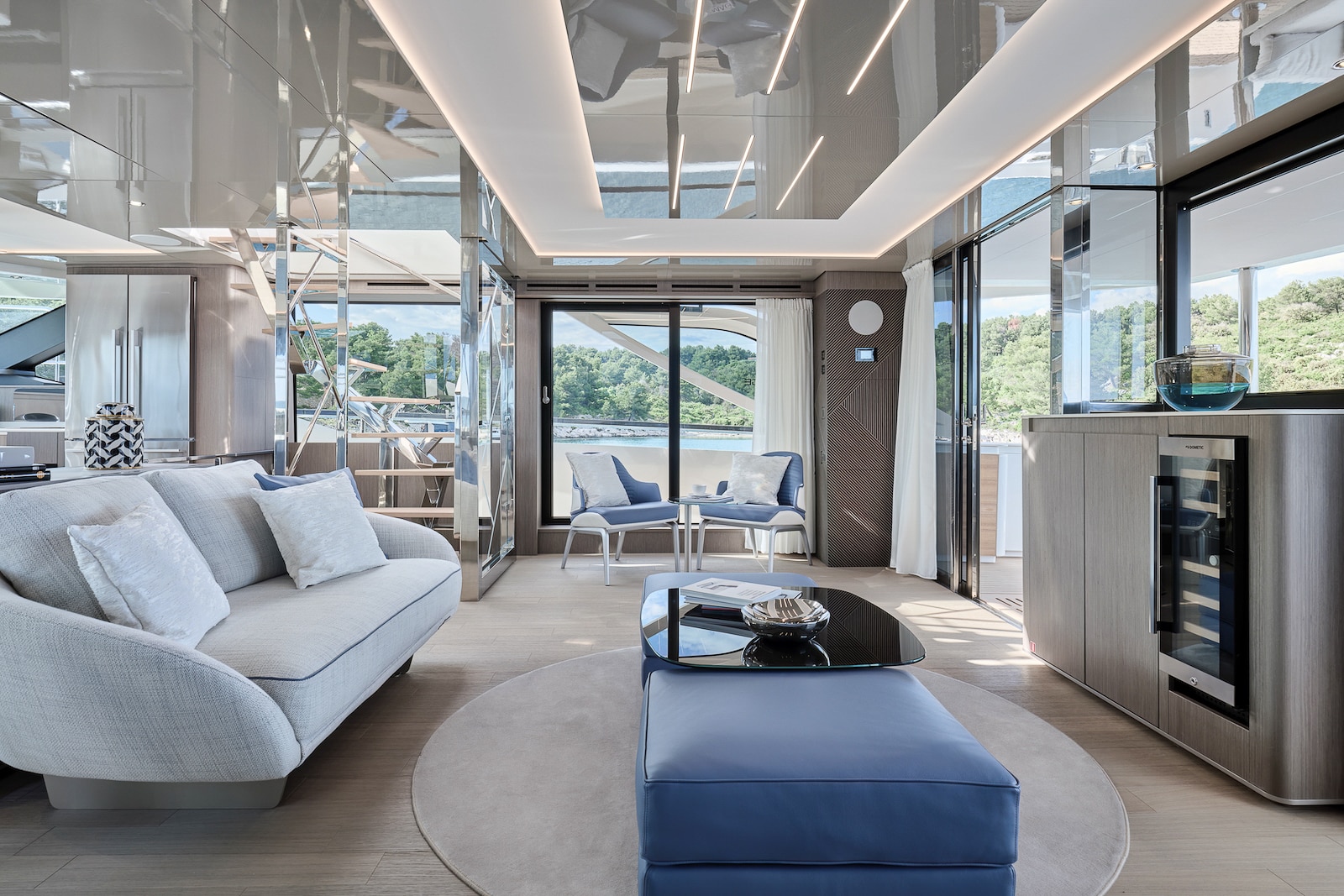
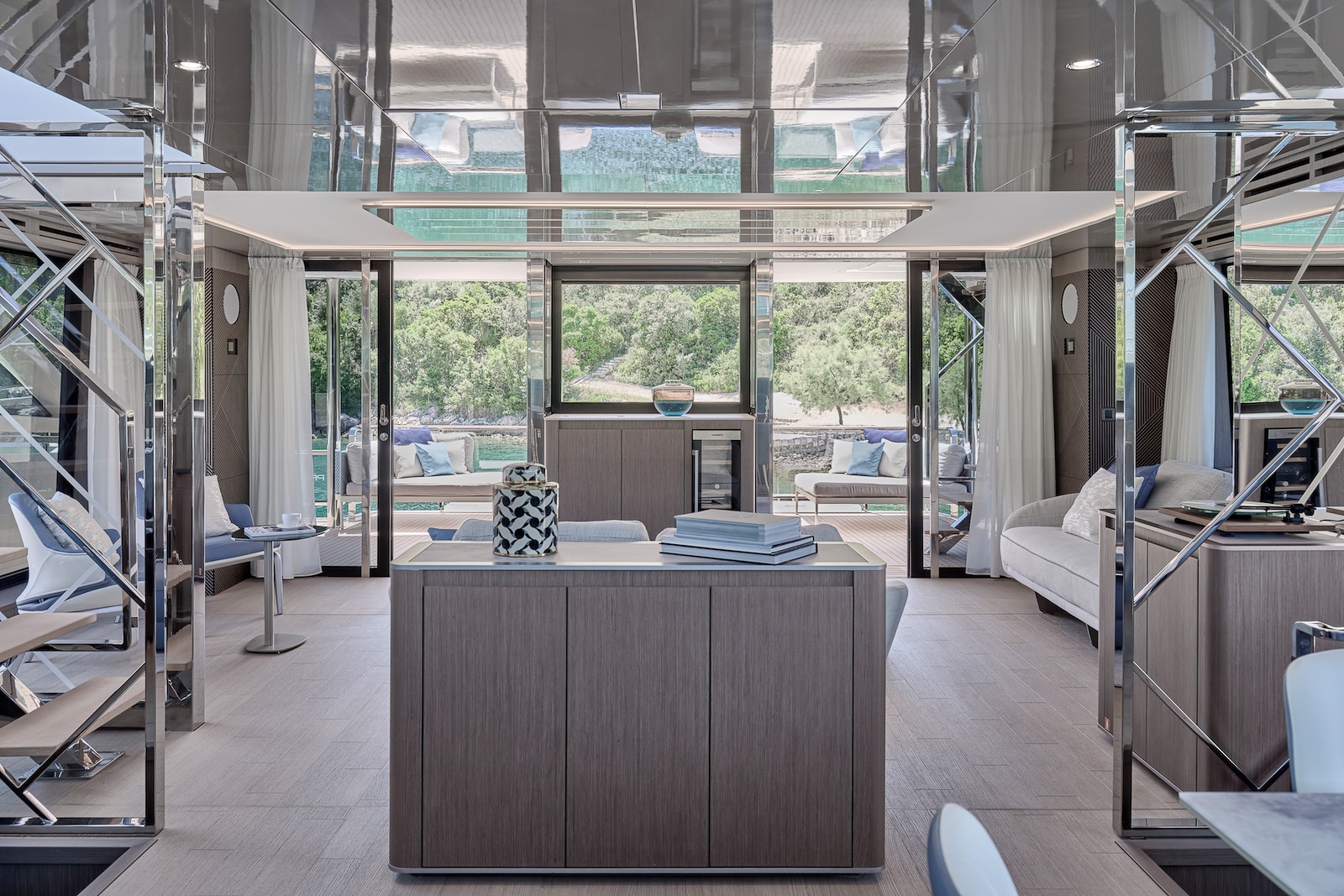
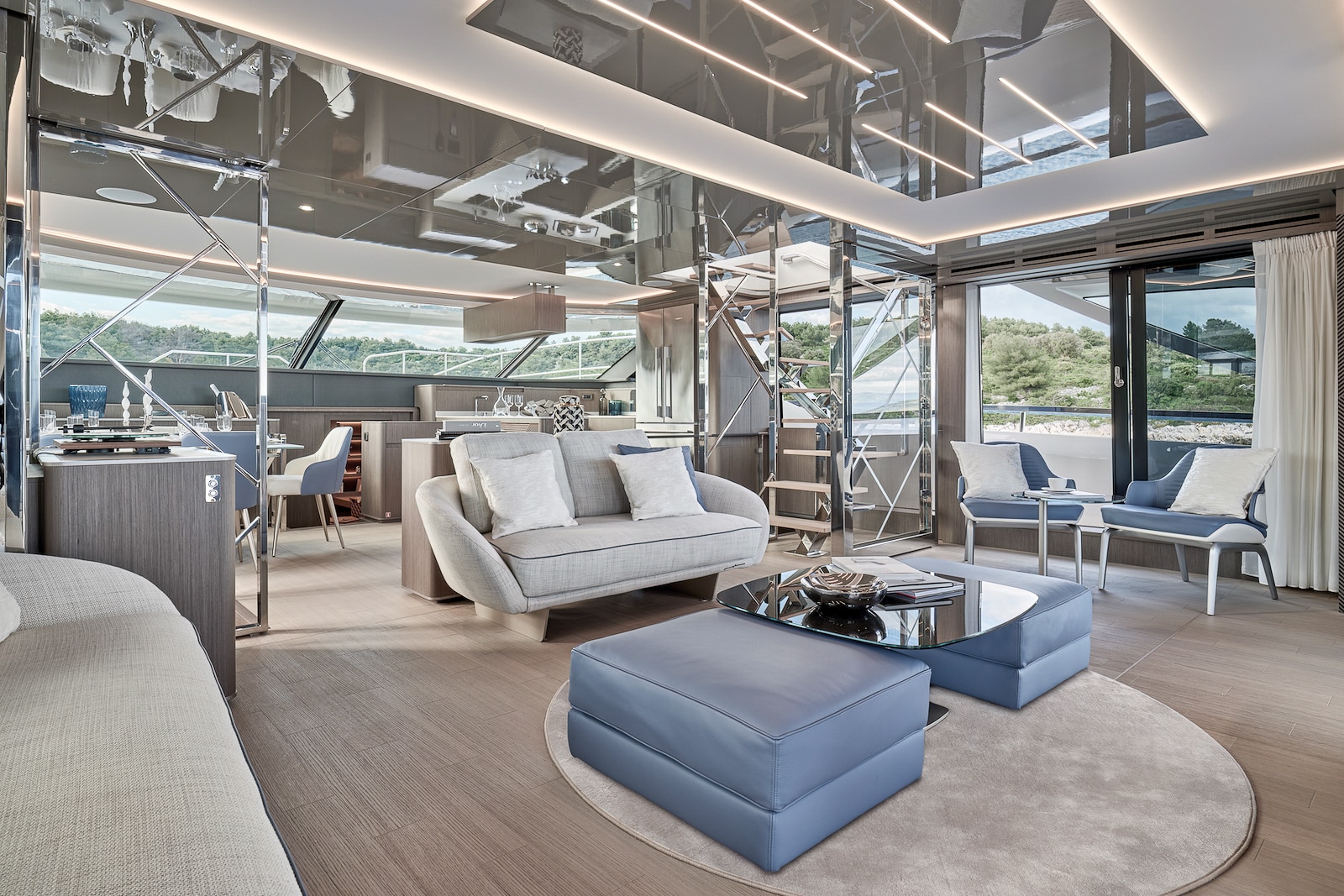
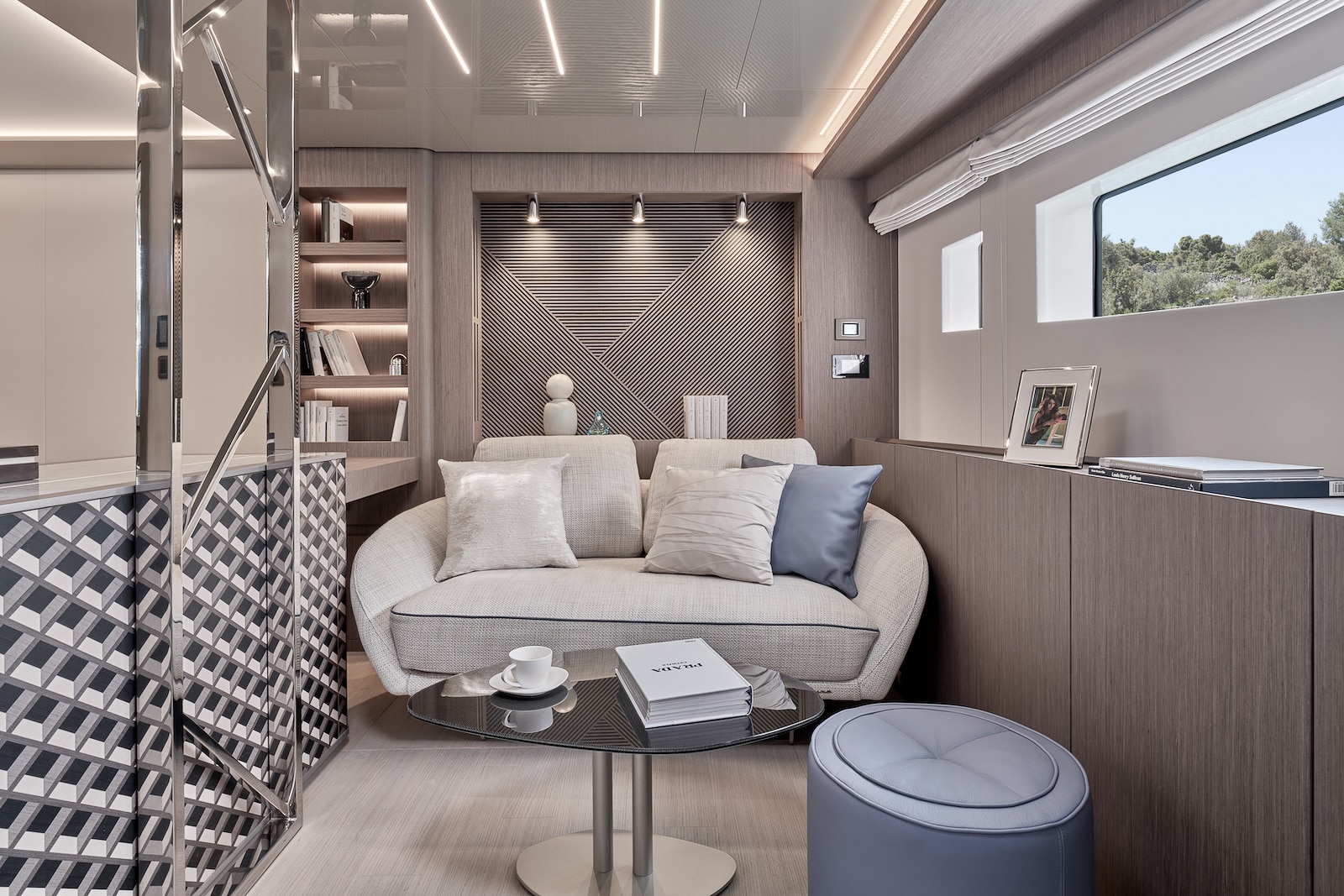
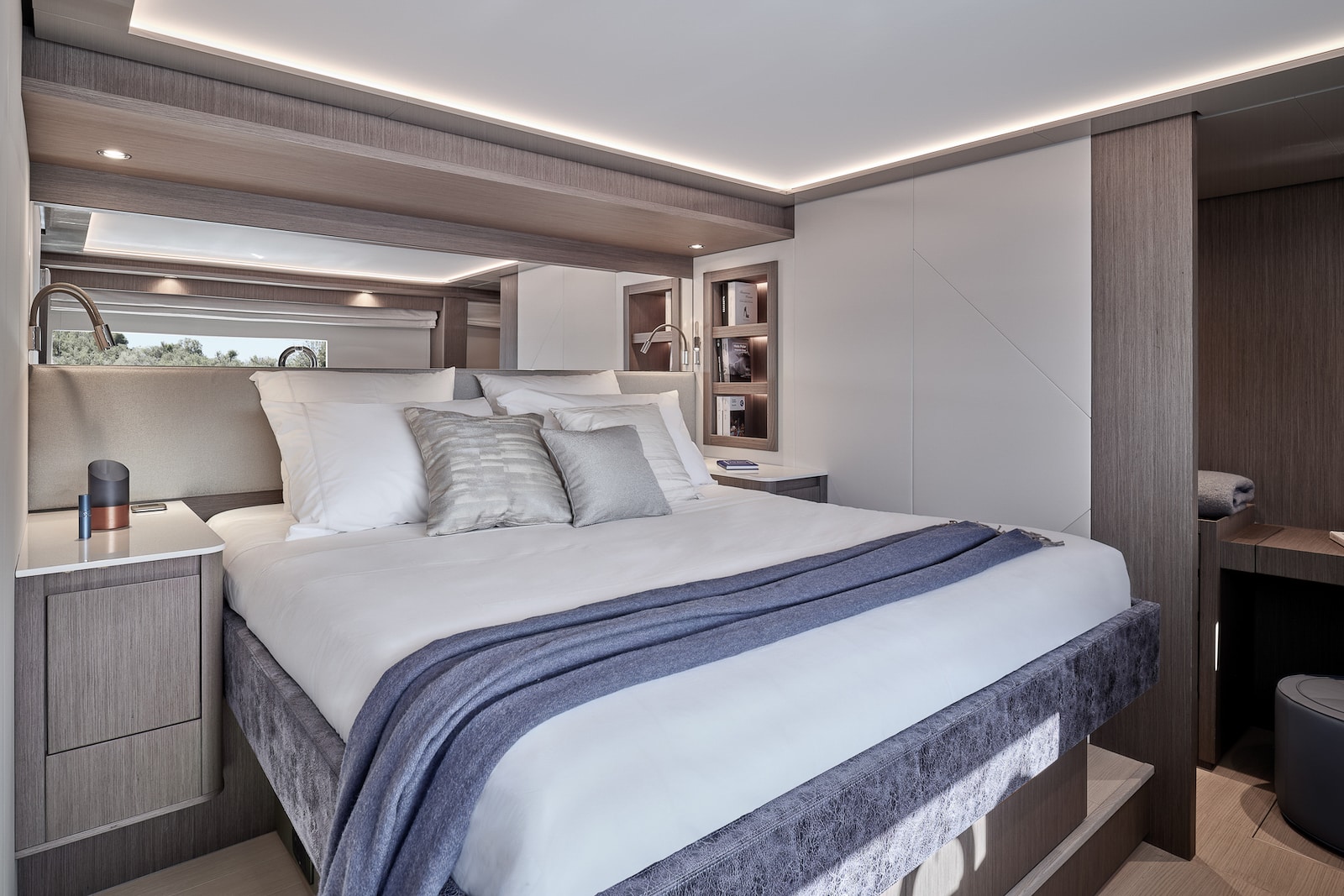
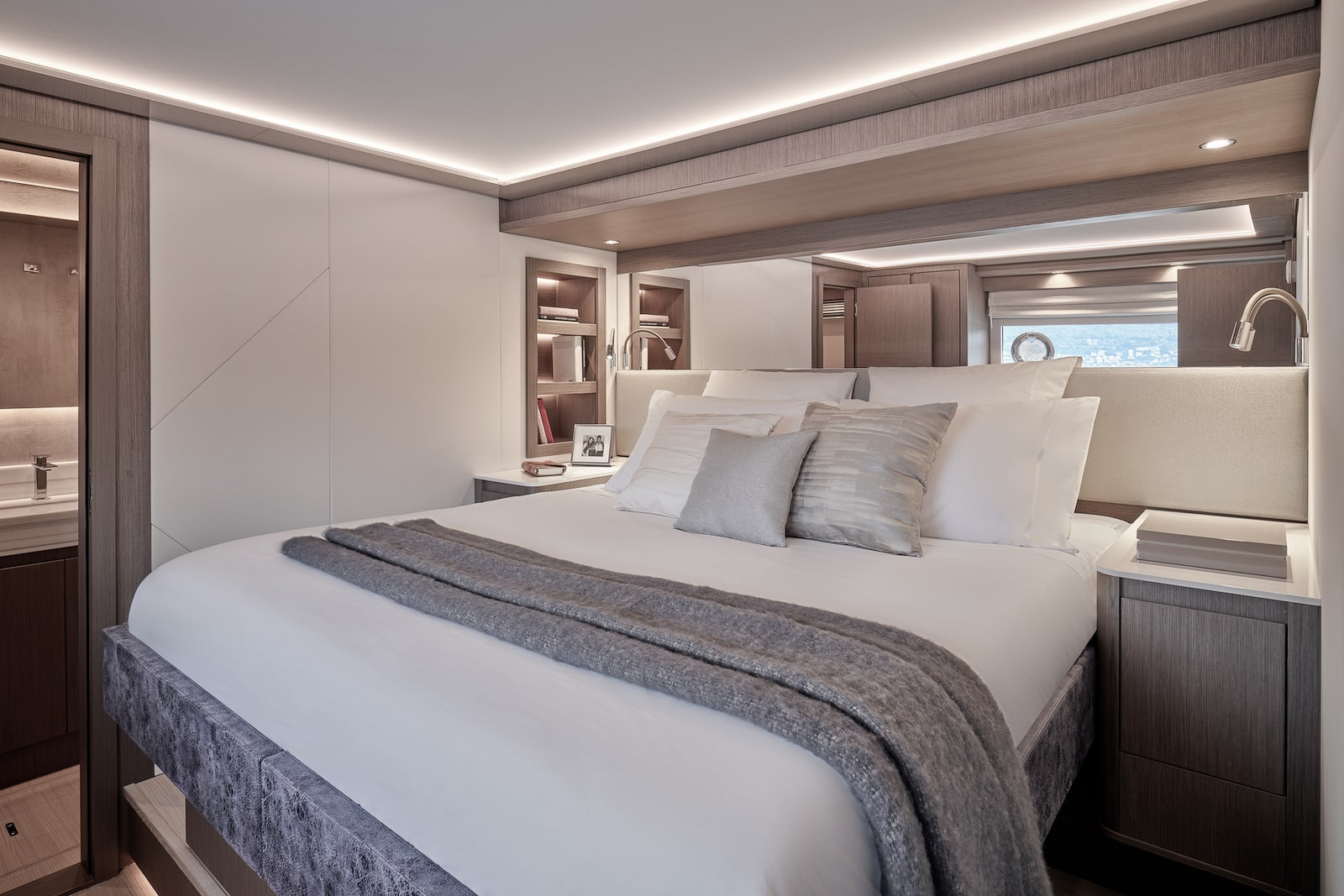
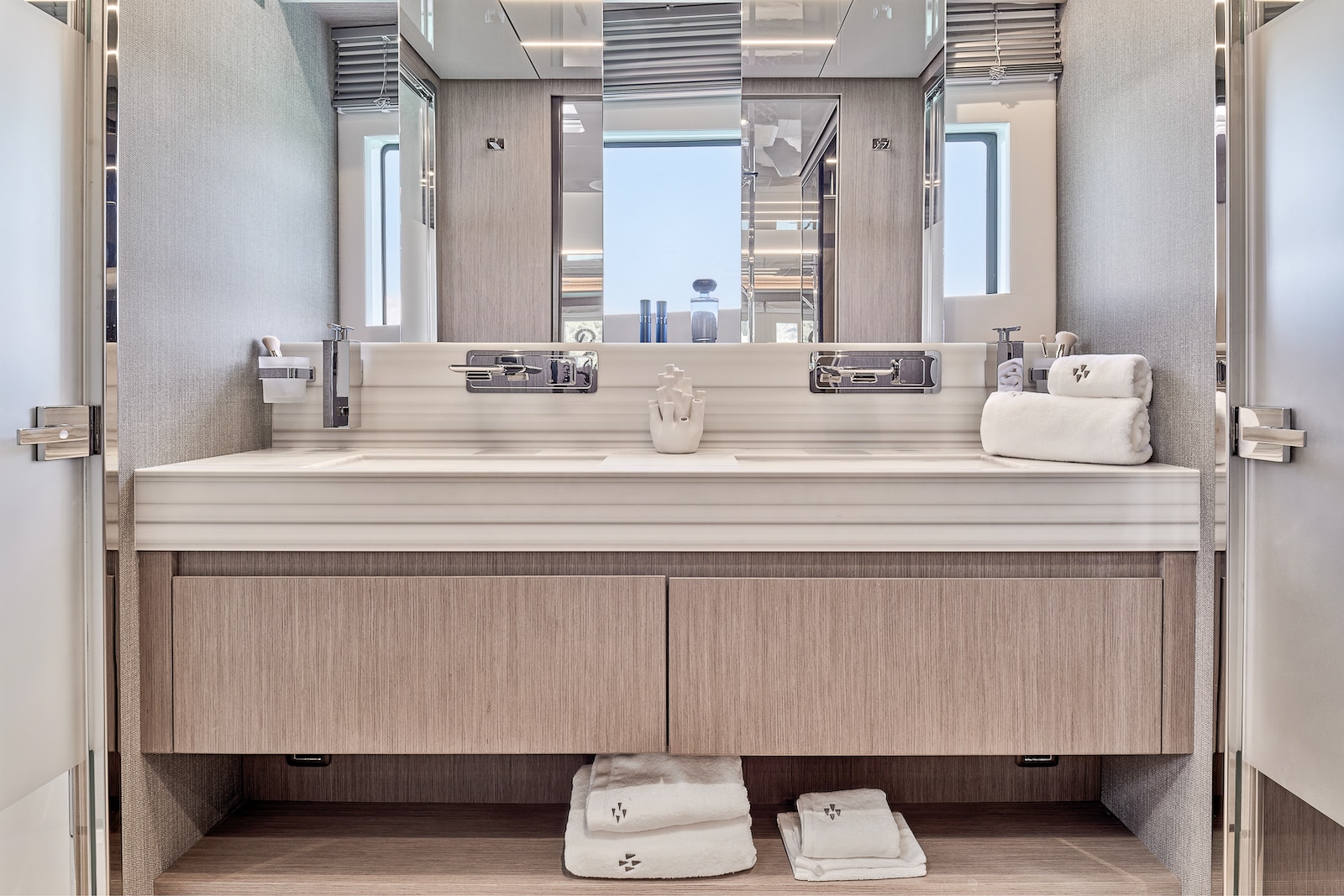
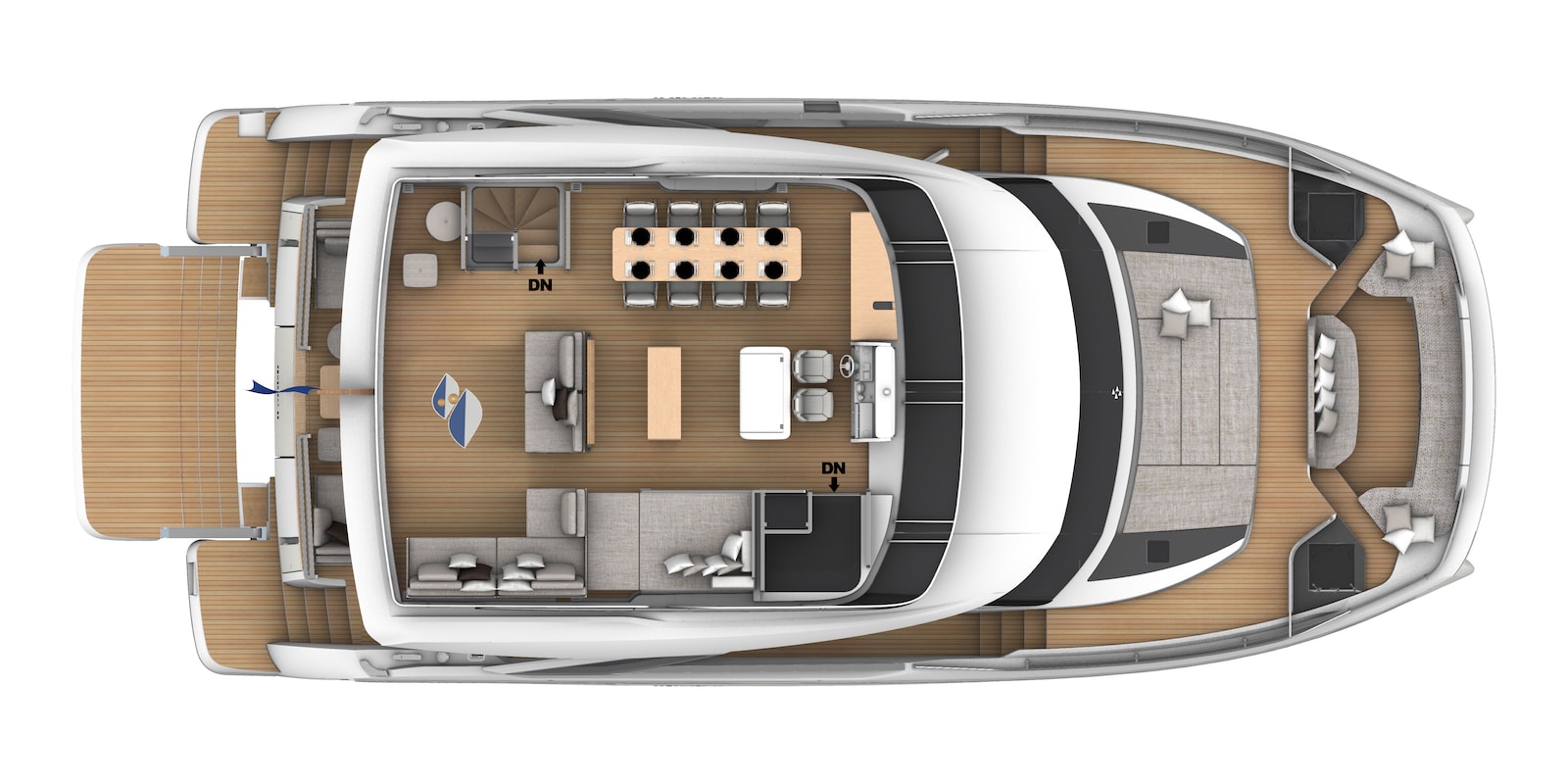
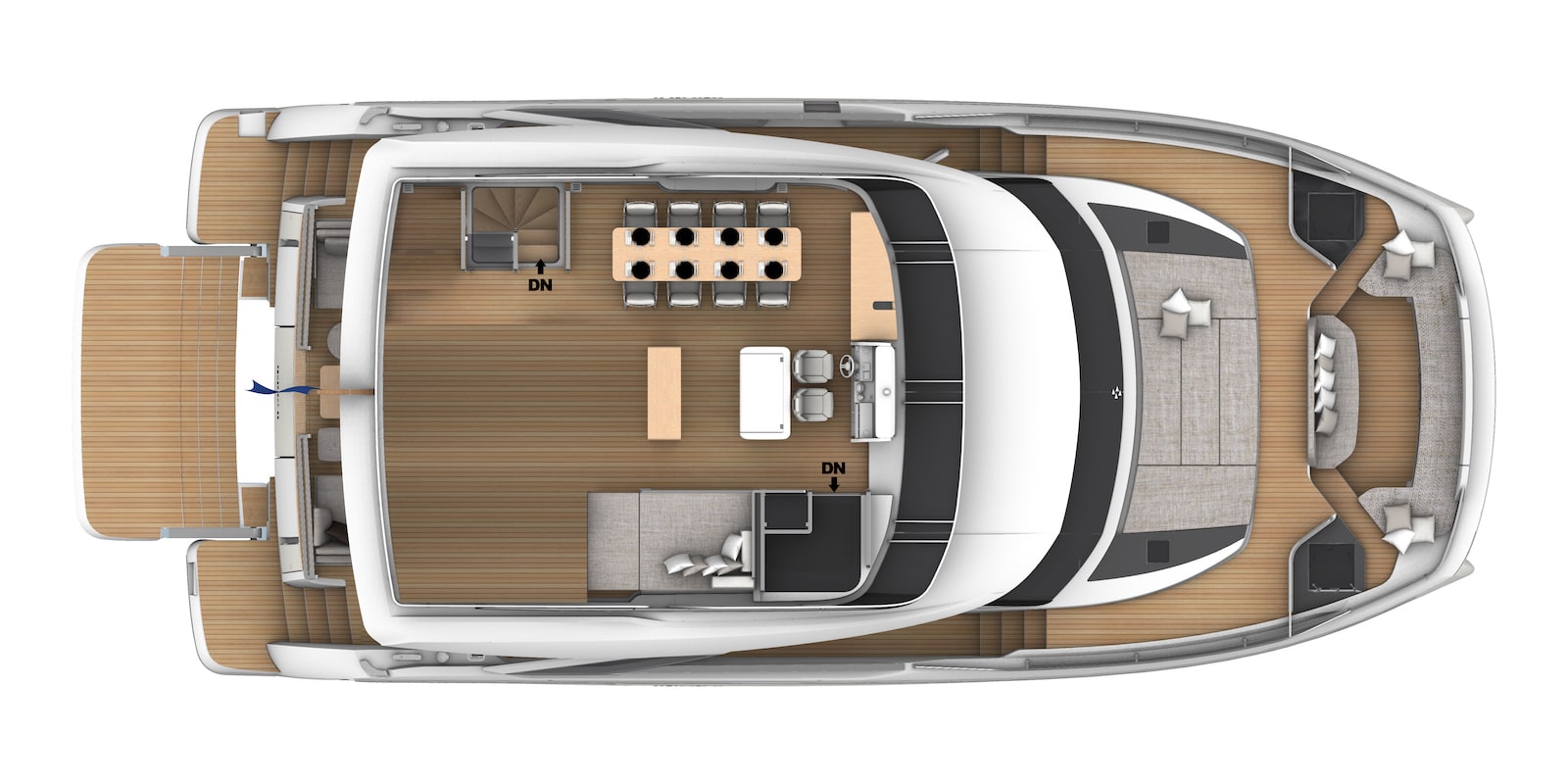
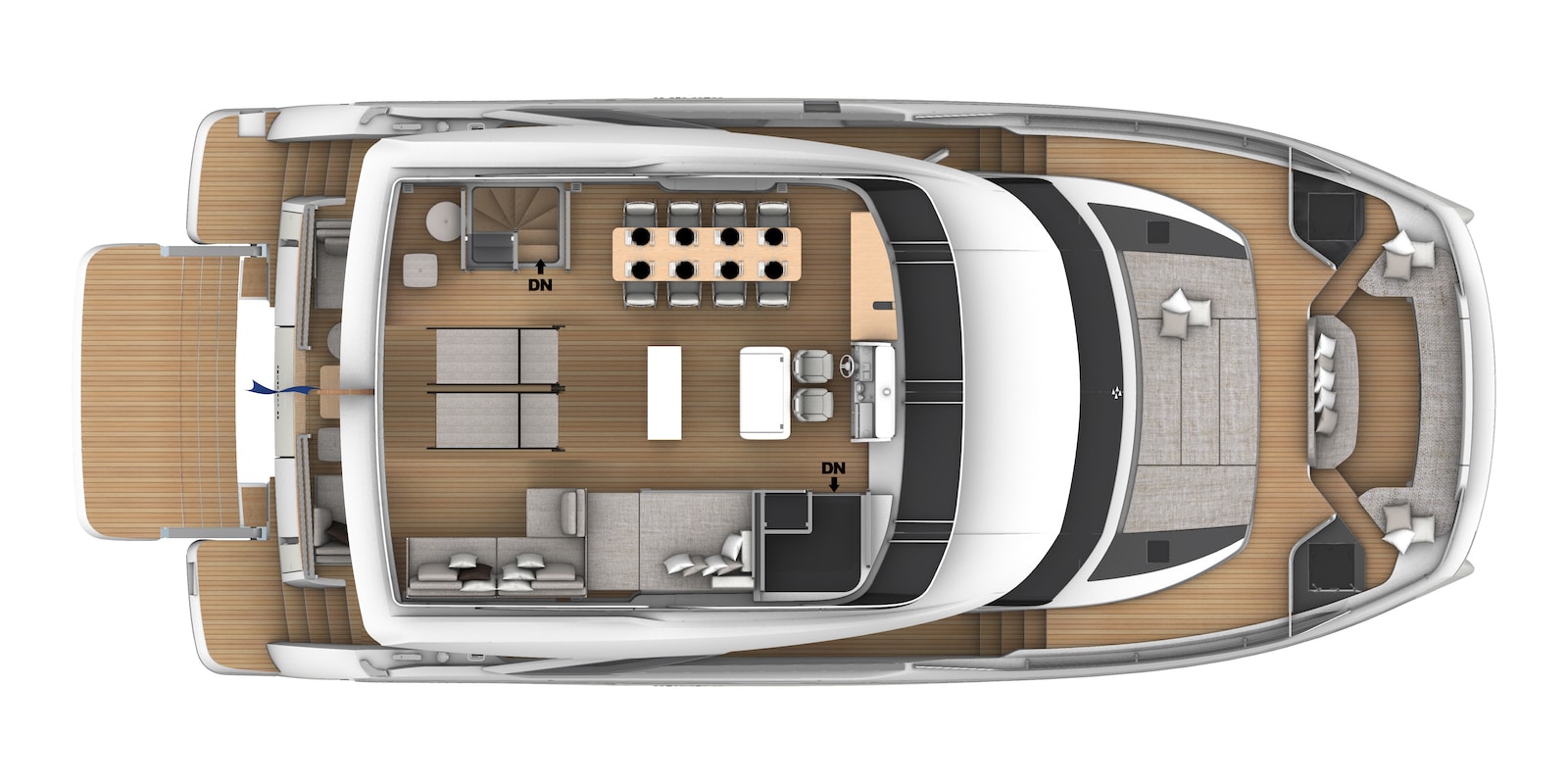
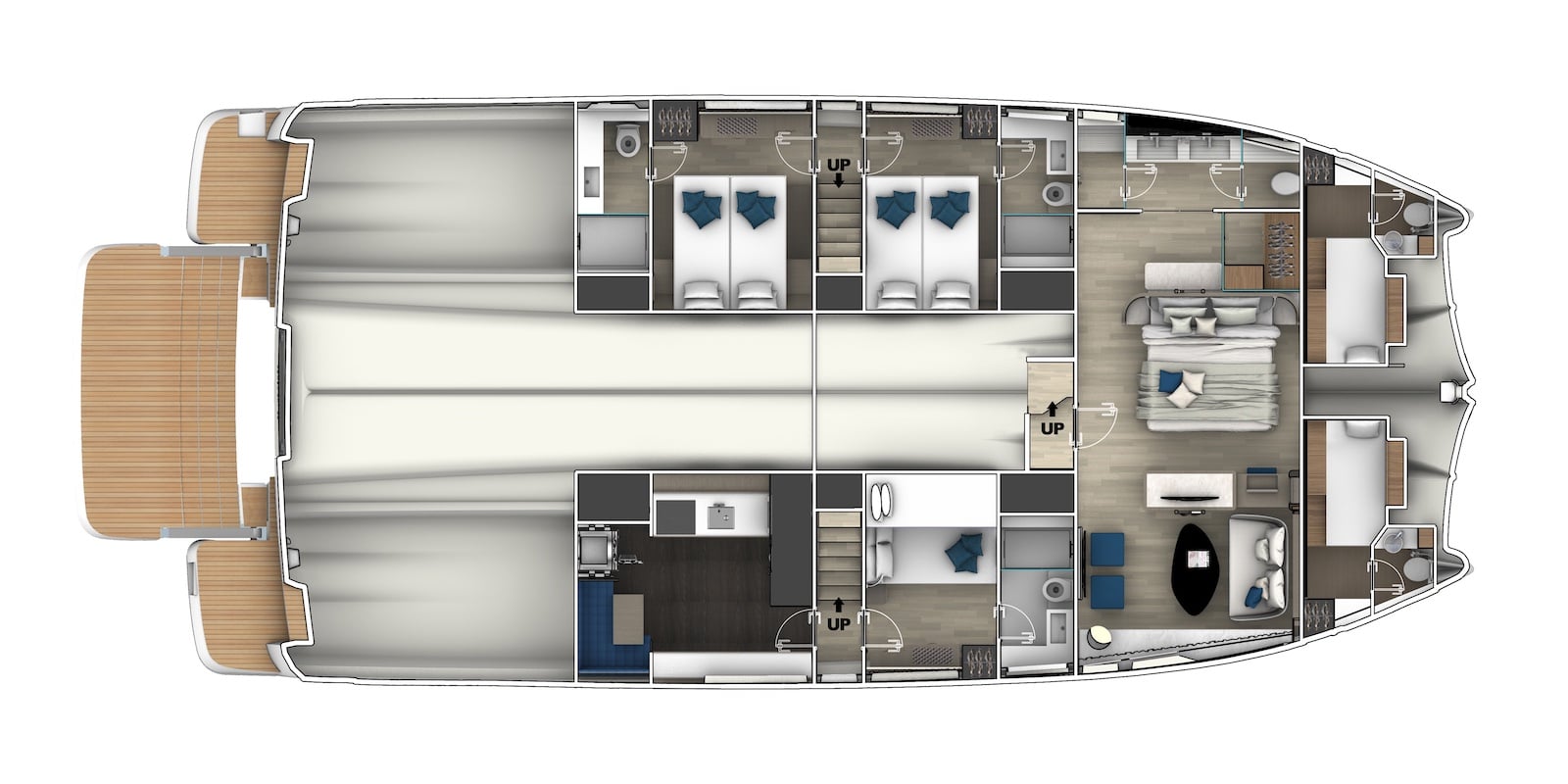
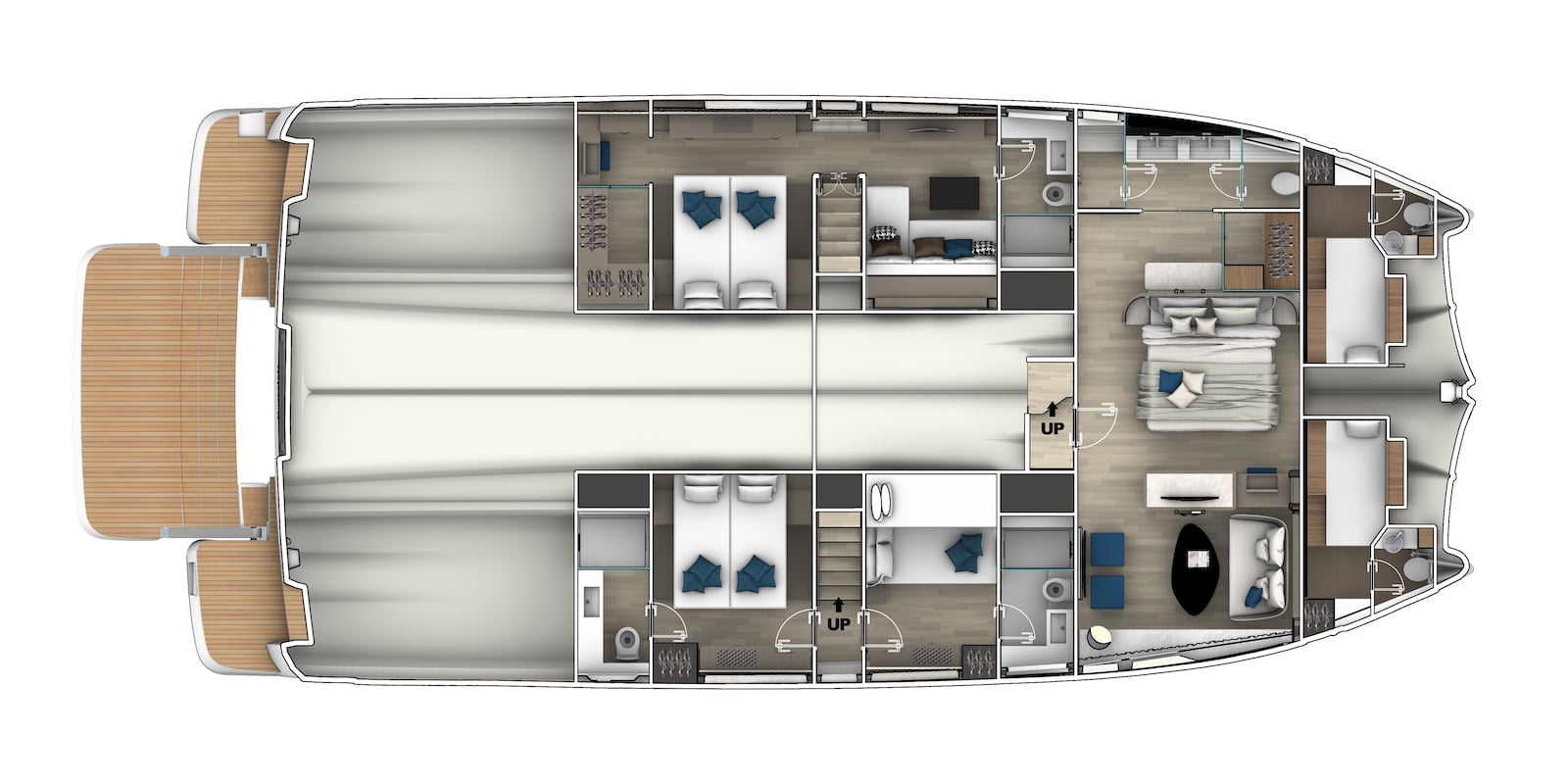
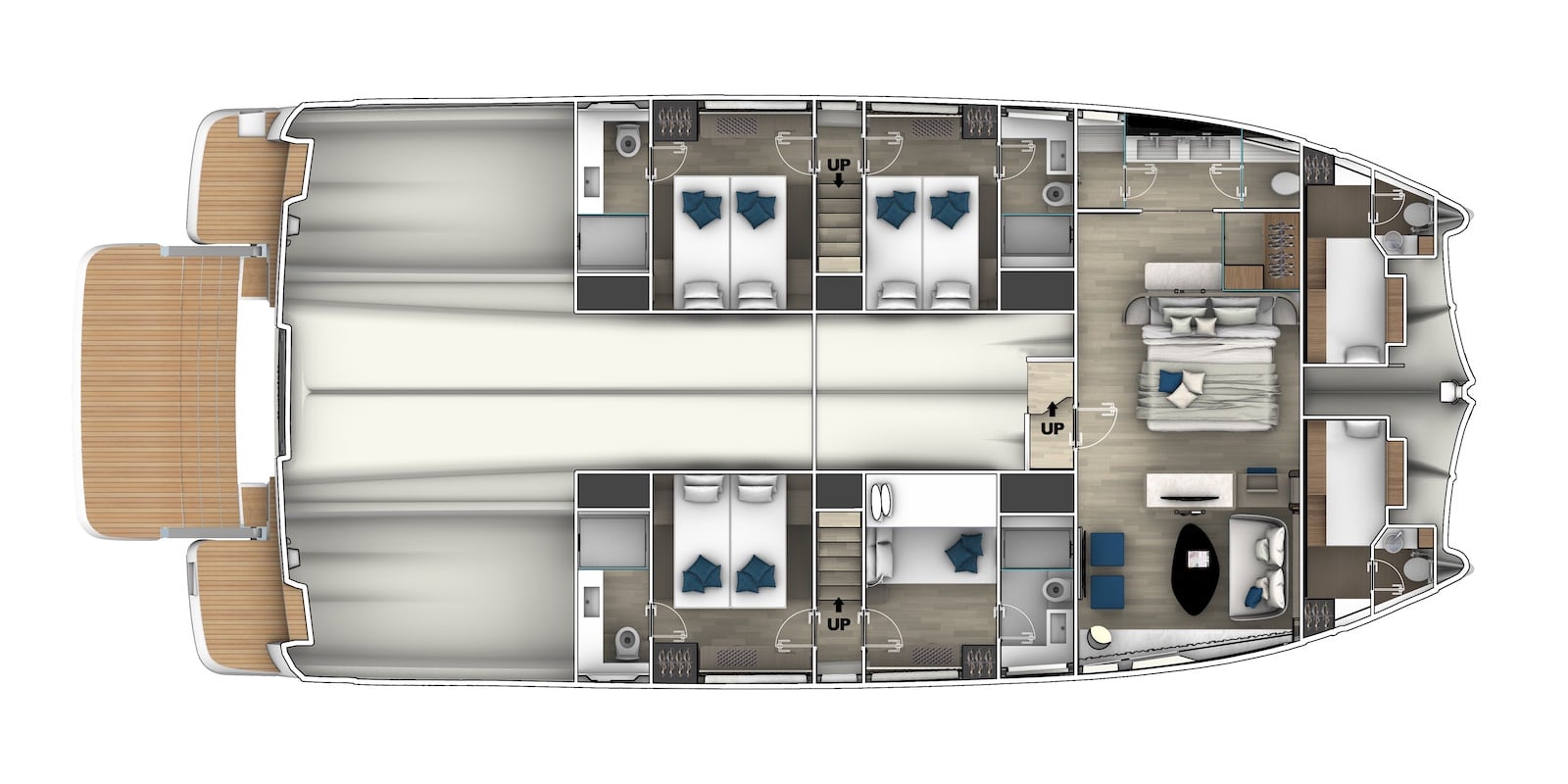
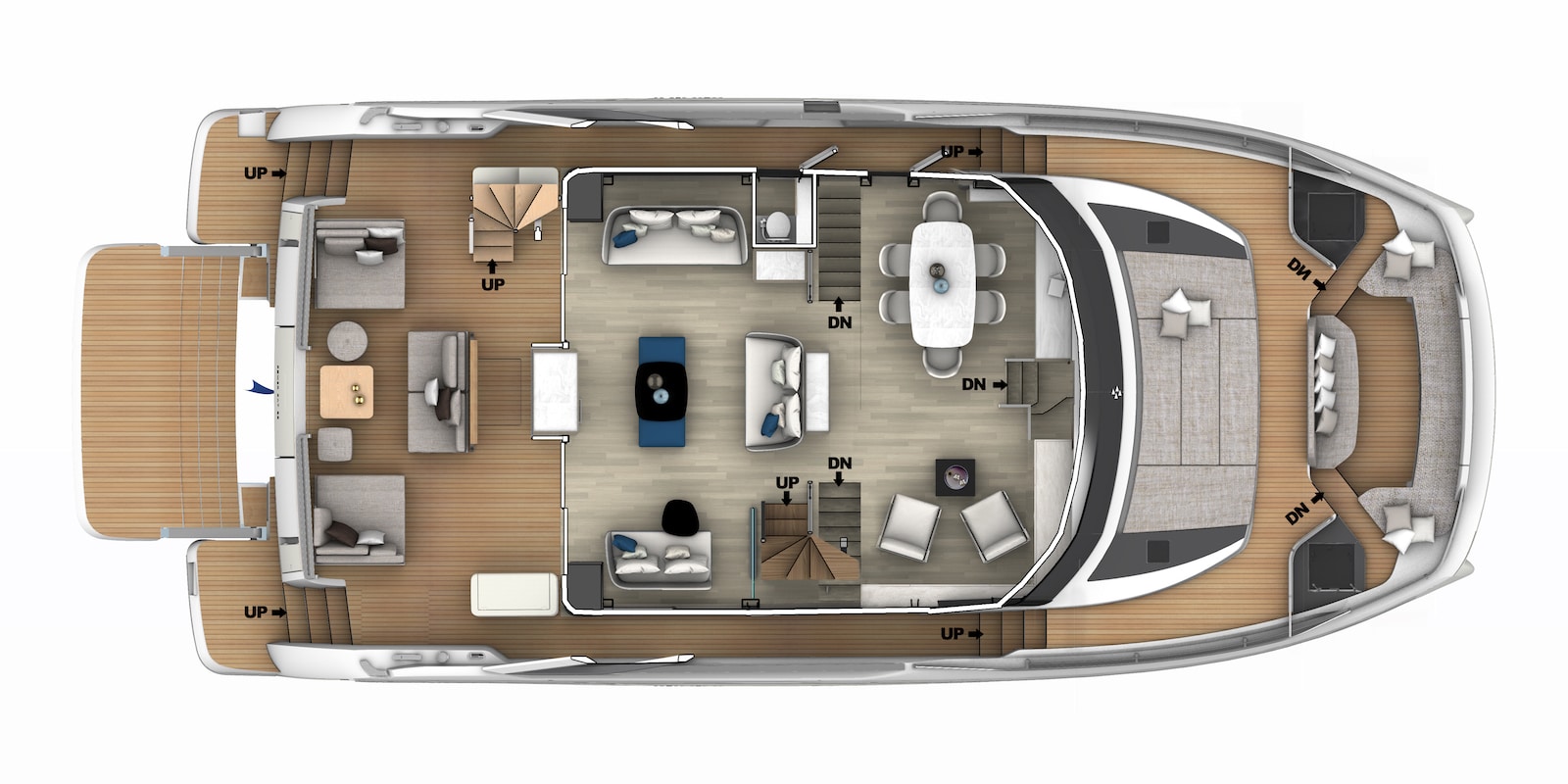
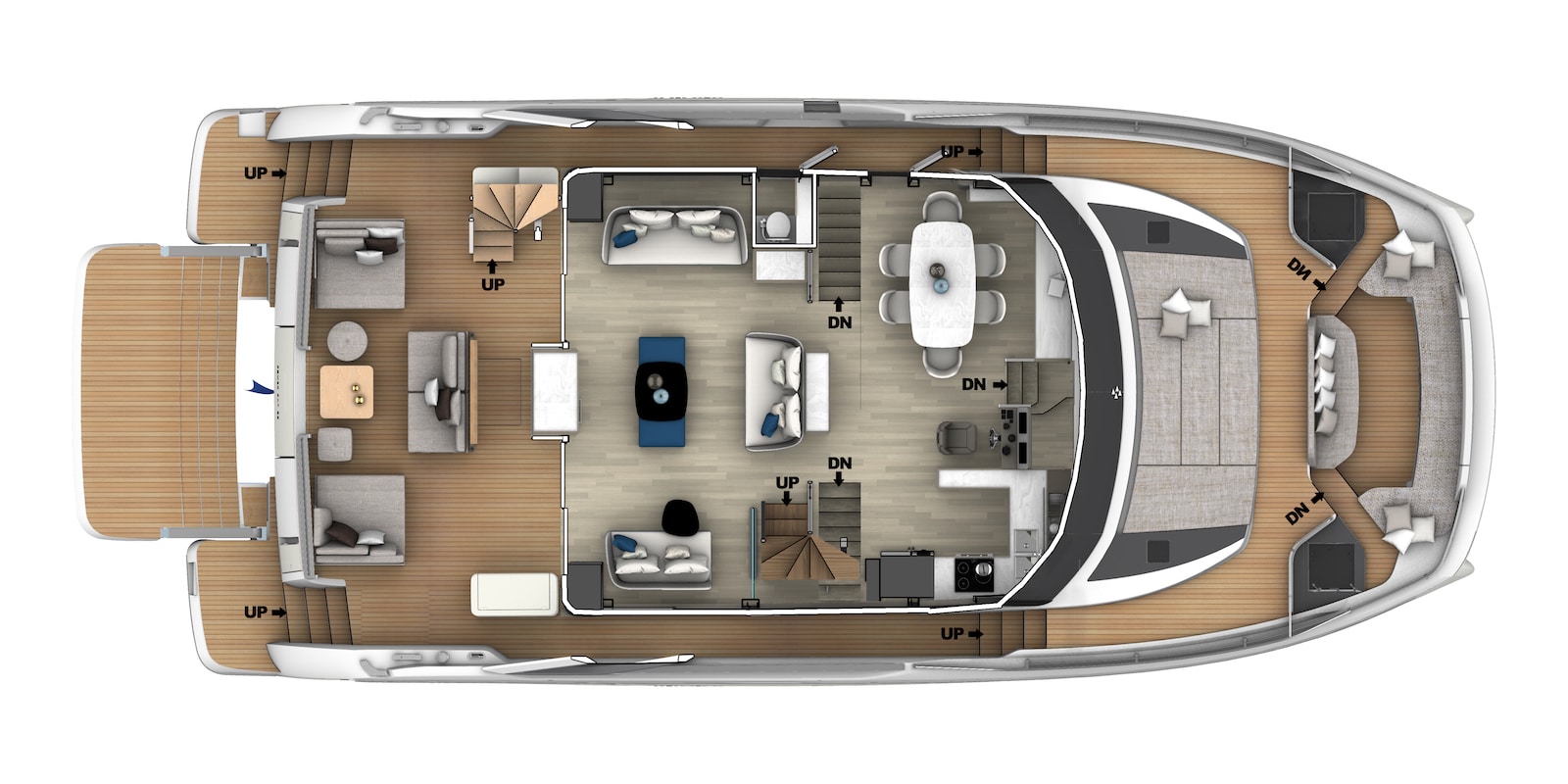
The post Prestige M8: first-class navigation from Monfalcone to Venice appeared first on Yachting News.
]]>The post Nimbus 495 Flybridge, sea trial of an out-of-the-ordinary explorer yacht appeared first on Yachting News.
]]>Nimbus 495 Flybridge Sea Trial
To fully understand why a Nimbus is a Nimbus, you must, at least once in your lifetime, immerse yourself in the Swedish yachting lifestyle. A wonderful ecosystem forged by the relationship these sailors have with their archipelago and the northern seas, a complex relationship based on the solidity of these boats and their ability to naturally handle even the roughest seas.
It is perhaps for this reason that Nimbus chose the Island of Donso for the presentation and test of the new Nimbus 495 Flybridge, an explorer yacht that, as we will see later, easily combines beauty and seaworthiness, two characteristics naturally inherent in these places, where it is equally natural to use the boat to go to school, to work, or simply to meet friends, regardless of the weather conditions.
These are necessary premises when analyzing a boat of this type, which moreover defies any classification. An explorer yacht that possesses, as you will see, a strong inclination to cover distances in any condition, in maximum comfort.
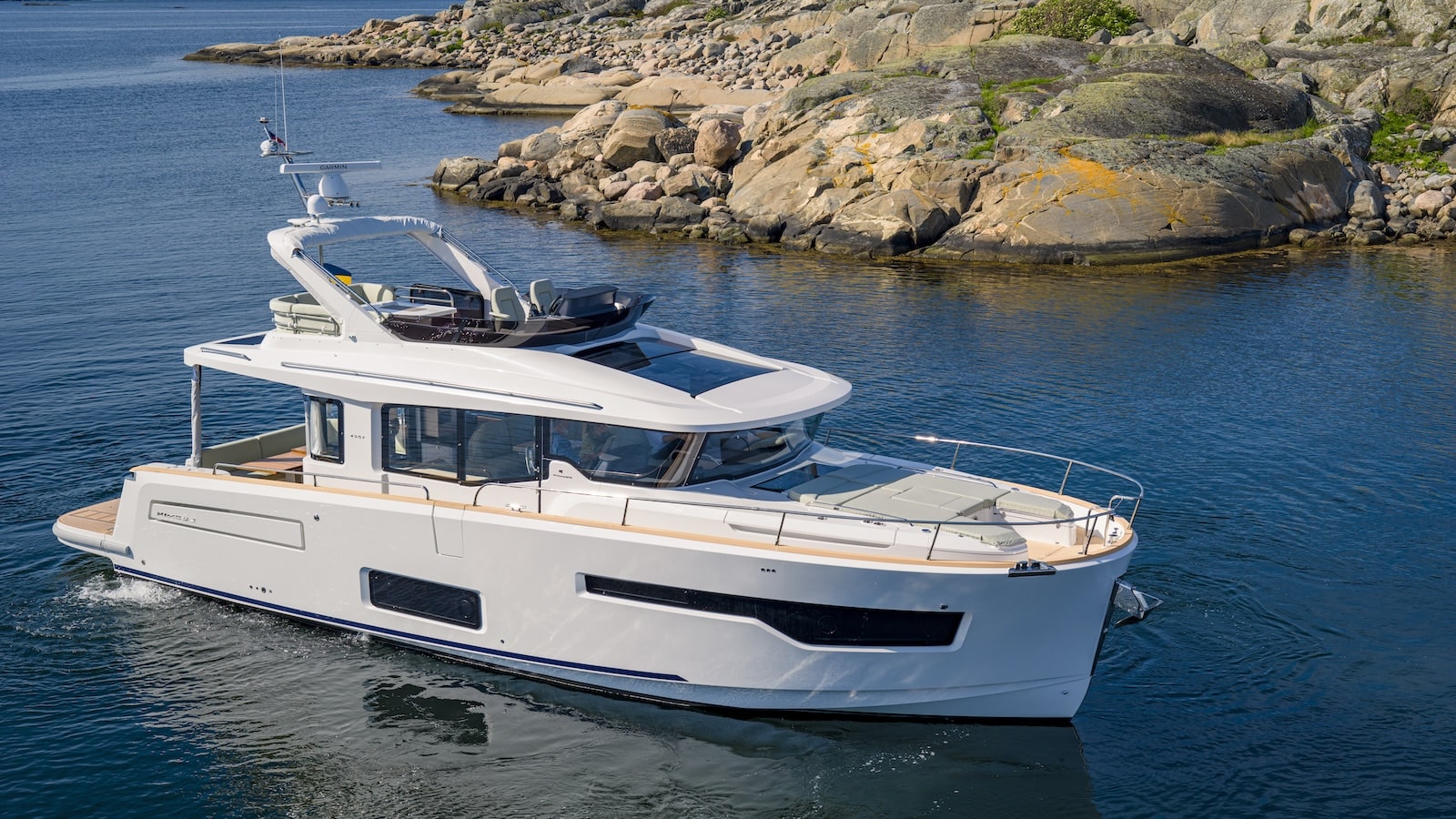
Upon entering the main deck of the Nimbus 495 Flybridge, you immediately notice how the shipyard’s design has succeeded in creating a versatile boat. We are on board a flybridge, but with all the windows and the roof open, it feels like being on an open boat, where the boundaries between exterior and interior are erased.
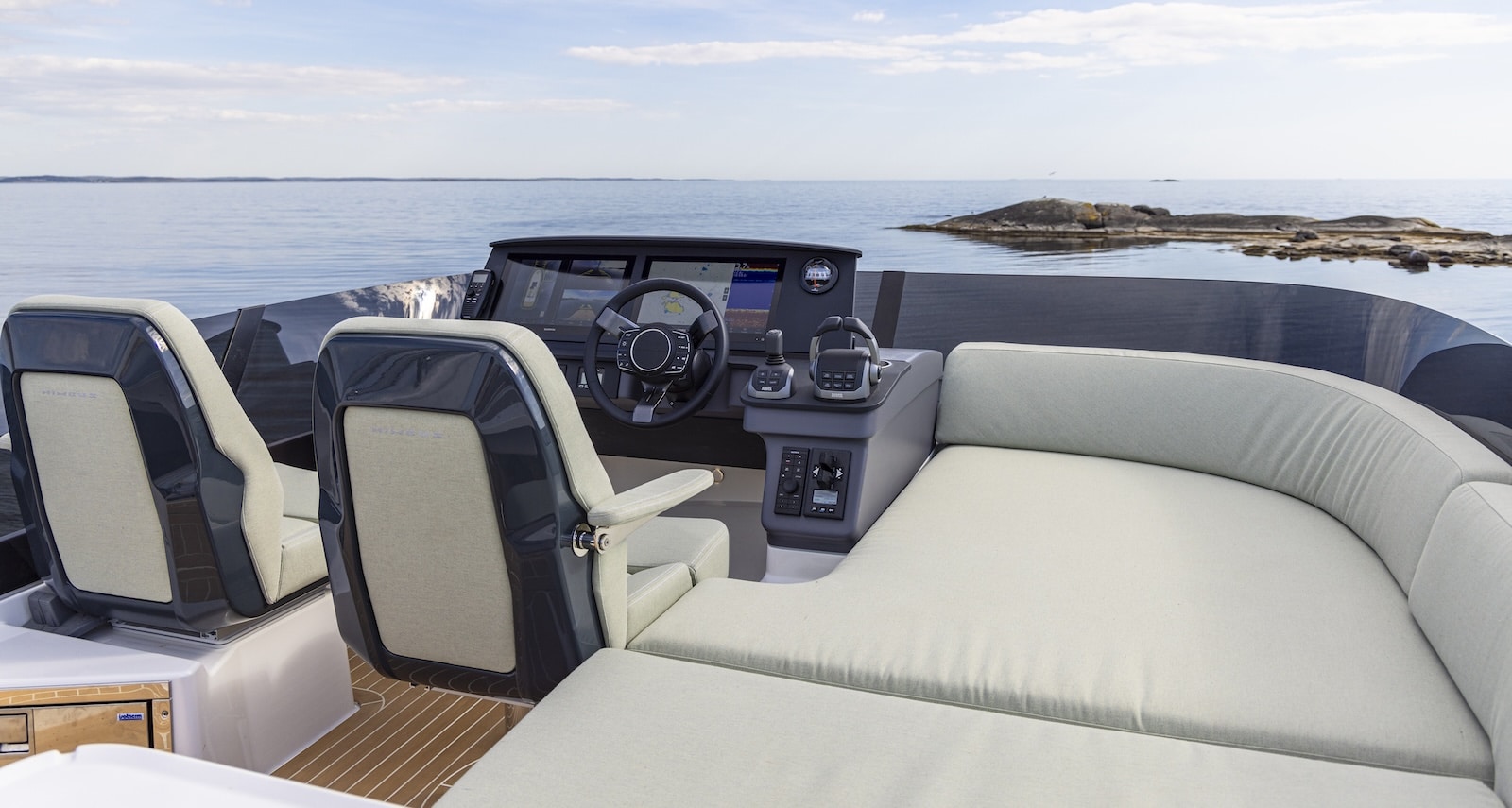
I reach the interior helm station and sit down. From this chair, the visibility is perfect at 360 degrees, and all the necessary instrumentation for navigation and docking is within reach. I set the electronic throttles to “single lever” and then engage forward gear. The Nimbus 495 Flybridge sails smoothly without rolling, unaffected by the cross waves, thanks to the shipyard’s meticulous study of weight distribution.
At 8 knots, we navigate in first class, with very low consumption and minimal emissions. Under these conditions, the range provided by the 1,700-liter tank is extraordinary, more than sufficient for long crossings.
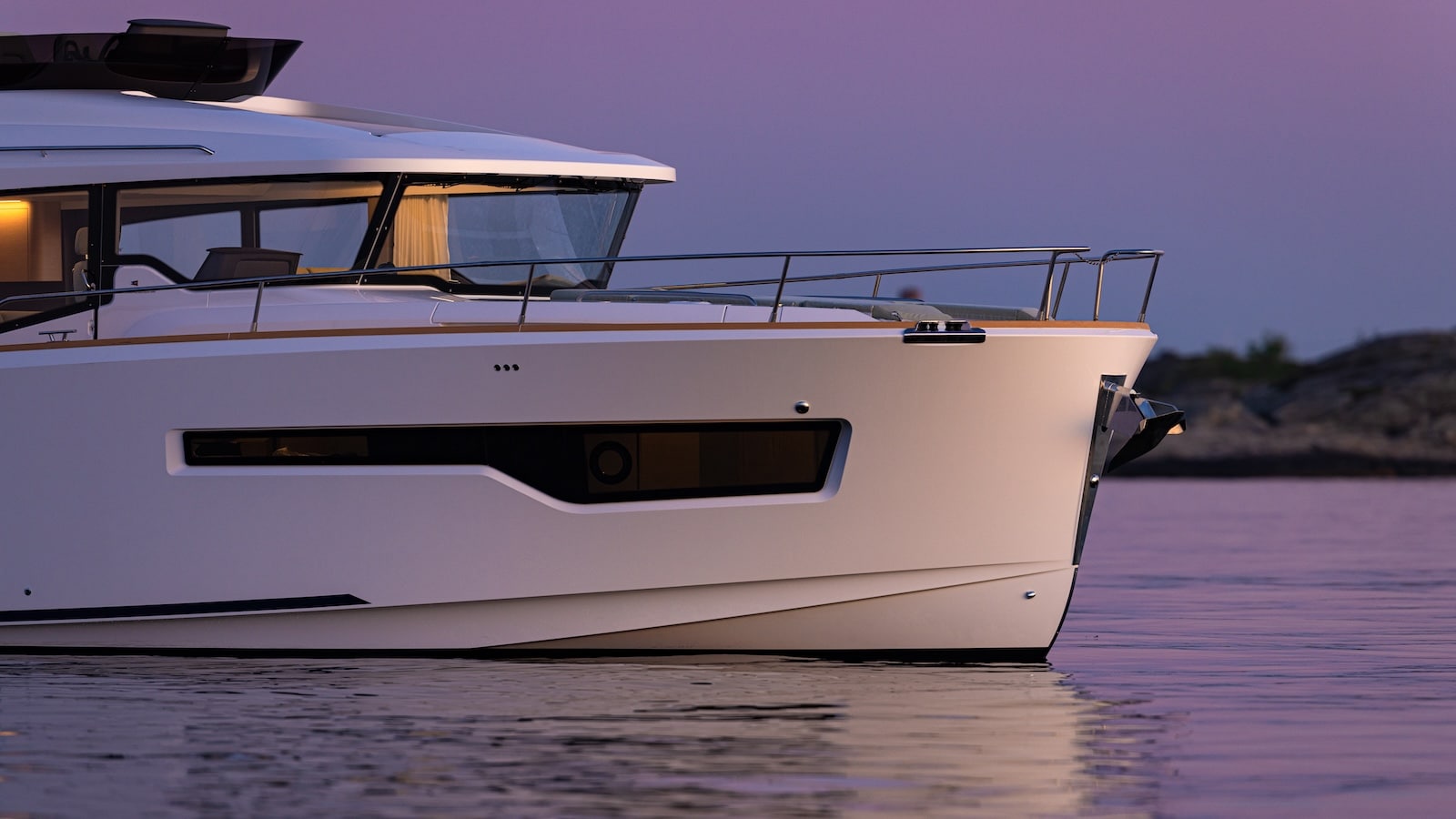
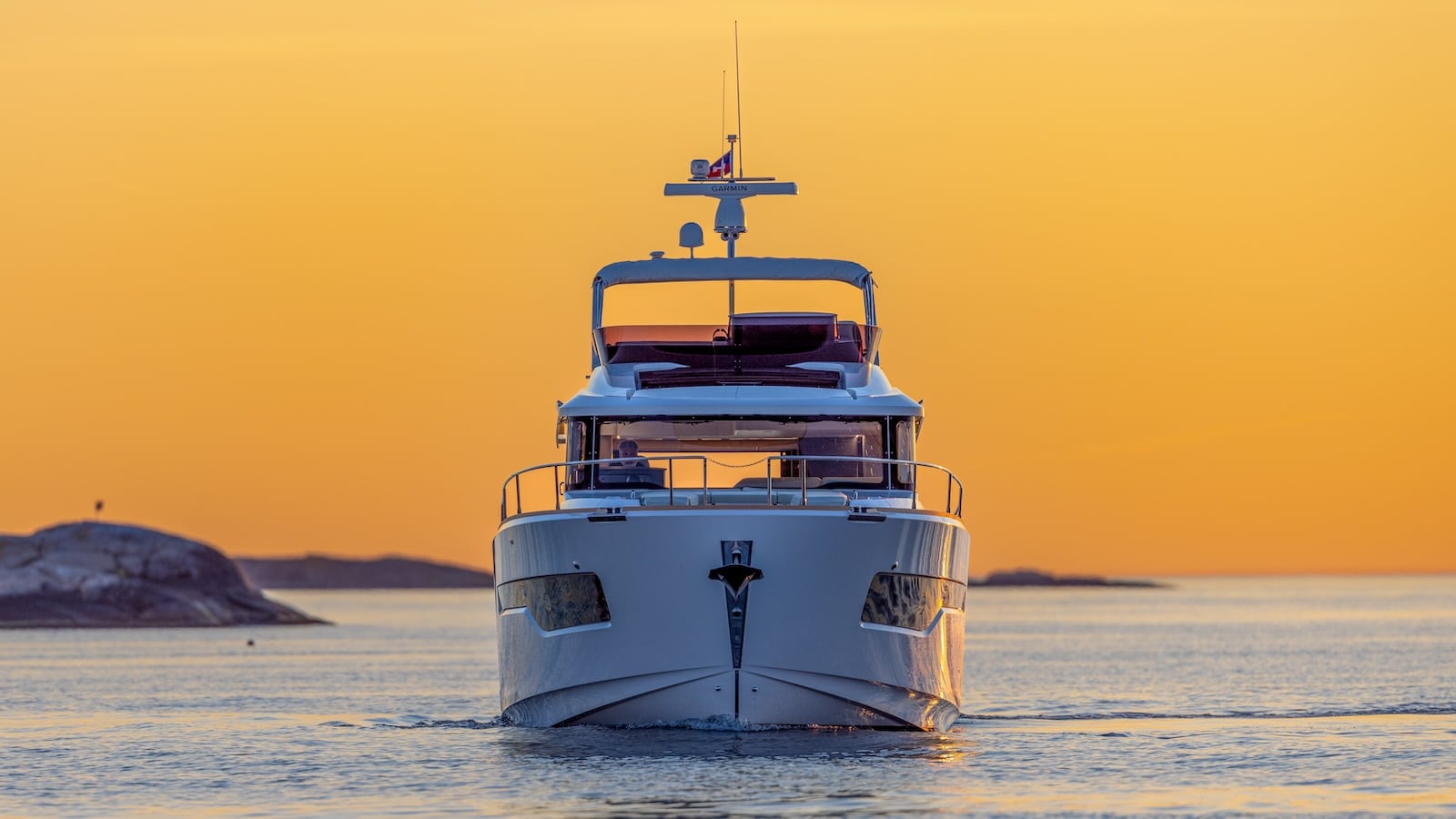
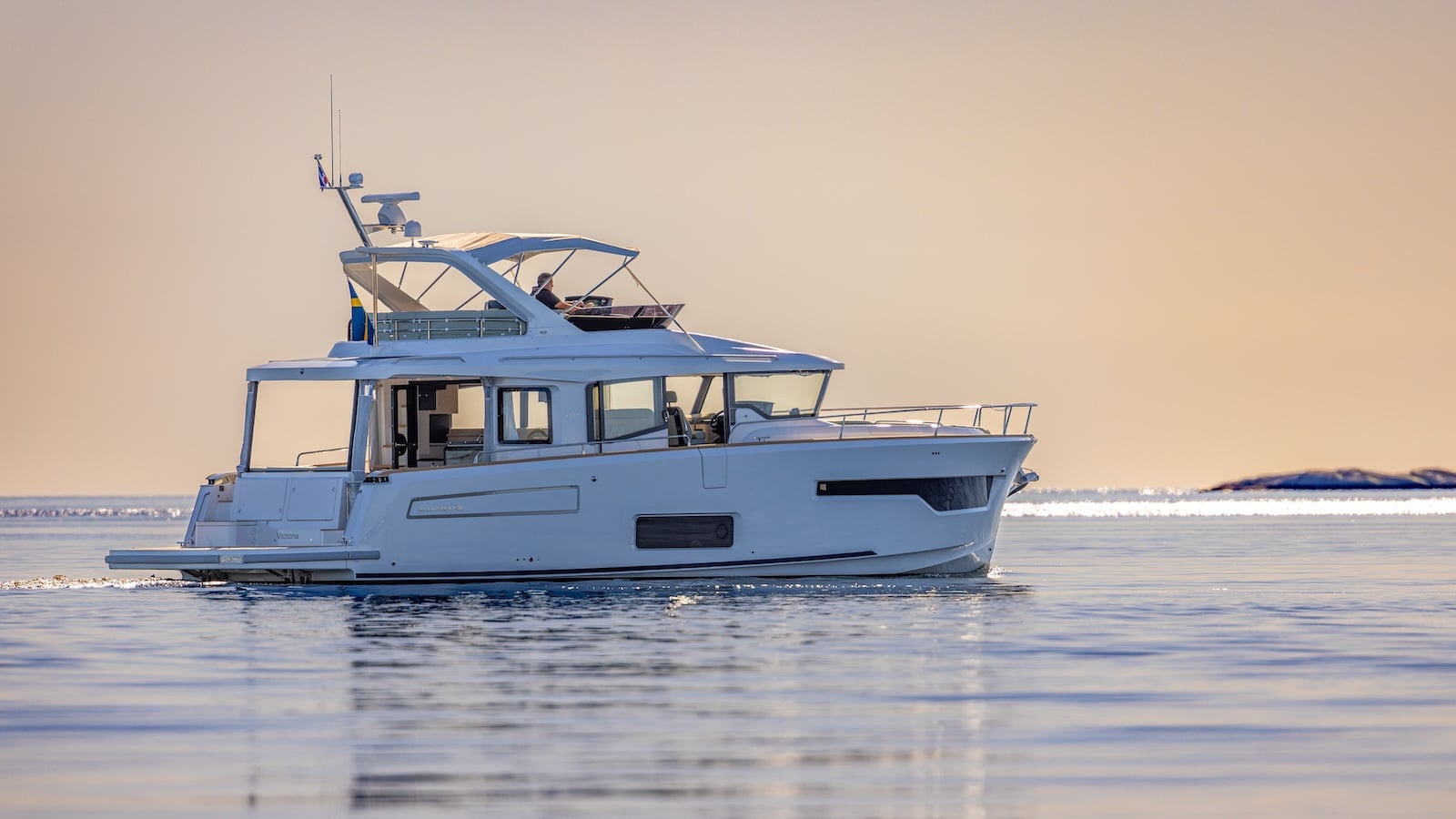
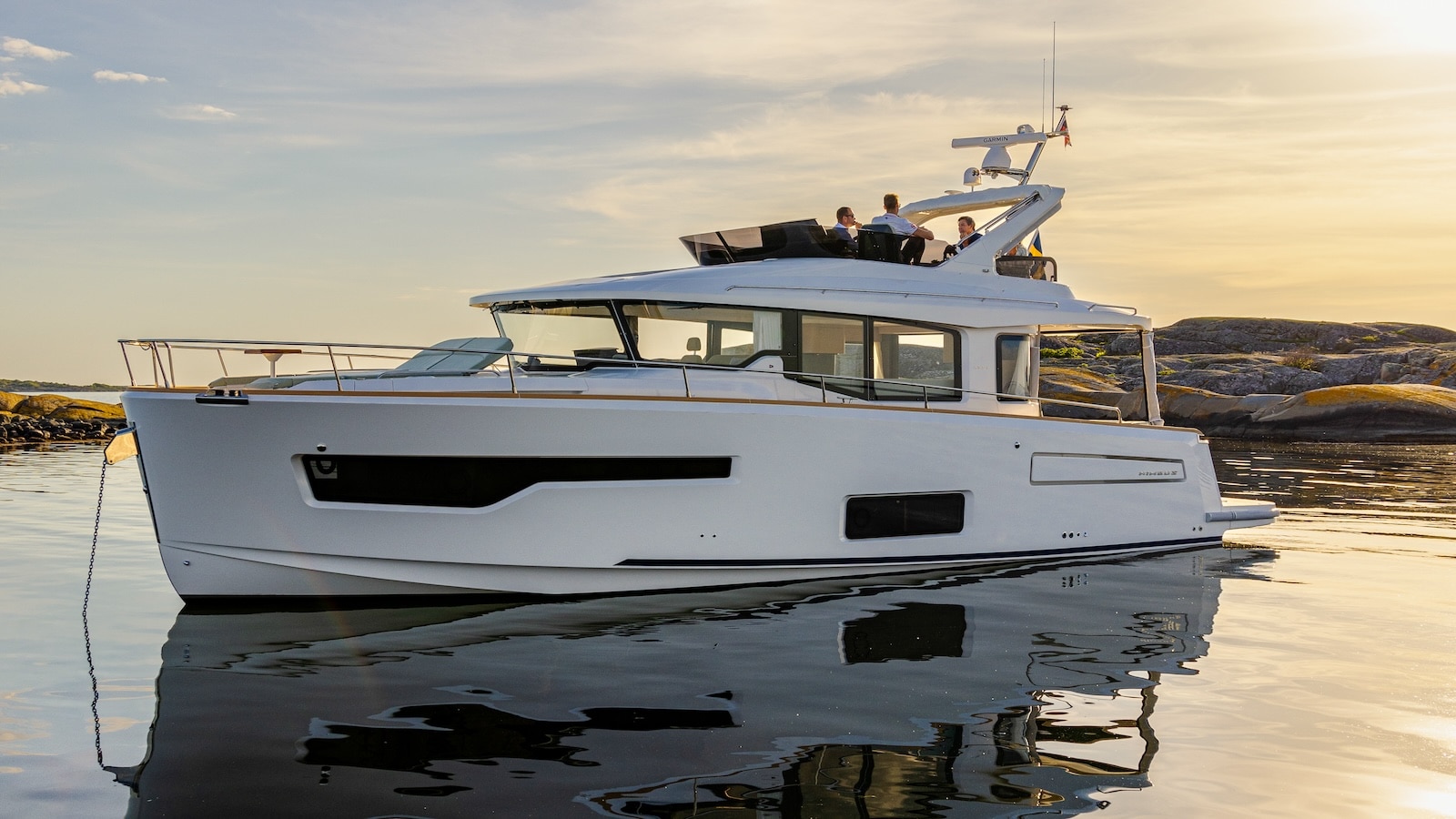
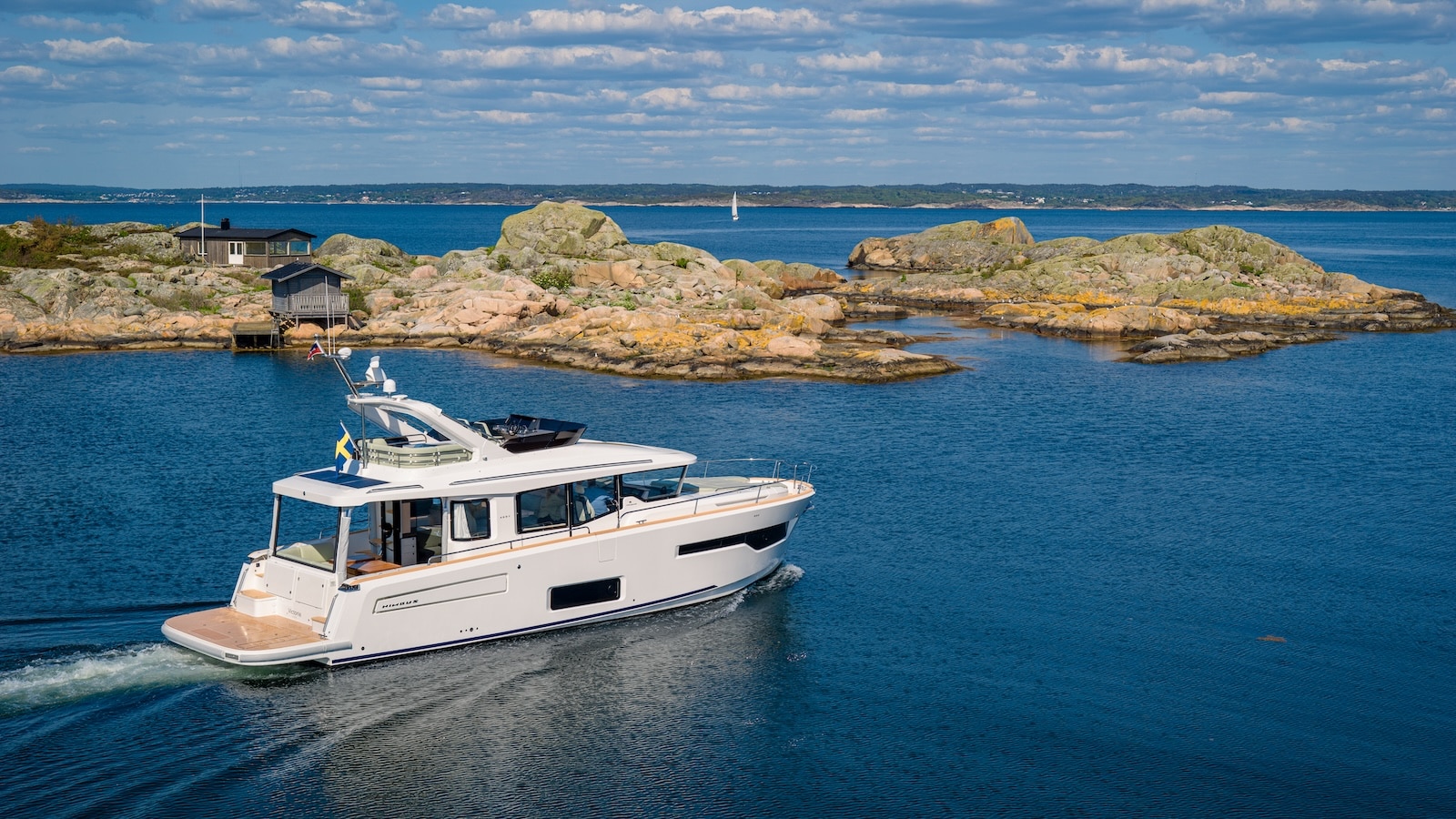
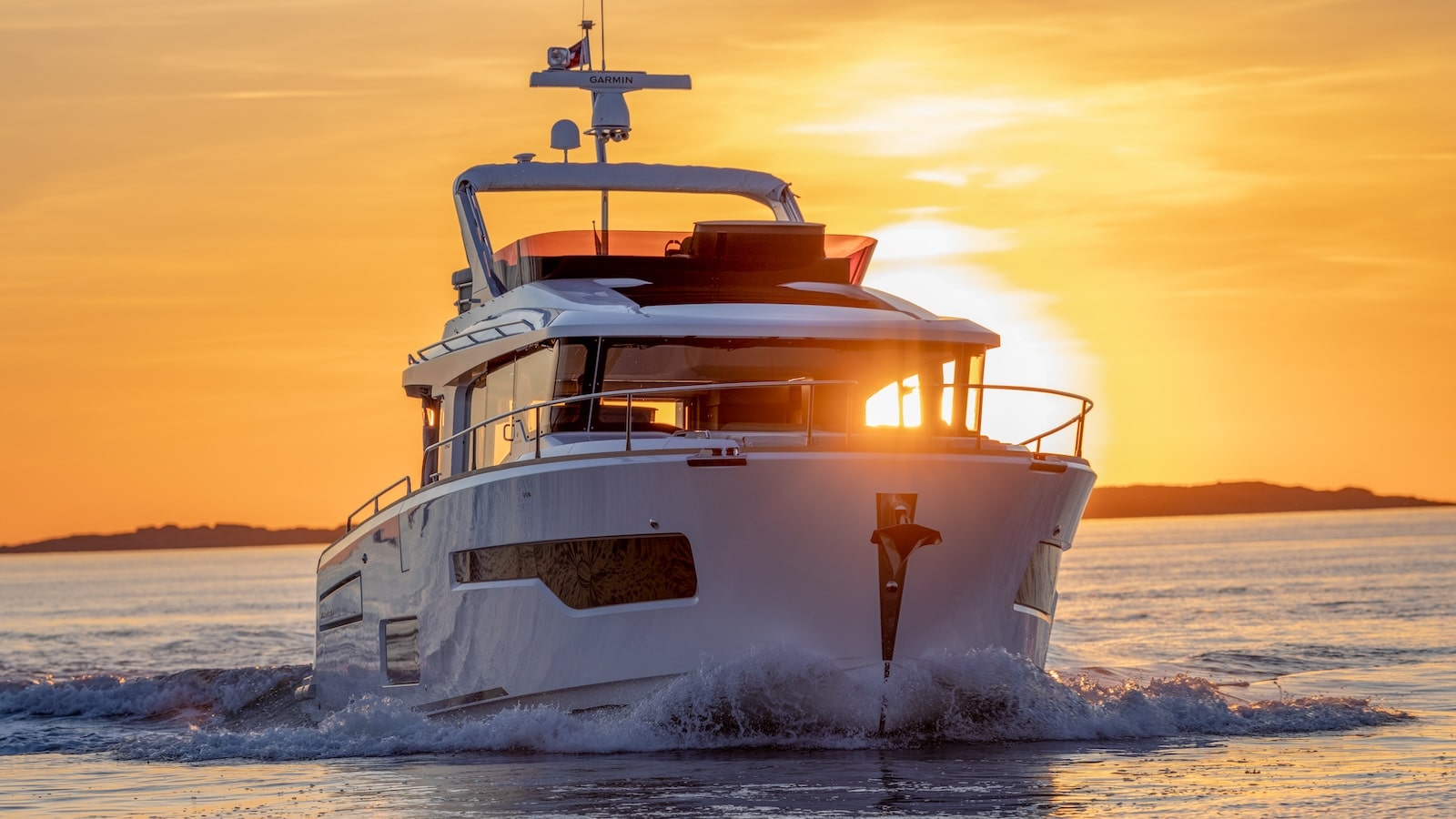
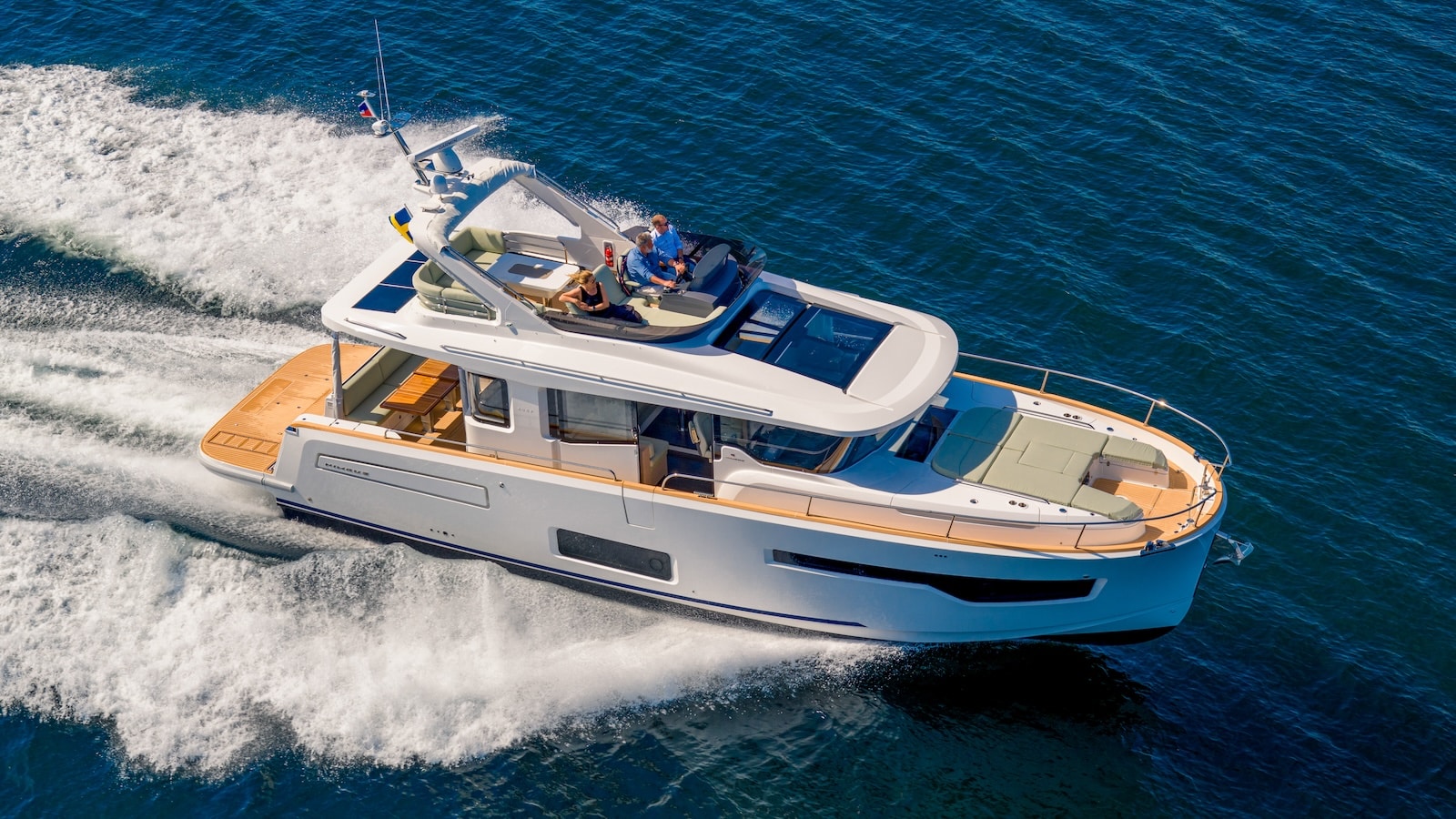
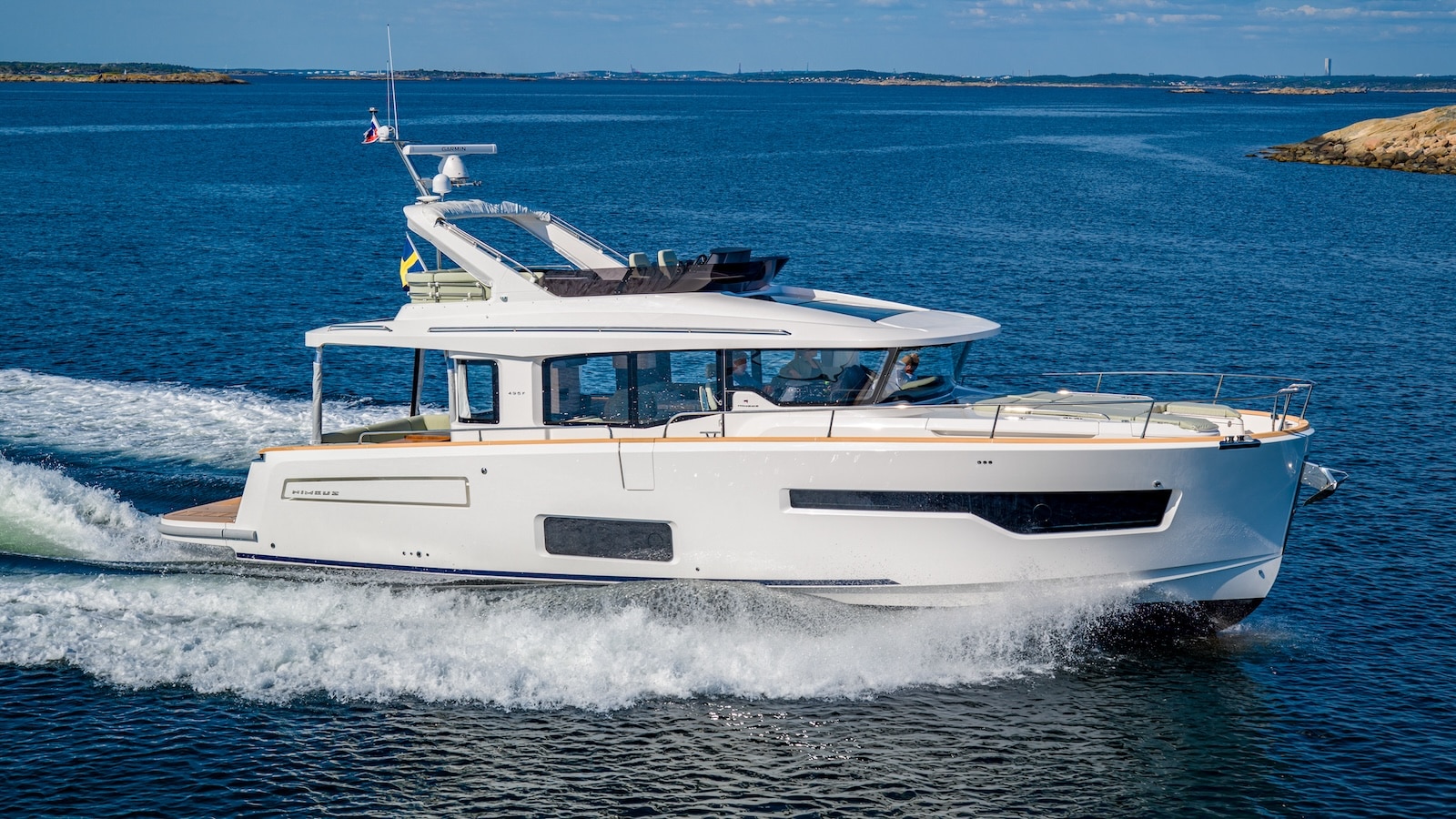
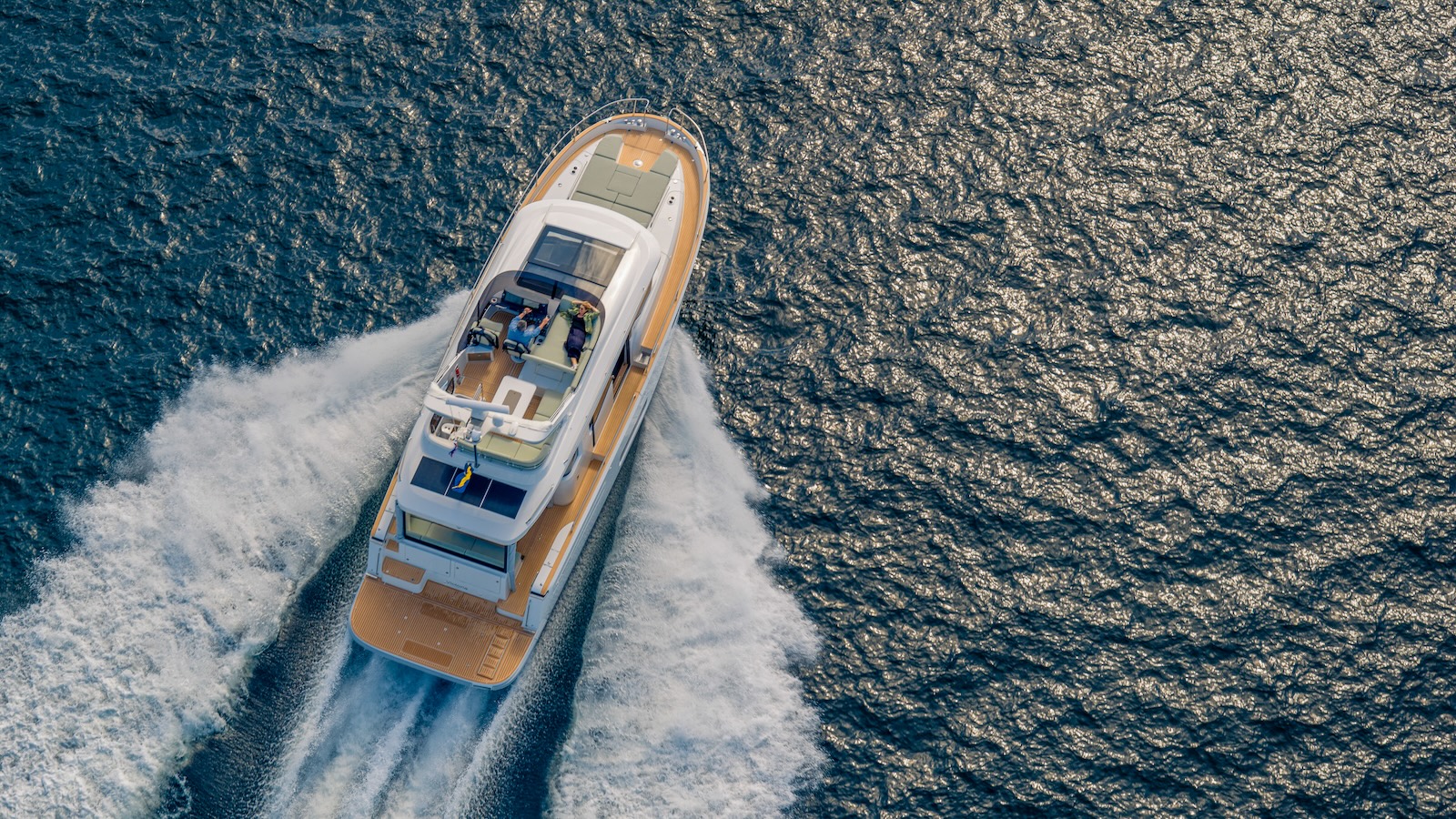
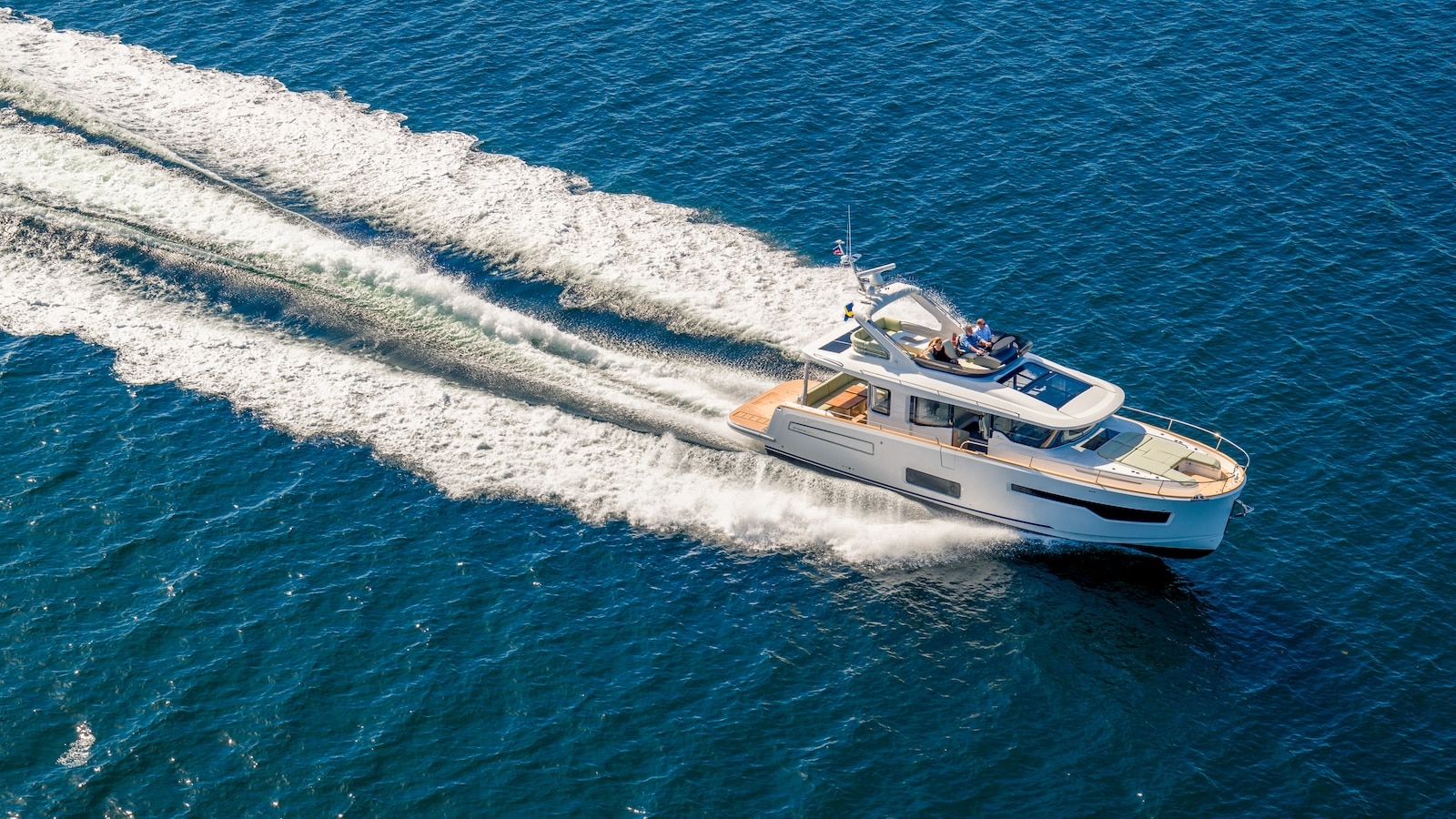
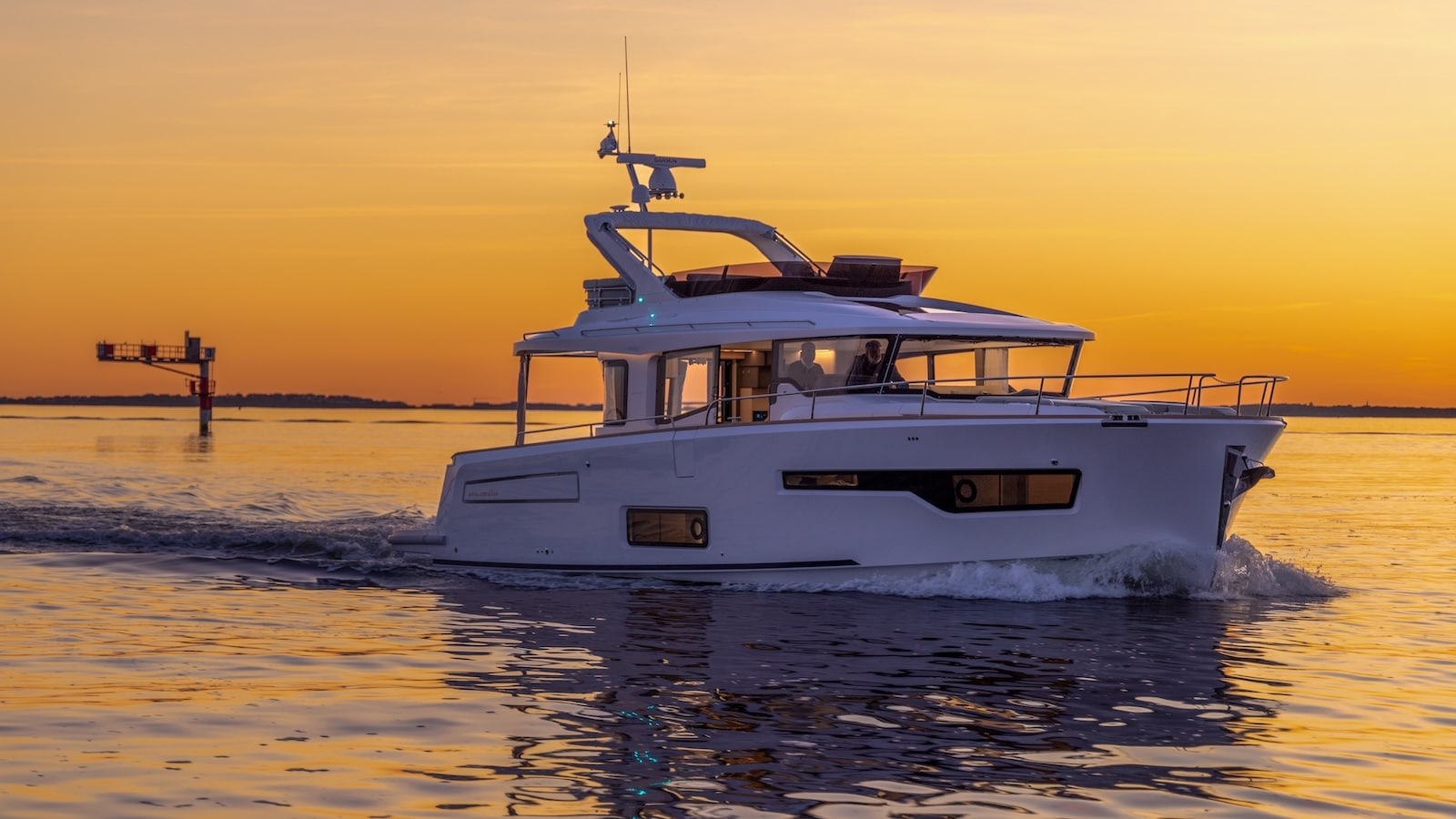
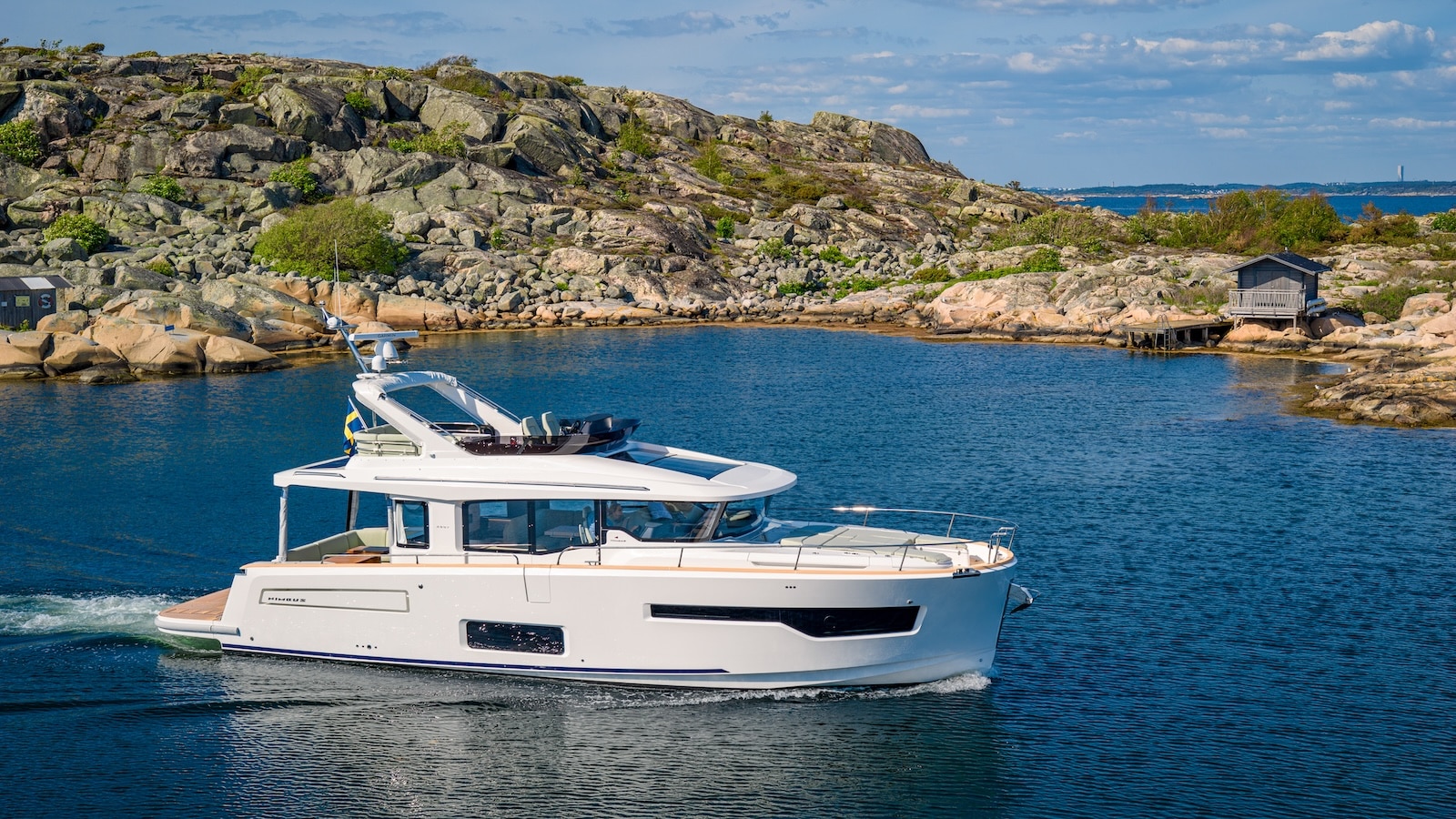
Intrigued by this behavior, I try again, searching for waves generated by passing boats. I find a particularly large one and pass no more than twenty meters from the stern, crossing a steep, nasty wake. Despite my efforts, the result is the same as before. Sure, the bow rises, but when it comes down, it re-enters the water very gently—a result as unexpected as it is pleasant. This Nimbus 495 Flybridge has an excellent hull design.
Back at the dock, I test the new “Assisted Docking System,” which practically allows anyone to steer this 50-footer with impressive precision and simplicity. When the system is activated, the joystick changes its mode of operation, and if released, it locks the boat in its current position. Giving the joystick a nudge forward, backward, or sideways moves the boat in the desired direction by one foot, or 30 centimeters. Moving it in the desired direction activates the “corridor” function, allowing the boat to advance or reverse in a straight line without the wind causing it to drift. All the usual Volvo joystick functions are, of course, still available, such as lateral translation, rotation, etc.
In practice, I docked 20 centimeters from the quay, released the joystick, and without even securing a line to the dock, despite the side wind, the boat remained immobile. We got on and off multiple times. Docking the new Nimbus 495 Flybridge with this system is as easy as parking a car, making the operation accessible to everyone.
Conclusions
The Nimbus 495 Flybridge is a revolutionary boat, decidedly out of the ordinary. It boasts outstanding seaworthiness and can be used in both summer and winter, or, if you prefer, in the Mediterranean as well as in Alaska. It is a practical boat that offers superior cruising comfort, making it ideal for demanding owners who expect the utmost from their boat, because that is precisely what the Nimbus 495 Flybridge is capable of offering.
Performance
RPM | Speed in knots | Consumption in l/nm | Consumption in l’h | Theoretical Range |
600 | 3.4 | 1.4 | 4.8 | 1214 |
1,000 | 5.7 | 1.4 | 8.0 | 1214 |
1,250 | 6.8 | 1.9 | 12.9 | 895 |
1,500 | 8.1 | 2.5 | 20.3 | 680 |
1,750 | 9.0 | 3.2 | 28.8 | 531 |
2,000 | 9.9 | 4.3 | 42.6 | 395 |
2,250 | 10.7 | 5.4 | 57.8 | 315 |
2,500 | 12.5 | 5.9 | 73.8 | 288 |
2,750 | 15.2 | 5.9 | 89.7 | 288 |
3,000 | 18.6 | 6.1 | 113.5 | 279 |
3,250 | 21.5 | 6.2 | 133.3 | 274 |
3,500 | 24.4 | 6.5 | 158.6 | 262 |
3,750 | 27.8 | 6.9 | 191.8 | 246 |
3,850 | 29.6 | 6.9 | 204.2 | 246 |
Test conditions: calm to slight seas, wind from 10 to 15 knots, 9 people on board, 75% fuel, 60% water.
The new Nimbus 495 Flybridge in detail
The Nimbus 495 Flybridge is a yacht perfectly at home in both the Mediterranean and harsher climates, a fact evident as soon as you step on board. This boat has the unique ability to transform, shifting from a traditional motor yacht to an open yacht that connects with the outdoors when temperatures rise. The slightly set-back flybridge allows for a large sliding roof that, along with the side windows and rear door, disappears at the press of a button, thus eliminating the barriers between interior and exterior spaces.
This functional revolution results in an extraordinary boat capable of satisfying even the most discerning tastes. After all, one look at its construction reveals that we are dealing with the highest levels of quality. The choice of woods, fabrics, and components unequivocally demonstrates that on the Nimbus 495 Flybridge, quality is beyond question.
Exteriors
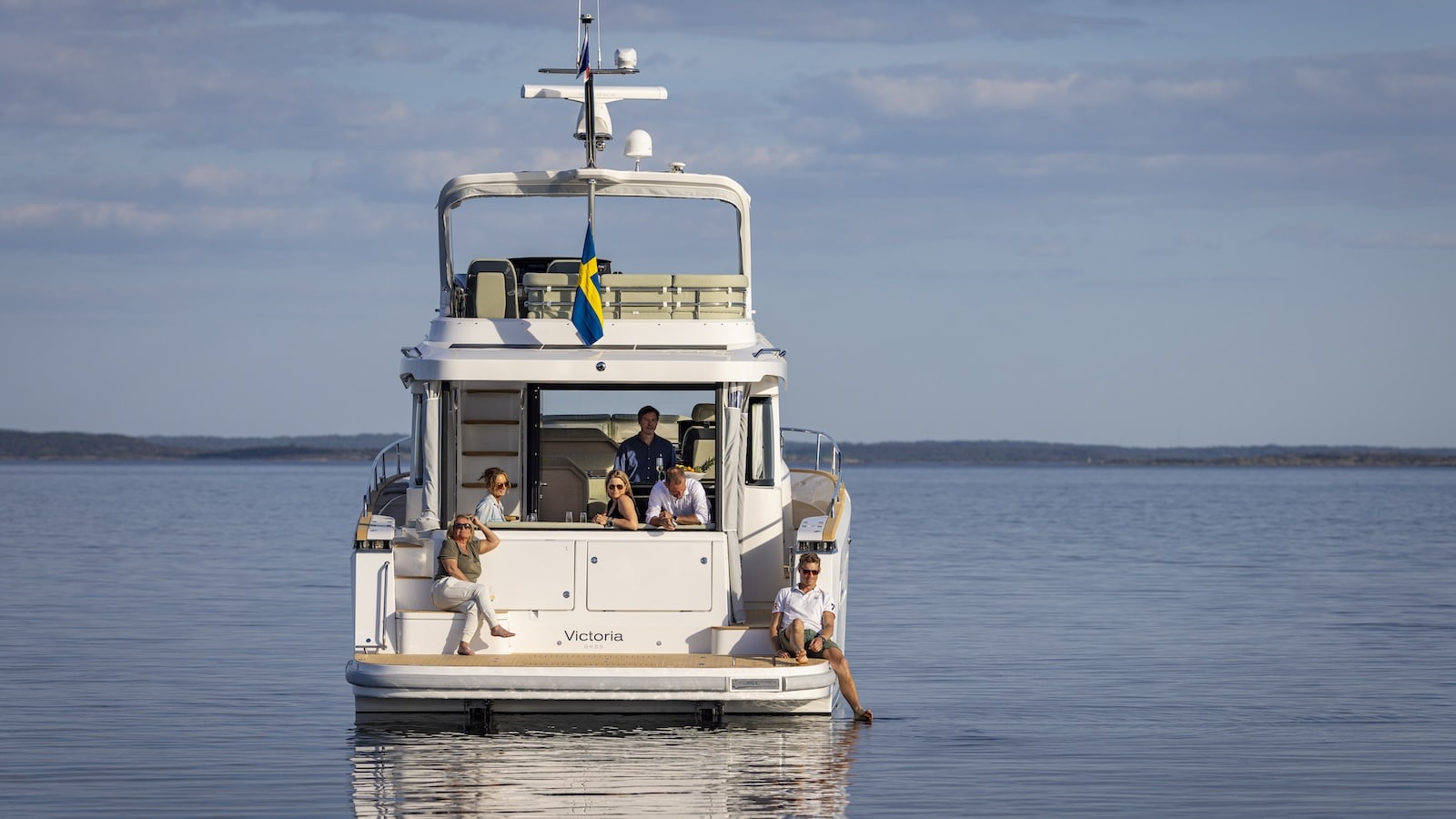
Climbing aboard from the stern, you immediately notice the large submersible platform equipped with retractable steps. This system allows for effortless tender storage and launching, while also providing a spacious beach club area featuring three large storage compartments, perfect for storing all water toys.
Ascending a single step, you enter the exterior dinette of the Nimbus 495 Flybridge, equipped with an L-shaped sofa and a folding table. This area is protected by a large, electrically retractable glass window that disappears when it’s warm. Opposite, a large window opens completely, revealing the kitchen peninsula, which, thanks to two extensions, is perfect for use as a bar.
Convenient side-decks lead to the bow, where there is a large relaxation area centered around a huge sun pad. The latter can accommodate 3-4 people lying down to sunbathe or, thanks to the adjustable backrests, reclining in two enormous chaise longues. At the foot of the sun pad, two opposing sofas can be used for cocktails or relaxation when the central table is mounted, and the entire area can be shaded with a large canopy supported by carbon poles.
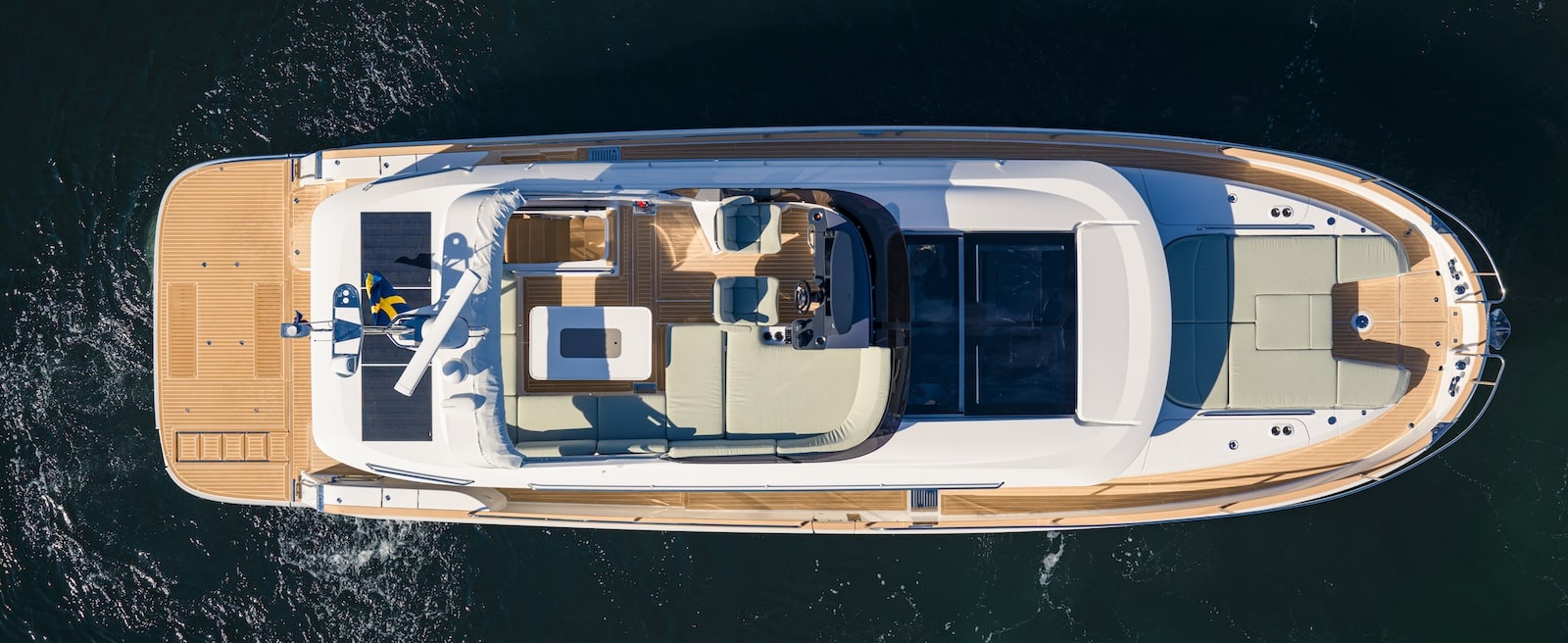
Access to the flybridge is via a staircase on the left side of the aft dinette. Here, you immediately notice the two forward-facing chairs, with the starboard one positioned at the center of the boat and reserved for the captain. From this position, visibility is perfect all around, and with the descending hatch open, the stern of the boat is clearly visible—an important feature during maneuvers.
To the right of the helm seat is a large sun pad that extends seamlessly towards the stern, connecting to a large U-shaped sofa that can accommodate 5-6 guests around the central table. A large awning can be extended from the roll bar to cover the entire upper deck of the Nimbus 495 Flybridge.
Interiors
The main deck salon is decidedly large and welcoming. Immediately after the galley on the left, there is a U-shaped sofa that, opposite another sofa on the right, accommodates eight people for dining or socializing indoors around the central expandable table. Behind the sofa, a window opens electronically, while opposite, aft of the helm chair, there is a huge hatch that allows the captain to quickly exit during docking maneuvers and provides an invaluable view of the sea to guests seated on the sofa.
Moving further forward, on the left, aligned with the helm chair, there is a third sofa equipped with two forward-facing seats and a wonderful chaise longue. Thanks to the slanted windshield, this entire area is covered by a very large retractable roof.
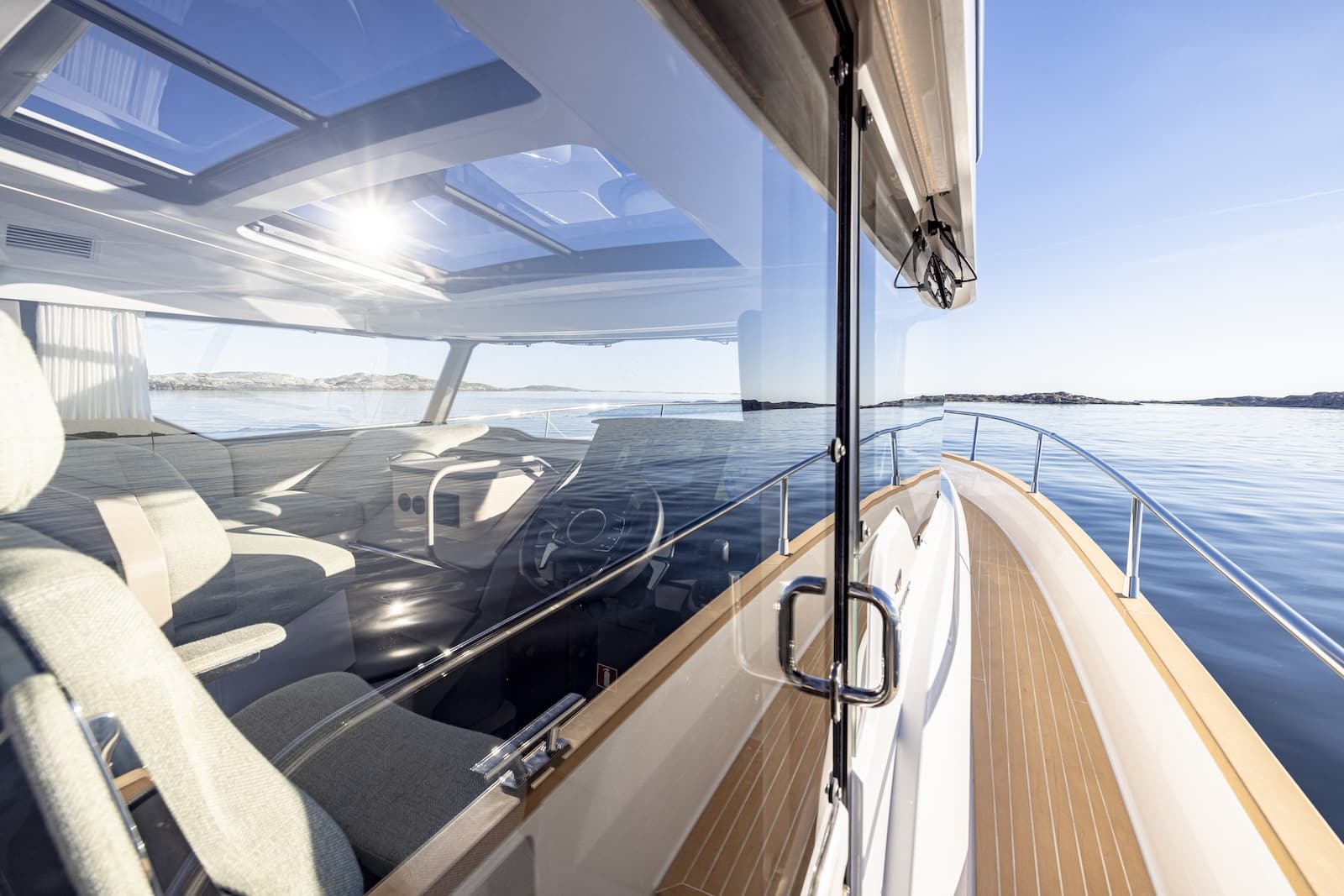
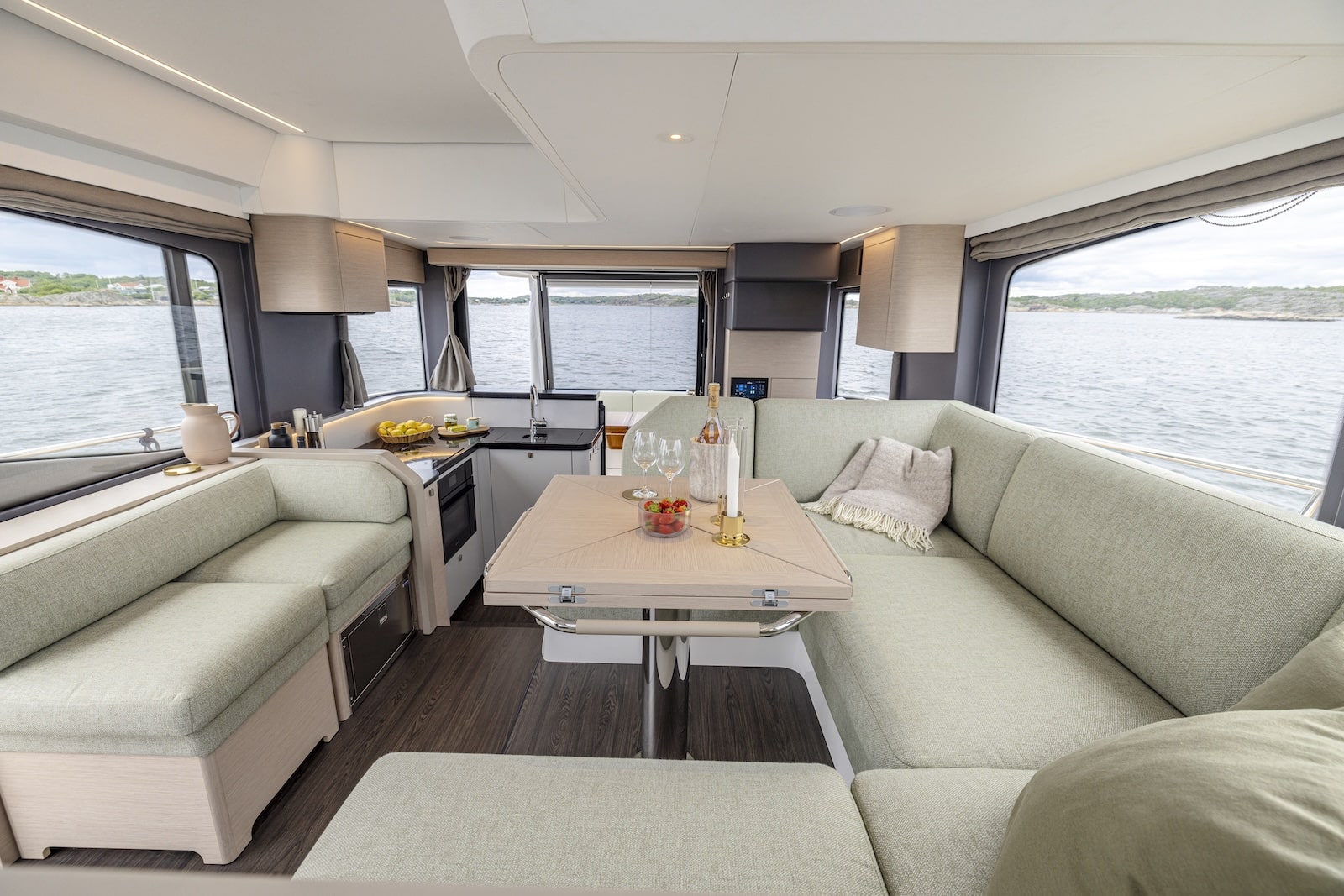
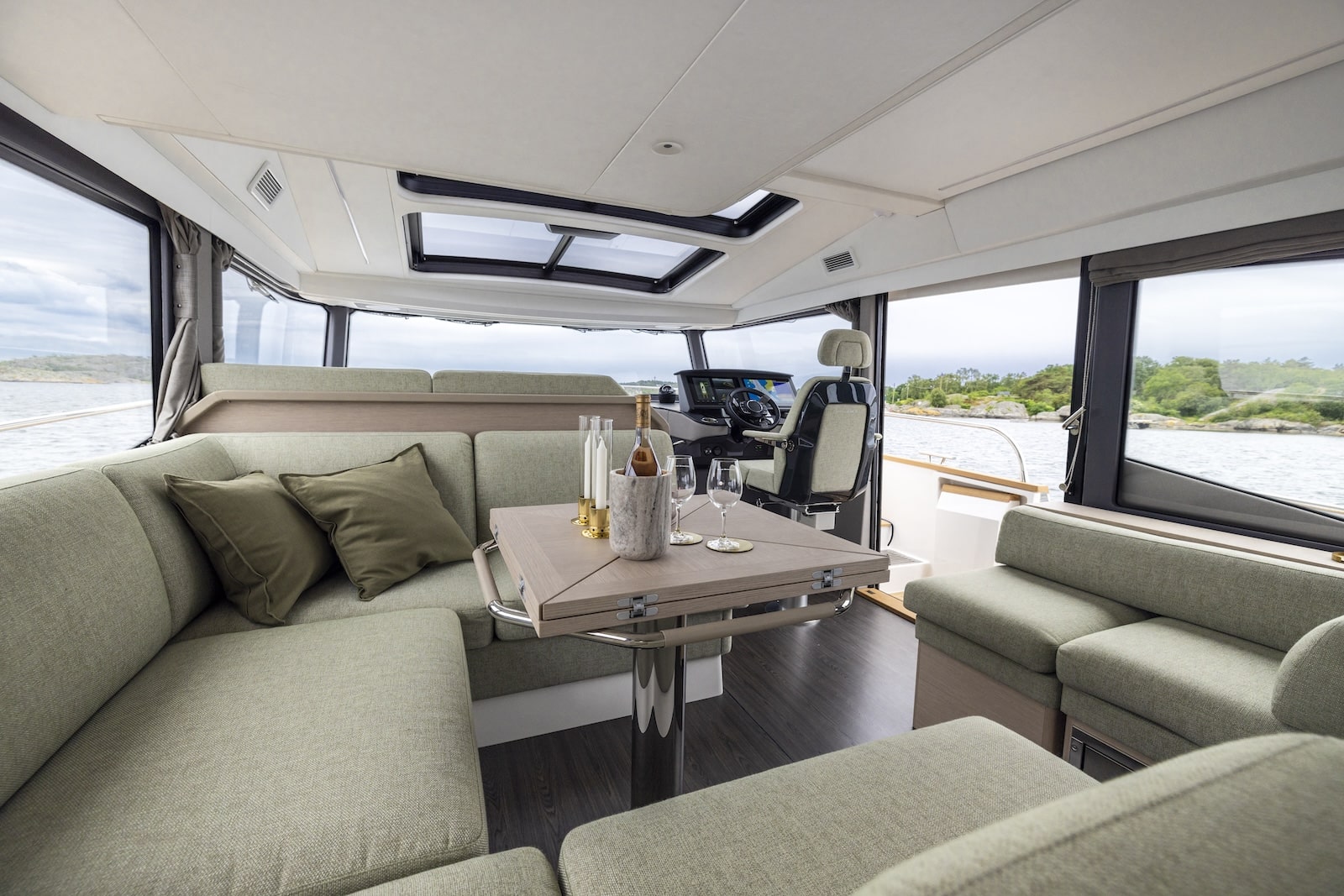
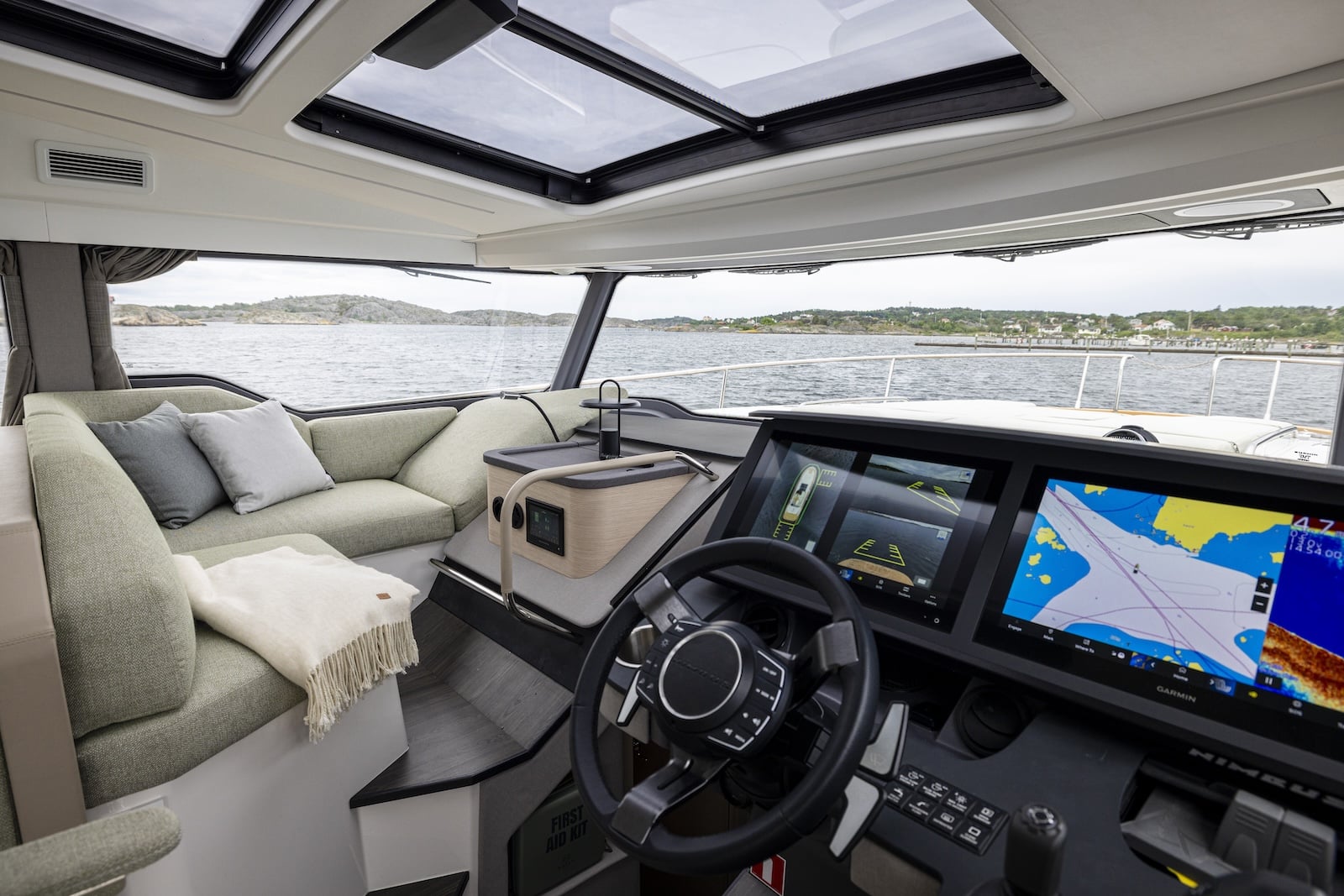
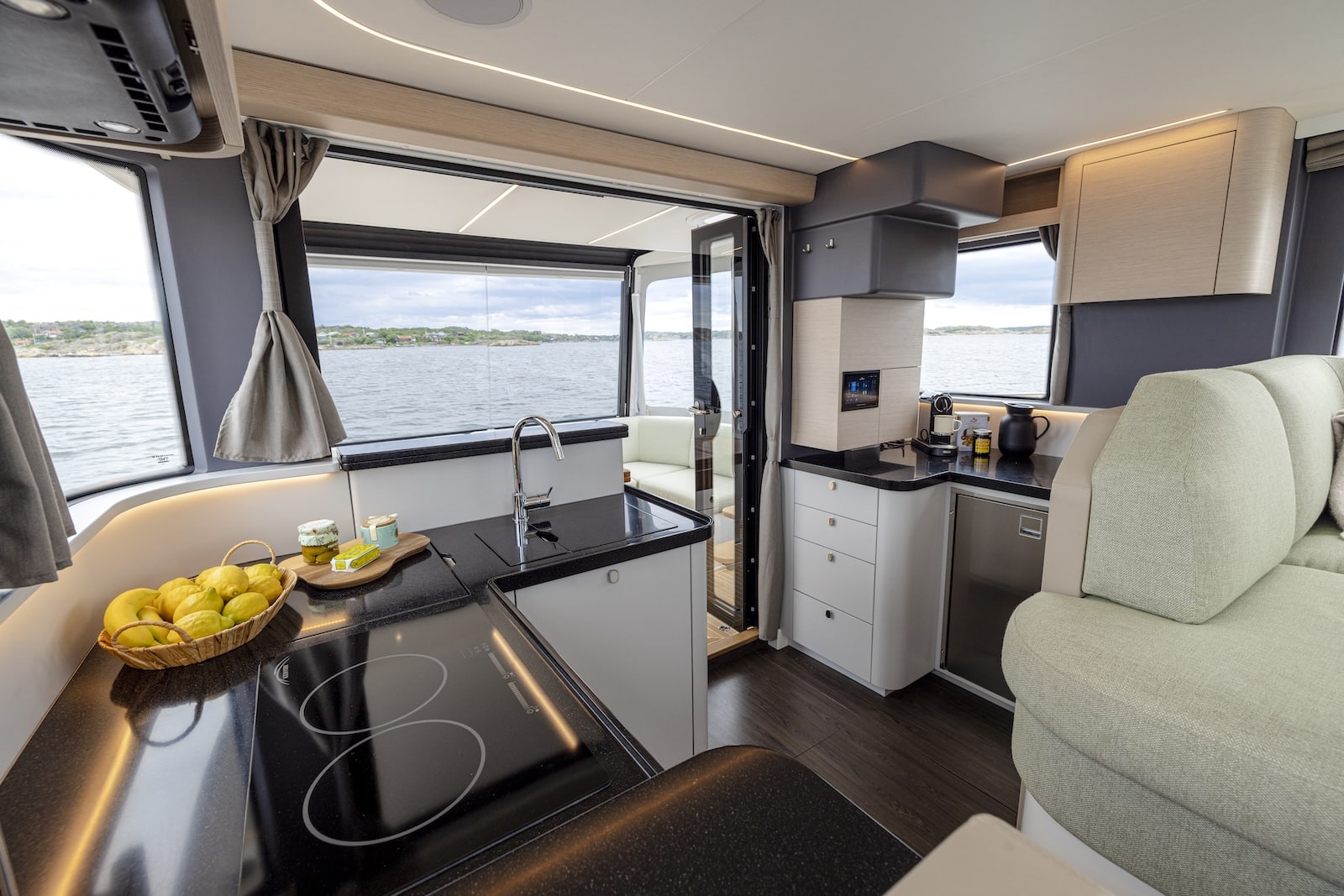

Descending to the lower deck of the Nimbus 495 Flybridge, we immediately find a large bathroom that serves as a day toilet, equipped with a separate shower, and also serves the two guest cabins. To the right, there is a cabin with two bunk beds and ample floor space.
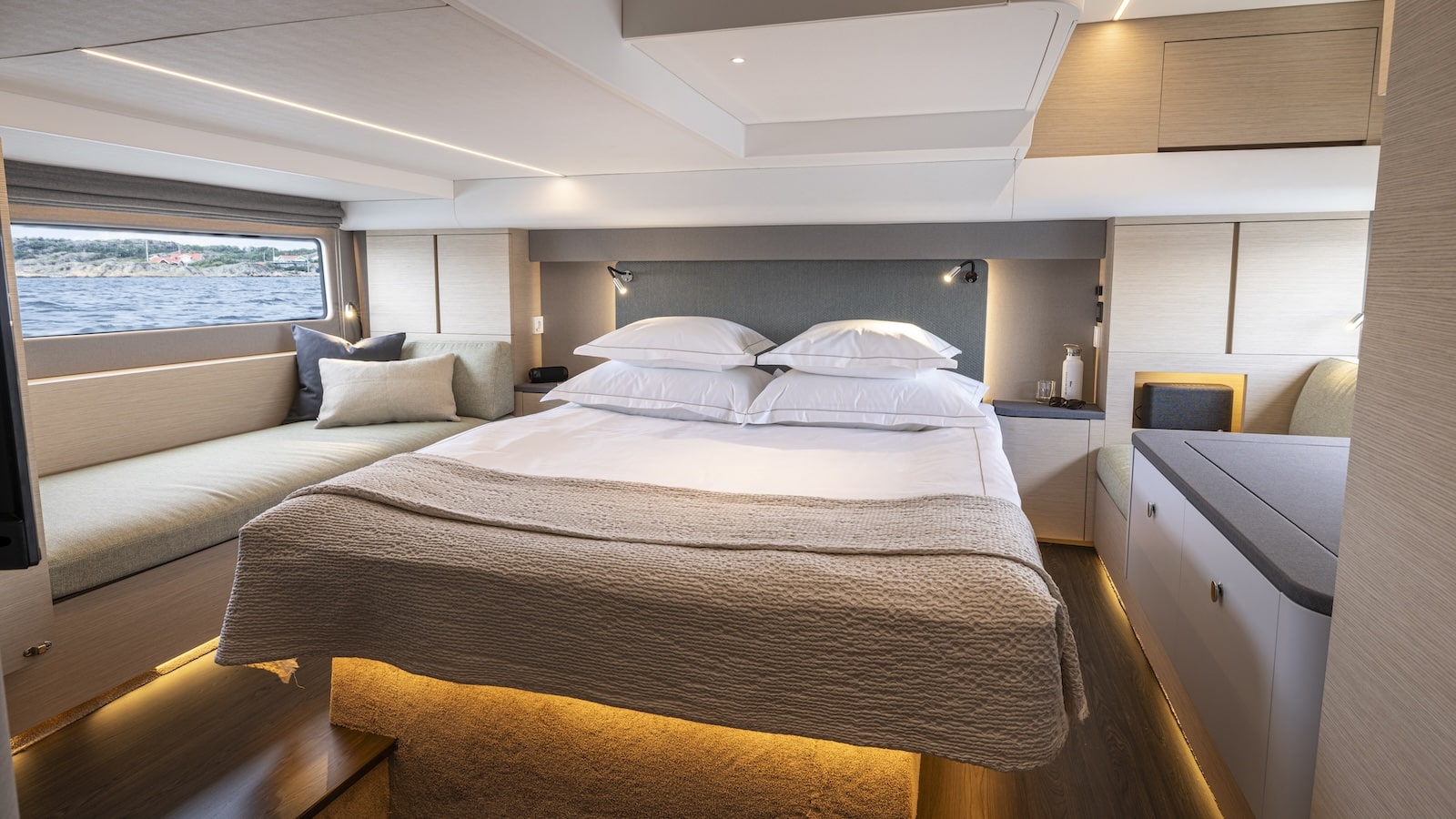
 At the very bow, there is a very spacious VIP cabin with a central queen-size bed, offering panoramic views through two side windows. This area boasts ample storage space under the bed, in two side cabinets, and in two wardrobes.
Accessing the Master Cabin involves passing through the door that separates the owner’s suite. This area, equipped with an en-suite bathroom, exploits the maximum beam of the boat to create a surprisingly spacious environment with generous headroom.
Thanks to clever design, one can easily stand along the entire walkway around the centrally positioned king-size bed, flanked by bedside tables. Upon entering, to the left, there is an exceptionally long and wide sofa that can also serve as an additional berth if needed. To the right, there is a second sofa and a desk/wall unit.
The ceiling heights above the bed are higher than usual, allowing one to sit comfortably on the mattress with plenty of space above the head.
Storage space abounds here as well, so spending extended periods on board won’t be a problem. As you’ve probably gathered, the Nimbus 495 Flybridge is perfectly designed for this purpose.
Nimbus 495 Flybridge: Technical Specs
LOA | 15 m | 49′ 7″ |
LH | 13.7 m | 44′ 8″ |
Max Beam | 4.60 m | 14′ 9″ |
Draft | 1.20 m | 3′ 9″ |
Light Displacement | 14.600 kg | 32 120 lbs |
Normal Displacement | 17,600 kg | 38 720 lbs |
Full displacement | 20,260 kg | 44 572 lbs |
Diesel tank | 1,700 l | 449 US gal |
Water Tank | 520 l | 137 US gal |
Grey Water tank | 340 l | 90 US gal |
Black water tank | 170 l | 45 US gal |
Hot Water Heater Capacity | 80 l | 21 US gal |
Start battery 12V | 2 x 95Ah (850 CCA EN) 4 (2+2) | |
Heavy Aux 24V | 4 x 95Ah (850 CCA EN) | |
Aux 12V | 660Ah | |
Engines | 2 x Volvo Penta IPS 650 | |
Category | B/C 10/12 |
The post Nimbus 495 Flybridge, sea trial of an out-of-the-ordinary explorer yacht appeared first on Yachting News.
]]>The post Solemar SX27: 100 miles aboard a mini Maxi-Rib appeared first on Yachting News.
]]>100 miles aboard the new Solemar SX27.
It is difficult to be unimpressed by Solemar’s big comeback. These are legendary inflatables that, starting in the 1980s, literally captivated a loyal audience of owners who chose them for their proven hull qualities and strong cruising-oriented attitude, even for long distance.
You can therefore understand how, as soon as the chance came to me, I climbed aboard the new Solemar SX27 to make a long transfer, which gave me a chance to test it thoroughly.
New Solemar SX27 Sea Trial
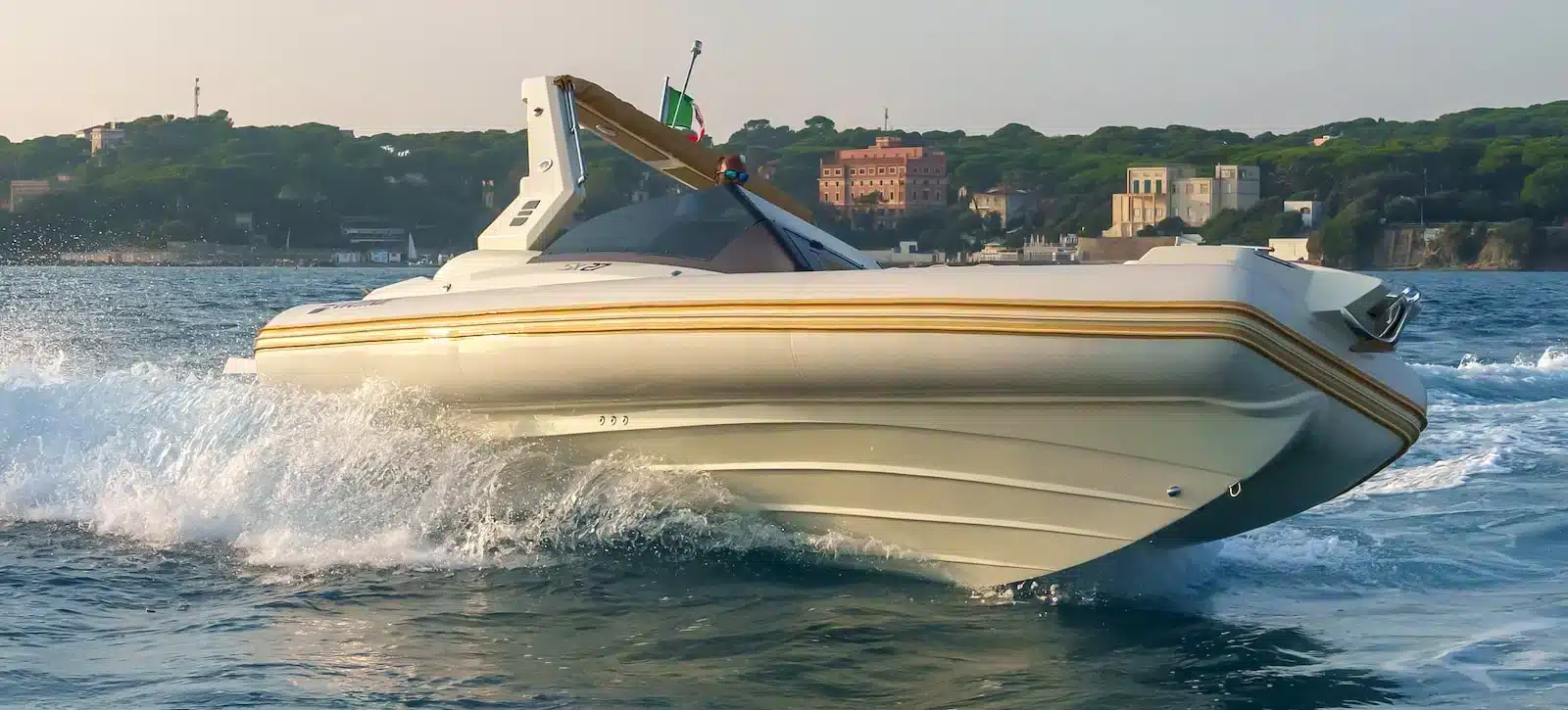
The clamor of the Genoa International Boat Show is a distant memory as we enter the basin of the Marina Fiera Genova; it is early in the morning and it is also cold. The Solemar SX27 is waiting for us at her berth and I take the opportunity to observe her hull. The pronounced V-bow and the deadrise angle are as I like them, pronounced, I am not a big fan of flat-hulled inflatables and this is fortunately not the case with this boat. Four skids on each side complete the design of a hull that already suggests to me that we will be navigating on velvet today.
Our destination is the Marina of Cala de Medici, and to get there, we have 90 miles of navigation to travel in variable weather and sea conditions. In the first part the sea will be rough with a tense northern wind, which should diminish after leaving Liguria to give us almost calm seas in the last part of the route.
Our Solemar SX27 is launched, we climb aboard, and, immediately, we turn on the Mercury Verado V8 300, cast off our moorings and leave the harbor. The boat is equipped with two tanks of 140 liters each, and the gauges indicate that we have about 50 percent fuel available so, despite the professed cheapness of Verado V8s, we will have to stop to refuel.
Forecasts were right, and as soon as we leave the harbor, we find a bit of a live-water wave coming in from the port beam. I gradually throttle up and our boat immediately gets up on plane, already at 11/12 knots. I give it a little more throttle, get up to around 25 knots and put the bow on the Portofino promontory. At this speed and in spite of the sea coming in sideways we travel really well, the hull smoothly absorbs roughness and it all translates into great cruising comfort, we are at around 4,000 rpm with a fuel consumption of 1.8 liters per mile.
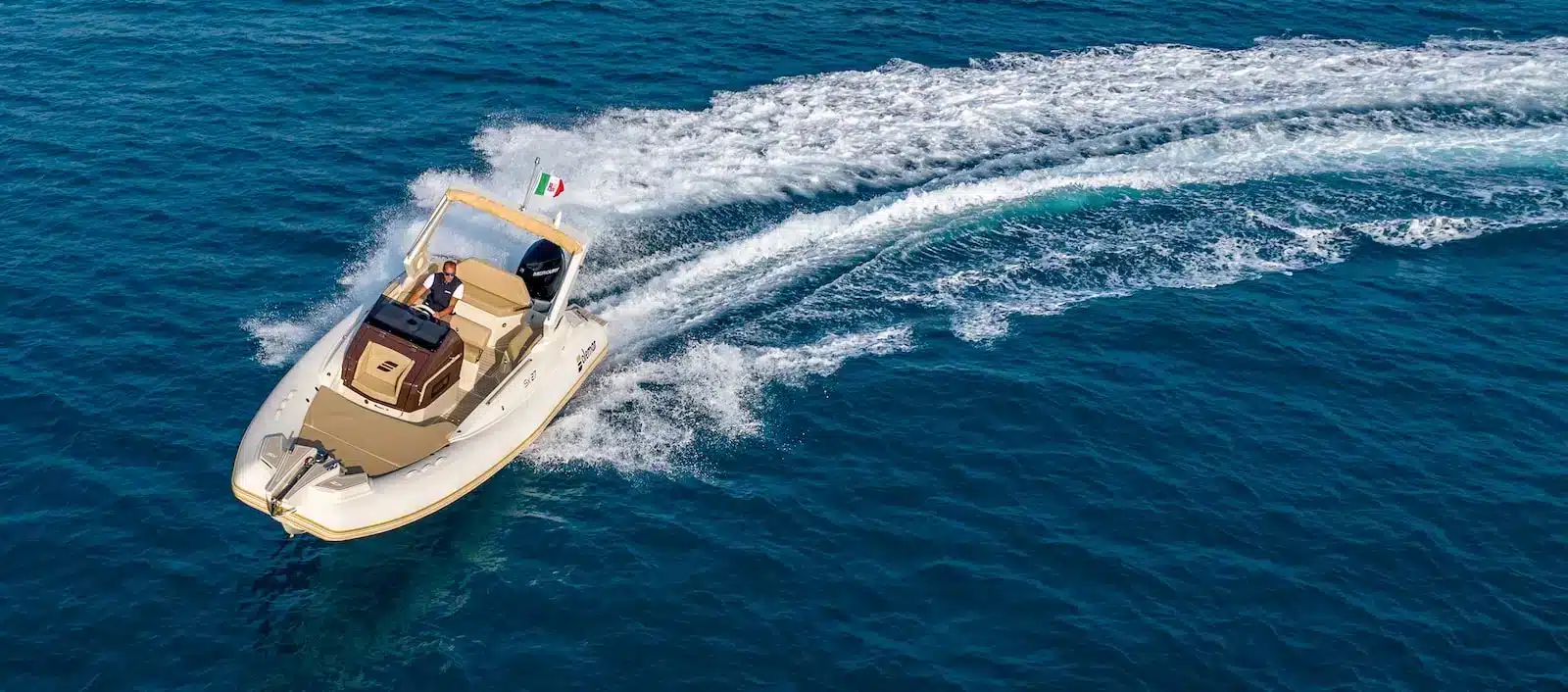
The seaworthiness of this boat, as well as the space available on board, are really very similar to those of a Maxi-Rib, even though the boat is less than 9 meters long. Solemar has not skimped with the fiberglass, gelcoat and finishes, we are certainly aboard a very well-made boat, the total absence of squeaks confirms that.
I throttle up again and bring the speed up to around 30 knots, the Solemar SX27 is still navigating very well so I decide that this will be our cruising speed for the transfer. We are at 4,500 rpm and we are consuming 2 liters of fuel per mile which, given the set-up of this boat and its two tons of weight, seems like a very good result.
Arriving at Punta Chiappa I glimpse a stretch of calmer sea, which seems like the right chance to get into it and test the performance. So, I give full throttle and the boat promptly accelerates, I get to 44 knots in no time then trim up and we record a top speed of 44.8 knots. Really not bad for such an inflatable, it doesn’t need a lot of horsepower to go fast.
I slow down and perform a series of turns, first wide and then increasingly tight, trying to get the boat in trouble but nothing, it just keeps going like it’s on rails. I counter-turn and accelerate but nothing: this Solemar SX27 does not drift and does not tend to widen, the hull is planted in the water and there is no way to find fault with it.
I get back on course, back to 30 knots, and in just under an hour and a half we get to Portovenere. Here we slow down to 5/6 knots and pass under the stunning St. Peter’s Church, probably one of the most photographed places in the world. We stop here to refuel and then set off again.
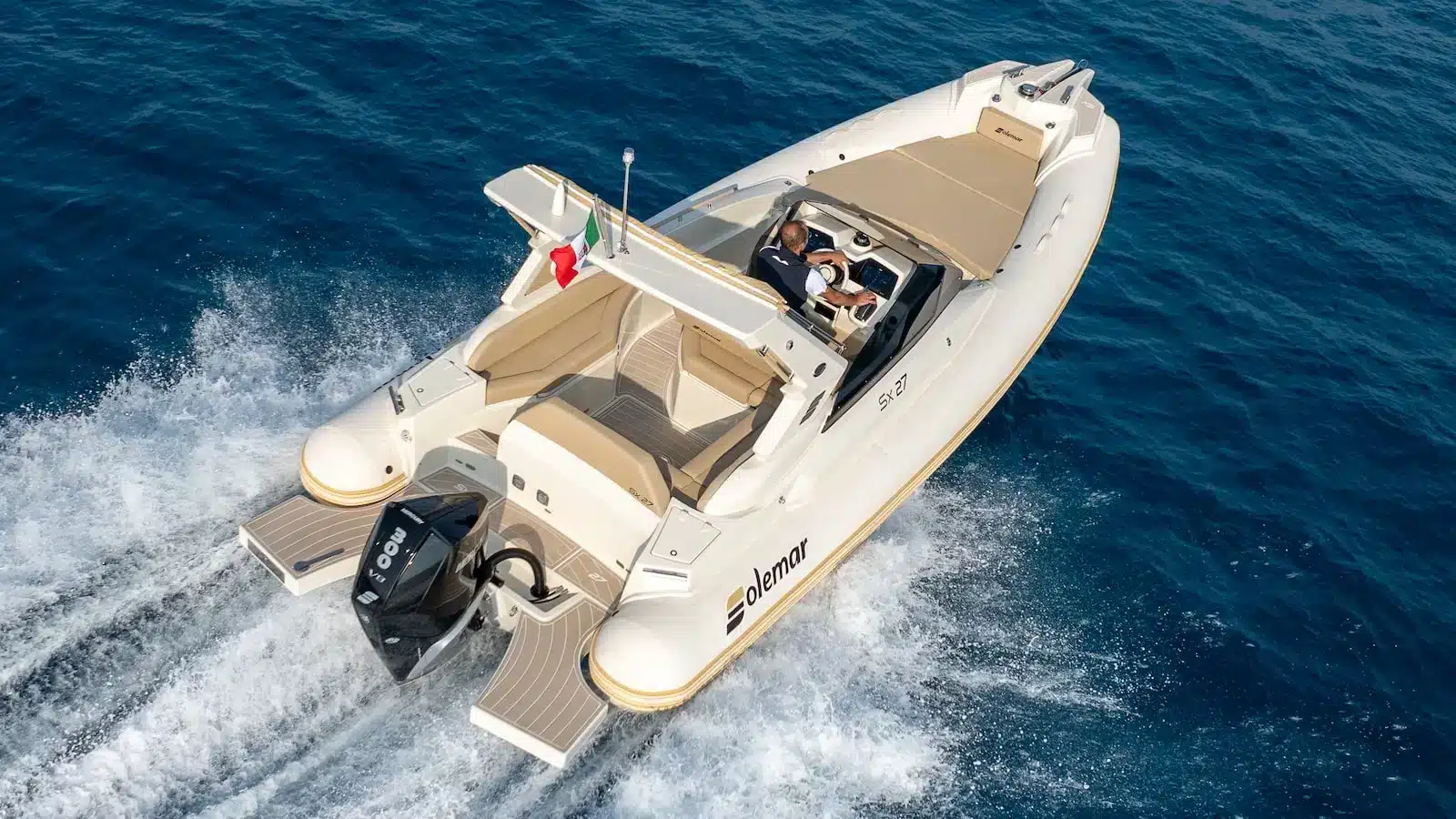
From here on the sea is really calm so I test again the top speed of the Solemar SX27 which, despite a full tank, improves to 45.6 knots.
From here to Livorno we cruise smoothly, always around 30 knots, with a sea that becomes flat and glassy and a sky made gloomy by the moisture. We pass the Secche della Meloria, Castiglioncello and, again in less than an hour and a half, enter Marina di Cala de Medici.
I had a really good cruising time with the Solemar SX27, she is comfortable and goes great. This inflatable boat is certainly the worthy heir to such a prestigious brand.
Test Data
RPM | Speed in kn | Fuel Consumption in l/nm | Fuel Consumption in l/h |
500 | 1.0 | 2.6 | 2.6 |
1,000 | 4.5 | 1.2 | 5.2 |
1,500 | 6.0 | 1.6 | 9.4 |
2,000 | 7.0 | 2.2 | 15.6 |
2,500 | 8.0 | 3.1 | 24.7 |
3,000 | 10.5 | 3.4 | 35.3 |
3,500 | 18.0 | 1.8 | 33.2 |
4,000 | 24.5 | 1.8 | 43.1 |
4,500 | 30.0 | 2.0 | 58.7 |
5,000 | 35.5 | 2.1 | 74.3 |
5,500 | 40.5 | 2.0 | 81.1 |
5,900 | 44.5 | 2.0 | 90.8 |
The Solemar SX27 in detail
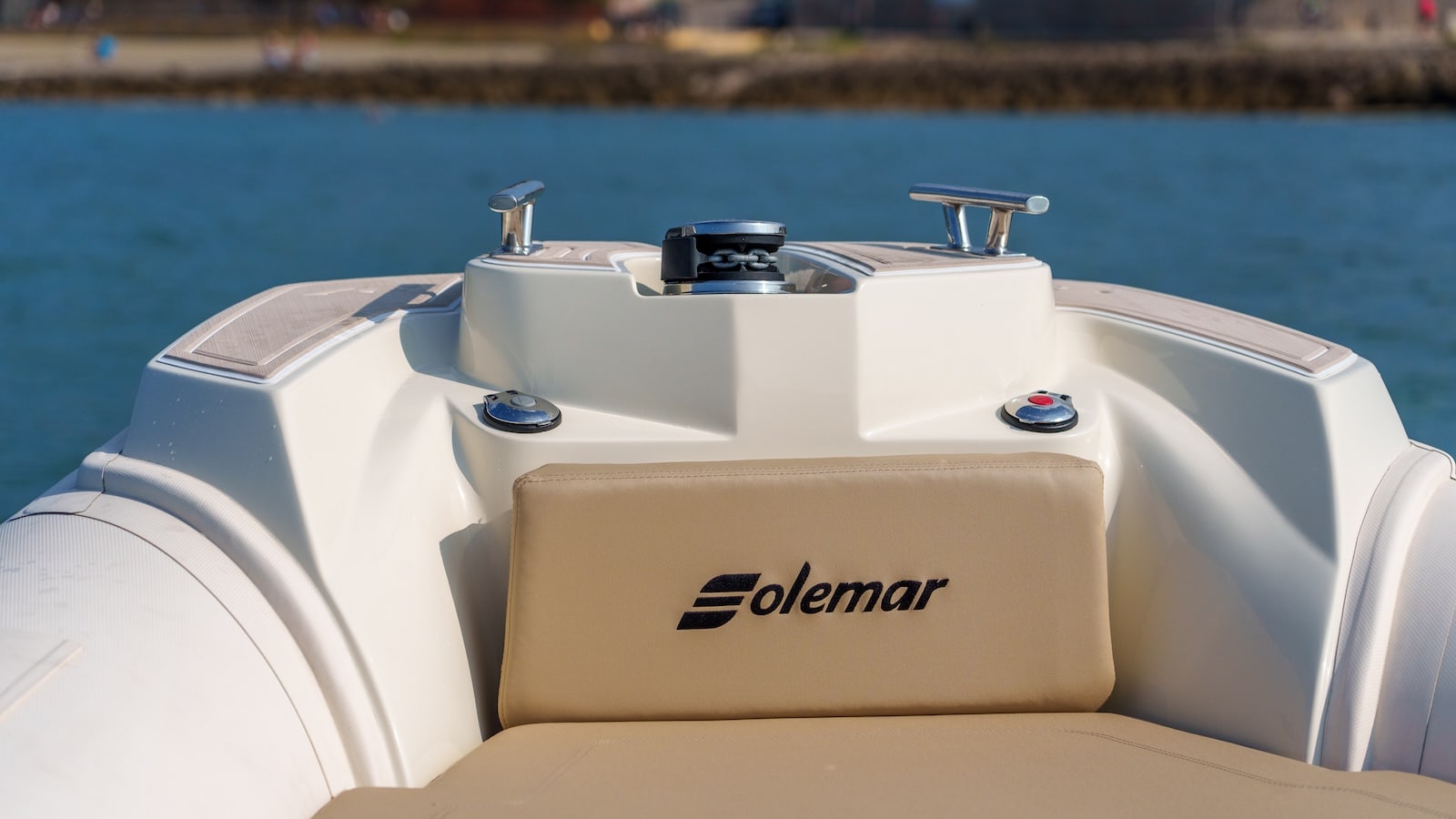
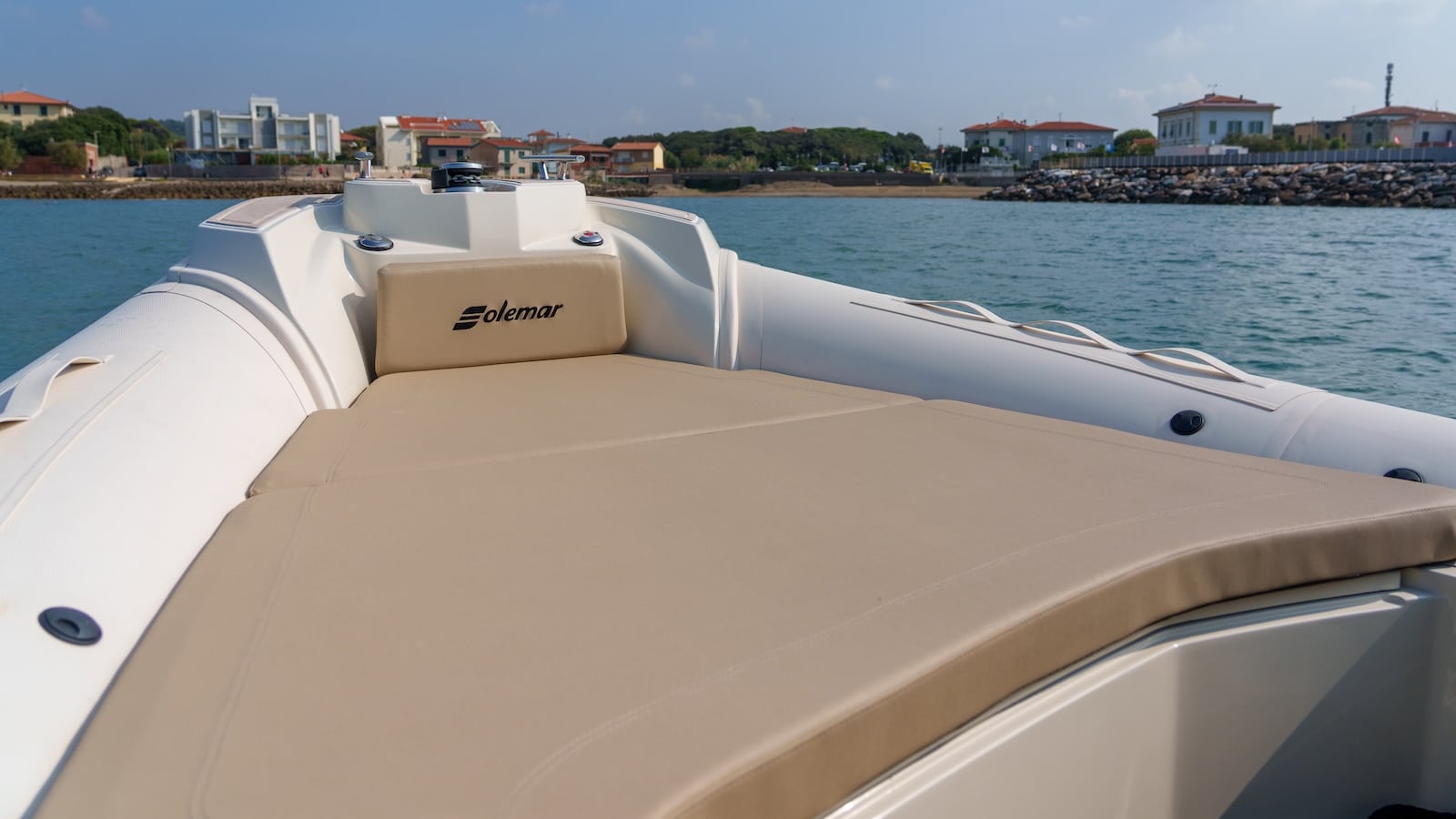
Entry level of this new range of boats, the smallest model in the Solemar family has little to envy its two bigger siblings. Solemar SX27 is really well made, the quality of the materials, gel-coating and finishing are high-end; not surprisingly, I called it a mini Maxi-Rib.
The deck plan is designed with comfort and safety in mind. Climbing aboard from the stern, the platform surrounding the outboard is immediately noticeable; it is shaped and equipped with excellent footing, an indispensable feature for enjoying sea bathing.
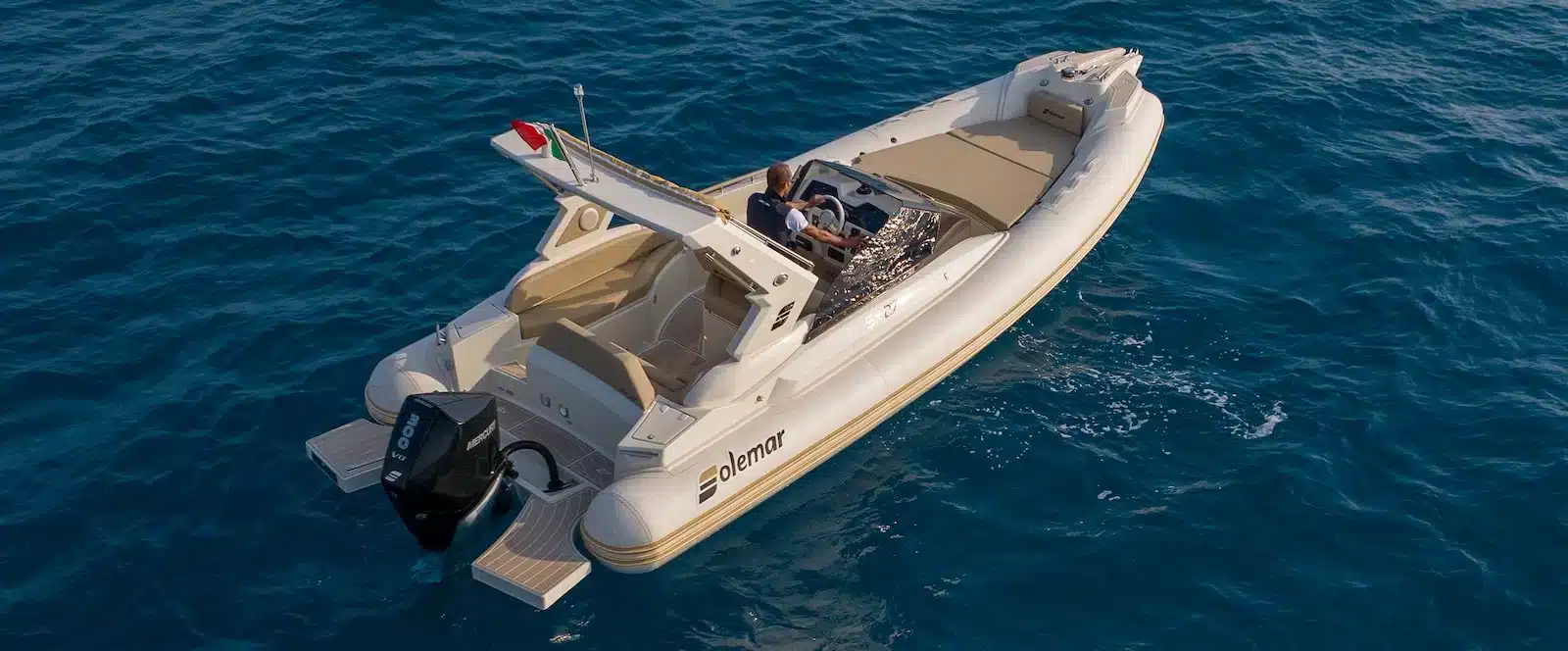
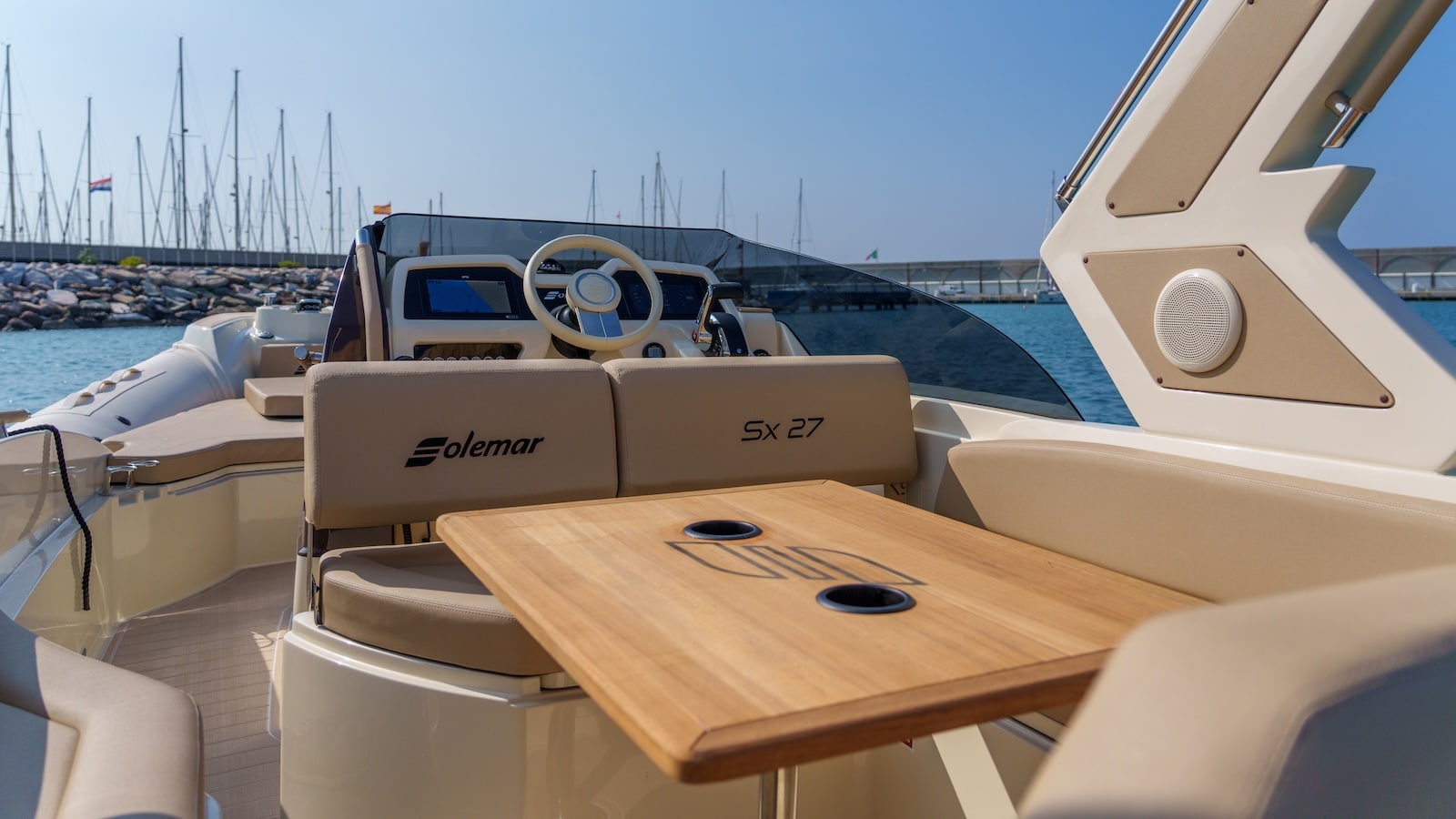
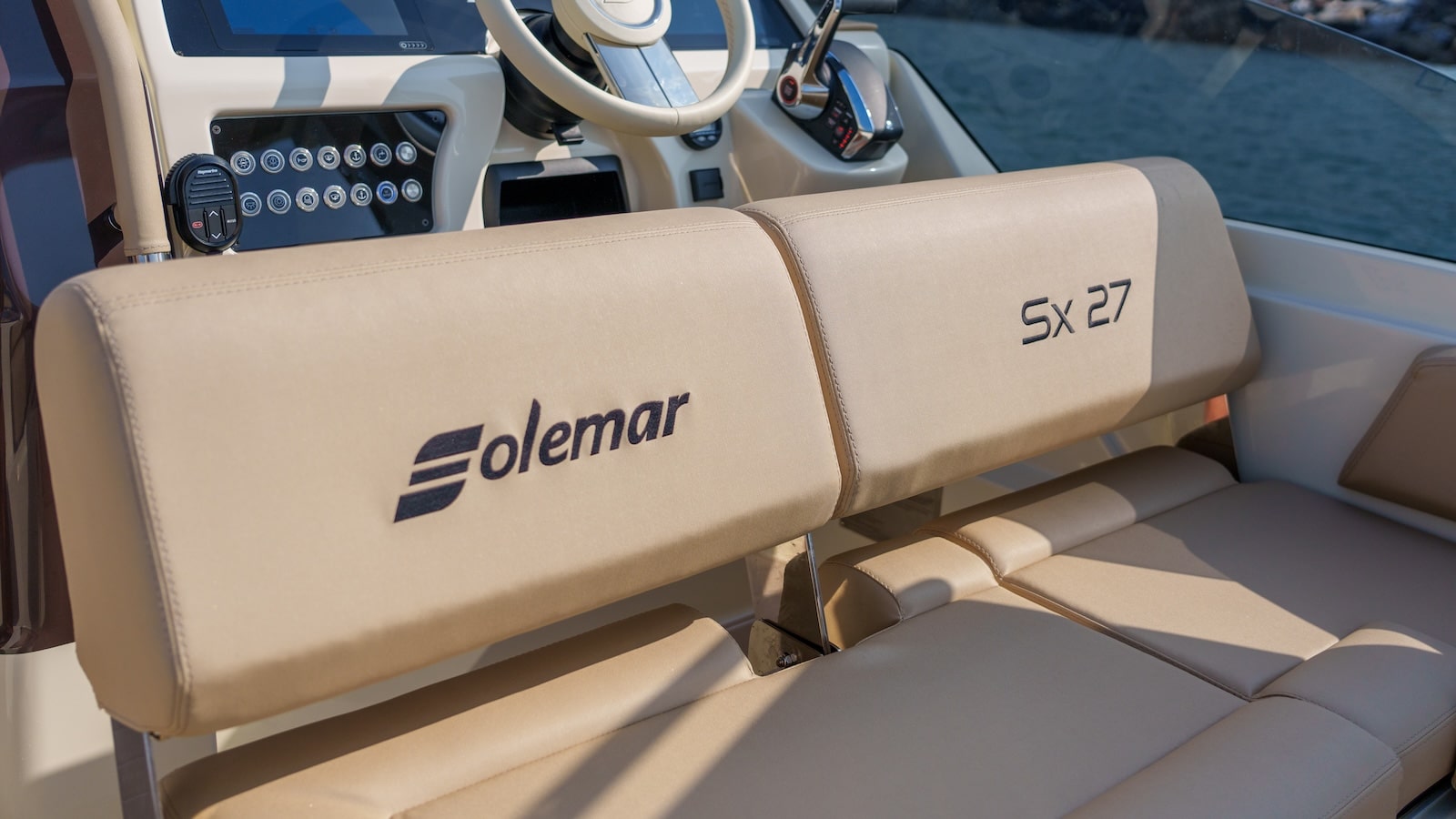
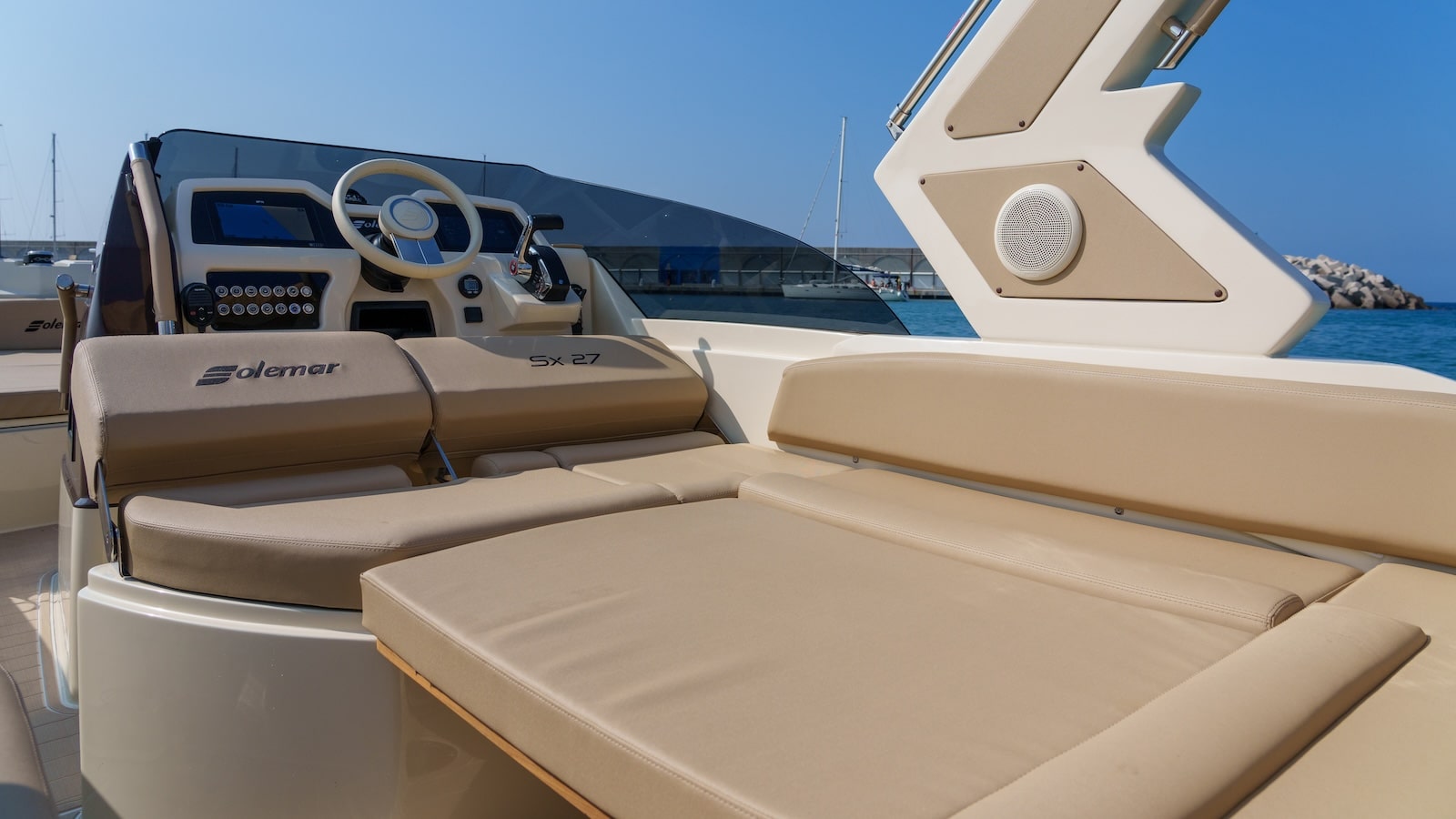
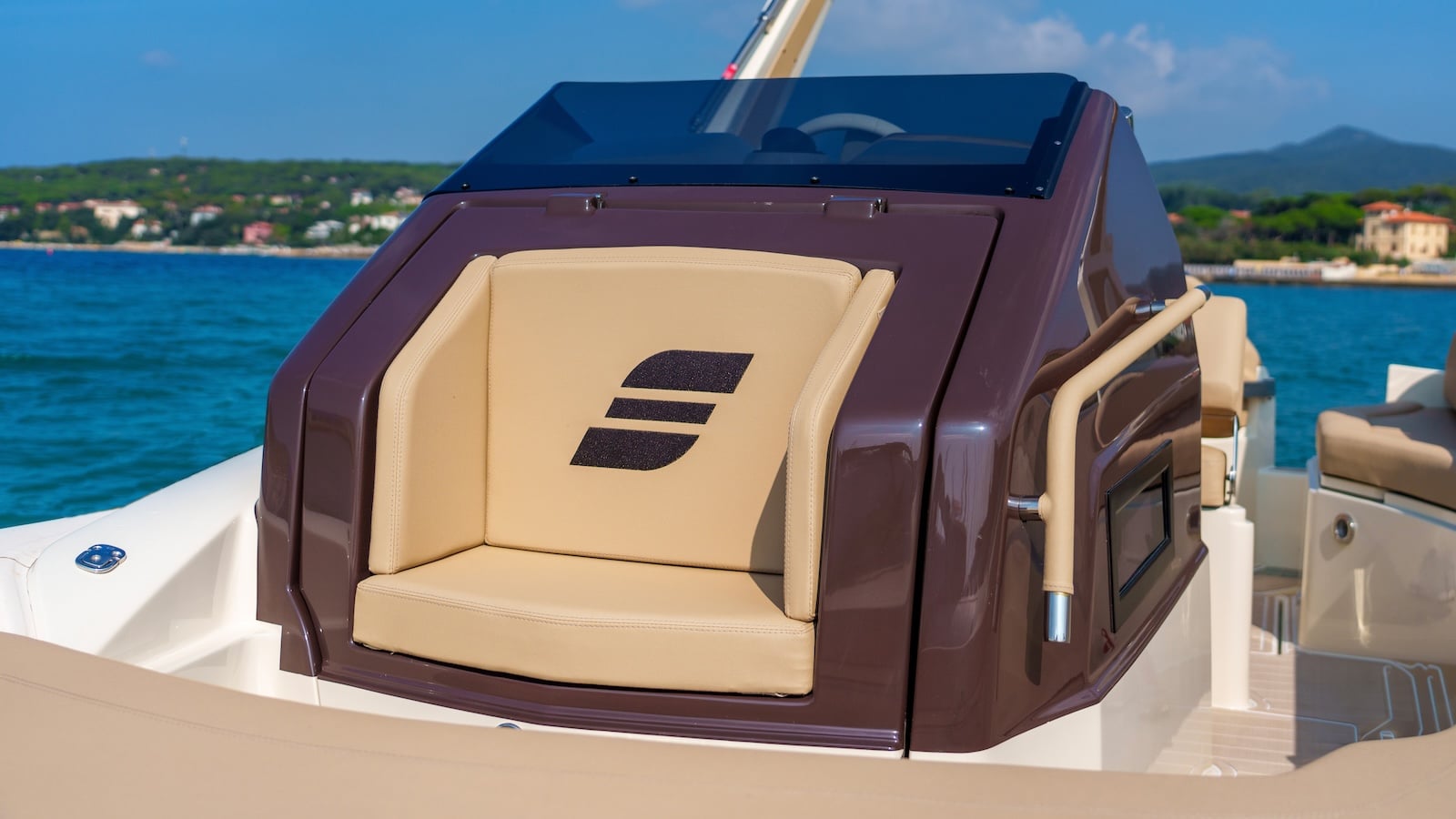
The dinette is cozy and smart; in fact, reclining the driver’s seat creates a lounge area where four sofas allow 7 to 8 people to sit around the table, looking each other in the face, which is uncommon on inflatables of this size. The center table is removable and also allows this area to be converted into a second two-person sundeck, which, another notable feature, leaves the passageway to the bow unobstructed.
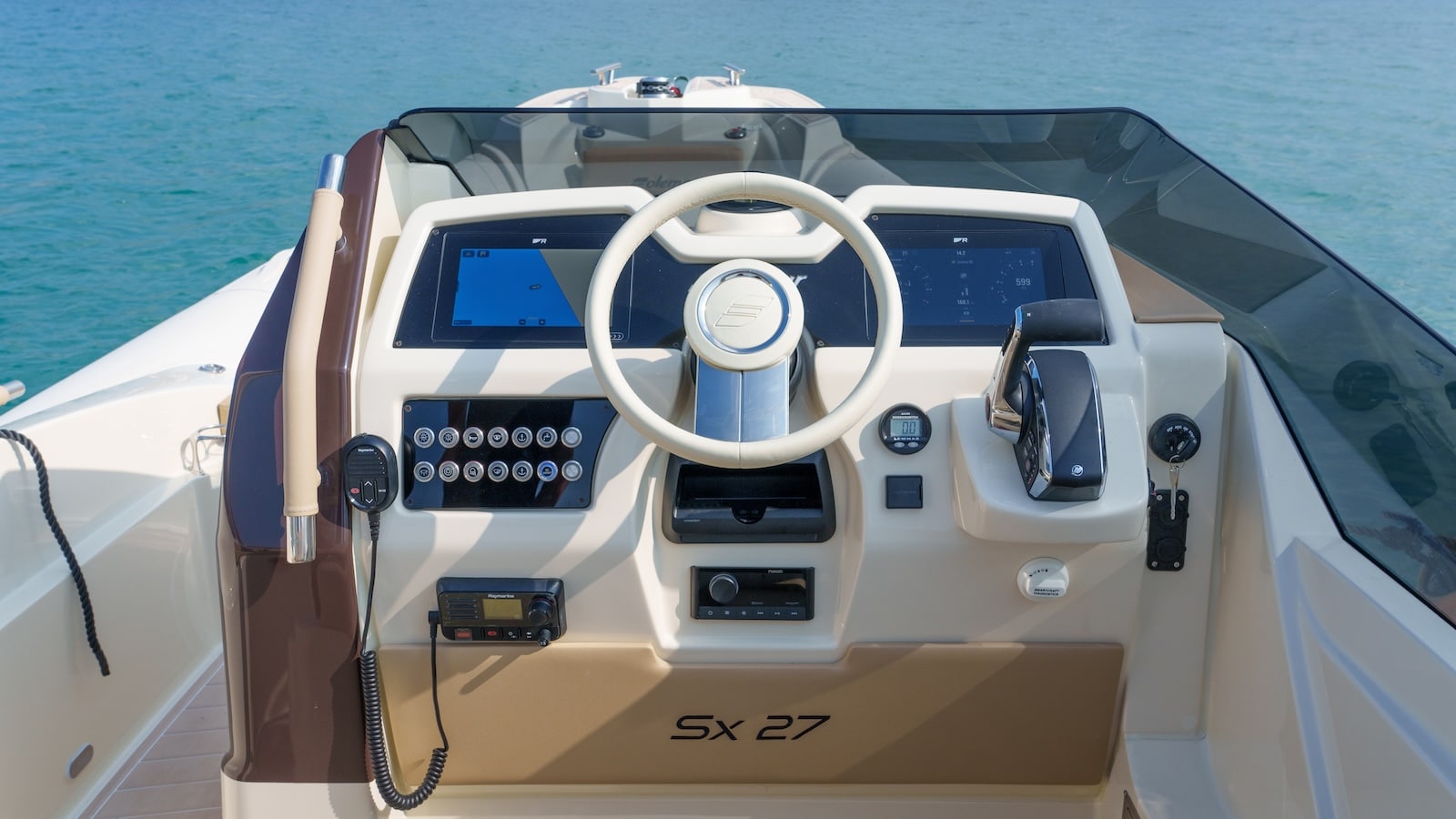
The helm station on the Solemar SX27 is set to starboard and comfortably accommodates two people who can then navigate while sitting here, enjoying excellent forward visibility. The cockpit provides plenty of space to accommodate two displays, all switches, the hi-fi system, VHF and even a useful and convenient space for smartphone induction charging.
The roll-bar houses the navigation lights, two speakers and a canopy that covers both the dinette and the helm station.
The post Solemar SX27: 100 miles aboard a mini Maxi-Rib appeared first on Yachting News.
]]>The post 100 miles aboard the Nuova Jolly Marine Prince 50: an exciting sea trial. appeared first on Yachting News.
]]>I had been trying to organize an offshore sea trial aboard the Nuova Jolly Marine Prince 50 for some time. The hull qualities of these inflatables are legendary and deserve to be tested, thoroughly and extensively. Maybe that’s one of the reasons why, when Teo Aiello of Nuova Jolly suggested me to jump on board during the transfer from the Cannes Yachting Festival to the Genoa Boat Show, I seized the opportunity and set off.
The following is the account of a sea trial which, taking place in fairly prohibitive conditions, was really useful for getting to know this exceptional maxi-rib in depth.
Nuova Jolly Marine Prince 50 : a 100-mile sea trial
It’s Monday morning and the lights of the Cannes Yachting Festival have just gone out. It’s raining and the forecast is not the best, which is certainly not the ideal given that a good 100 miles of sea await us on our way to Genoa.
However, this is the type of test I prefer; if you want to thoroughly test a boat, a long course allows you to understand all its facets, its strengths and, if there are any, also its weaknesses.
Sure, in such conditions most yachtsmen would stay in port but, for this very reason perhaps, it is better to have professionals measure the limits of a boat.
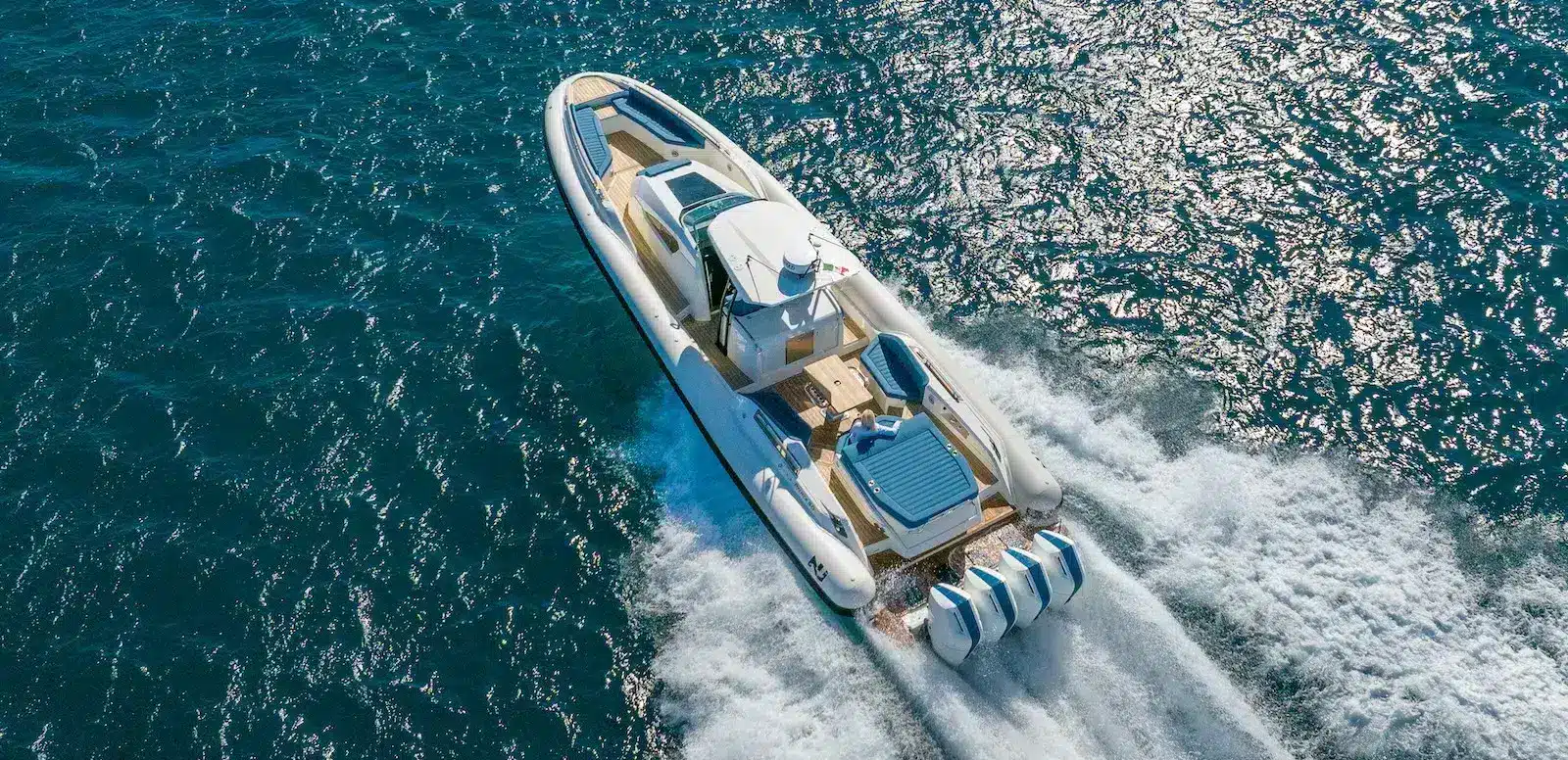
The Nuova Jolly Prince 50 is waiting for us at the dock, this Maxi-Rib was one of the most admired during the show, both for its size and for its lines that manage to be both aggressive and elegant.
 We are late, the marine weather conditions are expected to worsen further, so we have to leave quickly. Said and done, we release the moorings and head out into the open sea.
We throttle up and our Prince 50, at 12 knots, pulls away from its wake and immediately gets up on plane, which means that we will have many different speeds to deal with the sea ahead of us.
Indeed, just outside the gulf, the sea manifests itself and lets us know that today will be tough. Waves of a couple of metres, crosswind and rain, the perfect mix for the 100 miles that await us!
However, we are travelling at more than 25 knots with a level of comfort that is amazing for the situation, the hull is excellent, it doesn’t slam into the waves and leaves the boat very steerable and responsive.
The breakers of the waves raised by the crosswind are certainly not pleasant on the face, but just moving a bit inside the large windshield is enough to minimize the problem.
Cruising between 25 and 30 knots we arrived fairly quickly at Loano, where we have planned to refuel. The consumption of the Prince 50 is not very high, even in these conditions we have always remained in the range of 5.5/6 litres per mile, it was the trials during the boat show that drained the big tank!
We approach the fuel station dock with great ease despite the wind (how I love Mercury’s steering joystick) and … and the operator tells us that the pump isn’t working! As time passes and the weather worsens (and we are already almost resigned to a taxi ride with jerrycans), an idea comes over us and we ask the service station operator to try to restart the system. A very common practice in the age of electronics which, fortunately, proves to be effective and allows us to refuel, albeit slowly.
We have wasted more than two hours and in the meantime the wind and sea have increased out of all proportion.
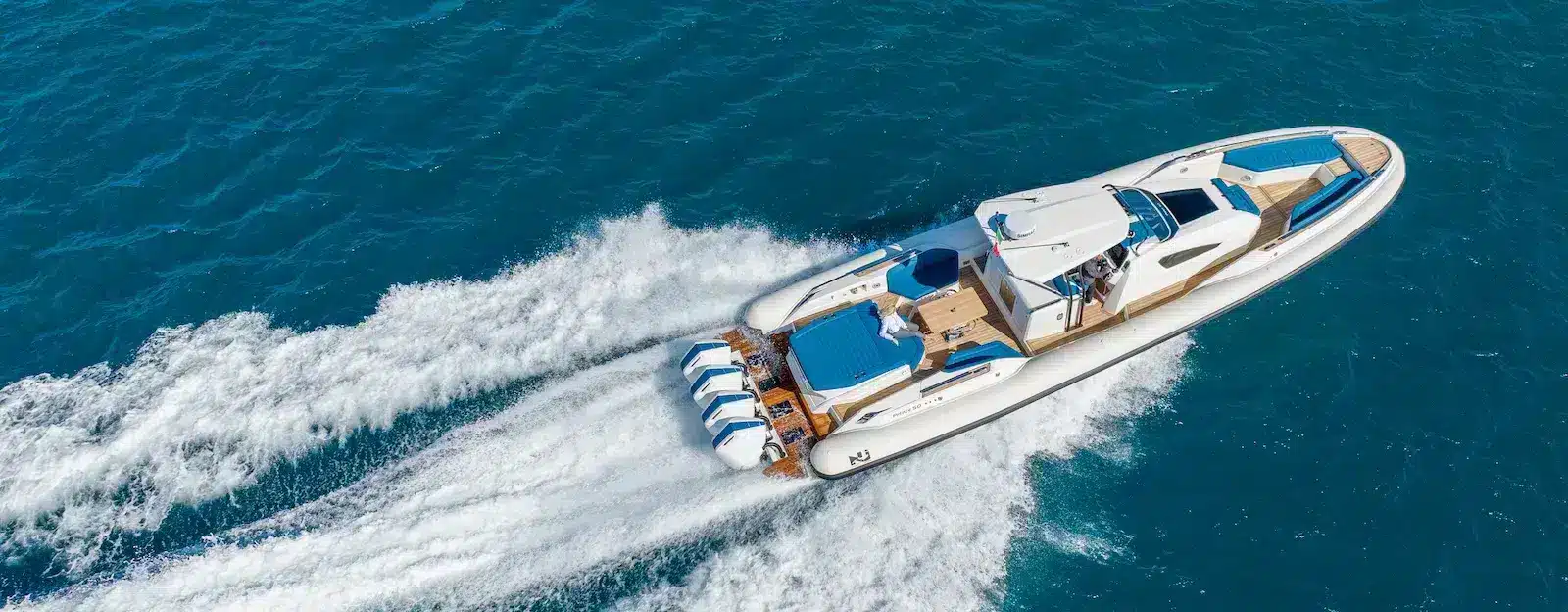
We put our raincoats back on, put on our self-inflating jackets and head the Prince 50’s bow out of the harbour. The wind is now blowing at more than 30 knots, the sea is white with breakers and the waves are much higher than before, in many cases more than three metres.
In displacement we are navigating well, the boat is stable and safe and the comfort is still high but, due to the various delays, we cannot afford to take it easy, we will arrive too late and the darkness does not agree with these conditions.
We are on plane and bring the Prince 50 up to around 20 knots which, once again, surprises us and demonstrates a superlative ability to hold the sea. At this speed the mountains of water that we pass seem like two-storey houses and climbing them is only possible thanks to the thrusters of the four Mercury V10 400s that literally bite into the water and push the Prince 50’s 10 tonnes uphill.
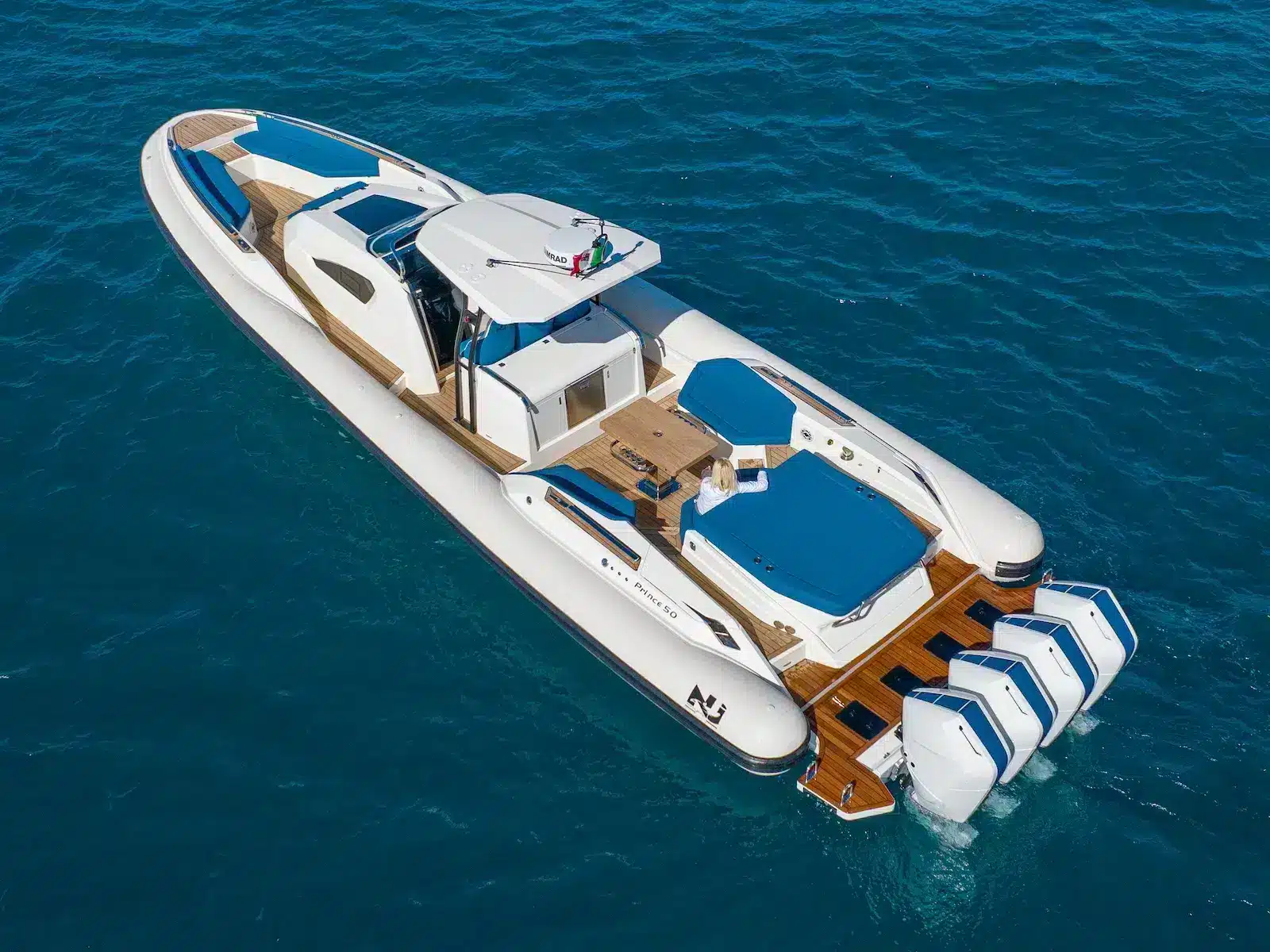
In such conditions the boat has to be steered well, trying to avoid the highest peaks, making its way through the space between one wave and the next. It is a continuous work of attention, which the buckets of water in our faces make even more tiring, so much so that we have to take turns at the helm. Fortunately there are two of us and we have been boating together for some time.
The situation continues to deteriorate until Genoa where, thanks to this extraordinary boat, we get in just before dark without having had the slightest problem on board.
Not a break, not a squeak, not even in the worst impacts. I have tested very few boats like this in my life….
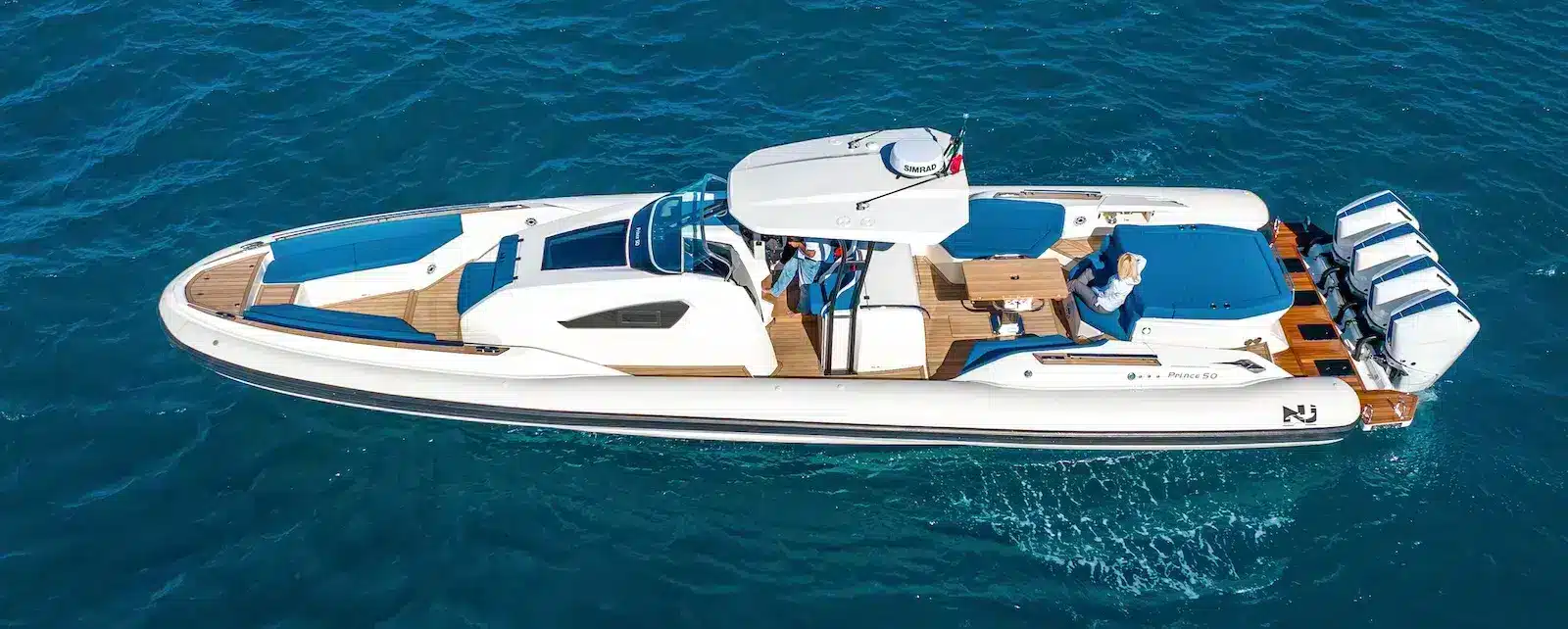
The Maxi-Rib in detail
It is definitely well made, with techniques and materials above the market standard. The hull is made entirely of vinylester resin infusion, using multi-axial mats that guarantee greater stability and structural strength. The structural grid is oversized and fitted with oversized main floors and keelsons. The interior, where the fibreglass is exposed, is counter-moulded with glossy gelcoat; the furniture is simply perfect, resulting from the mastery of long-experienced woodworkers.
The exterior, penned by Luca Macchi, is that of a pure open boat of unparalleled beauty. Traits that would not suggest how the Nuova Jolly Prince 50 can offer such a spacious and welcoming interior.
A wide hatch with a curved sliding closure and a two-step staircase lead below deck where the one room that welcomes the visitor is organized and designed to be multi-functional.
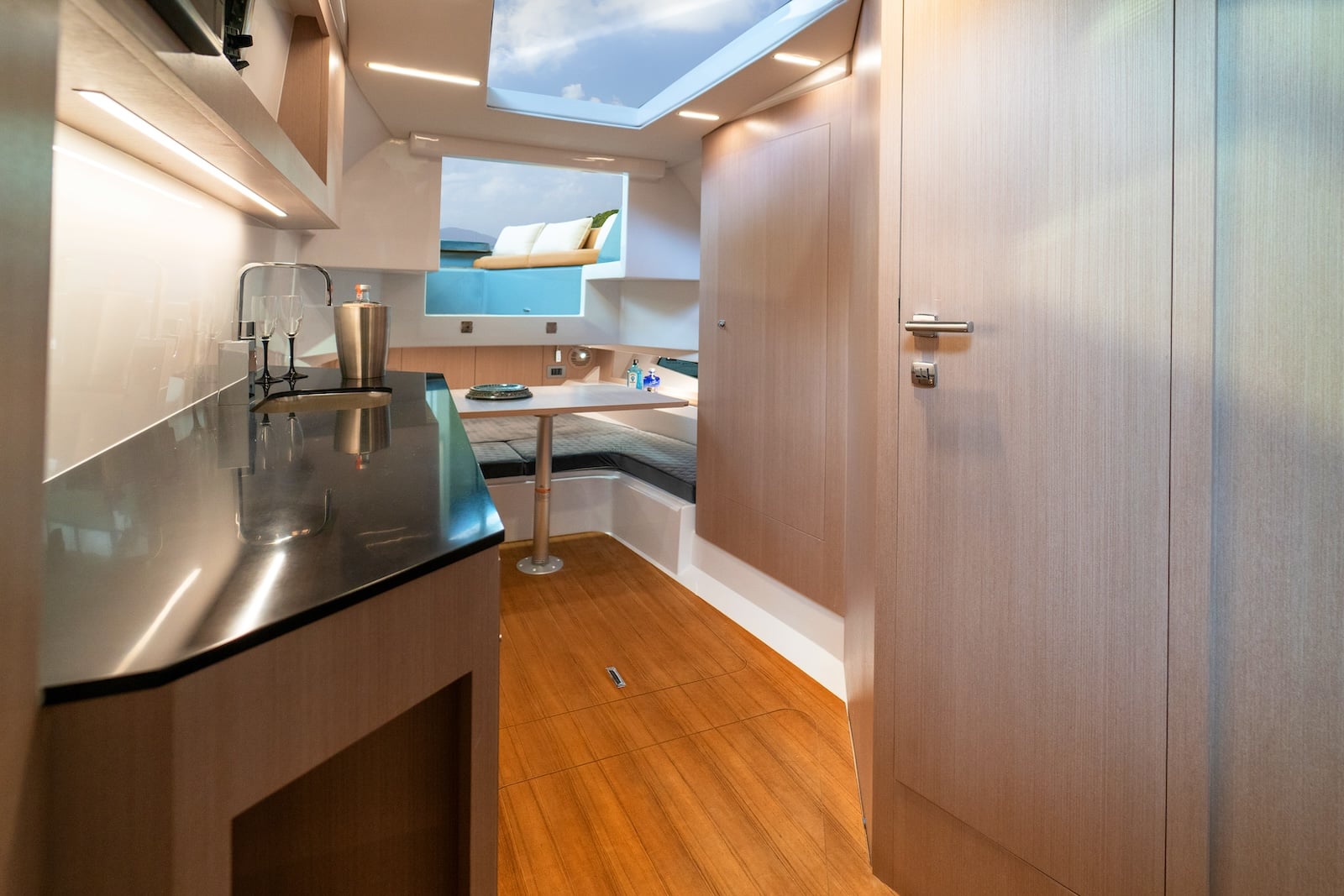
The post 100 miles aboard the Nuova Jolly Marine Prince 50: an exciting sea trial. appeared first on Yachting News.
]]>The post Pirelli 50, the flagship of Tecnorib walkaround series on test appeared first on Yachting News.
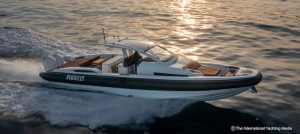
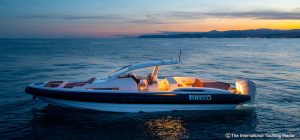
]]>Hard not to be dazzled by the beauty of the Pirelli 50. Aggressive, extremely fast and luxurious, it is the new flagship of the TecnoRib walkaround series which, in just three years, has enjoyed worldwide sales success with its first two models: the Pirelli 42 and the Pirelli 35.
In fact, the family feeling is unmistakable and, in accordance with the design of the series, also characterizes the lines of the brand-new Pirelli 50, which here take on even more sporty and exciting overtones. A boat that we couldn’t resist testing thoroughly.
A day aboard the Pirelli 50
 Having the chance to test a boat for a full day is not a recurring situation. It is an optimal condition, where you can assimilate everything happening in real boat use, including transfers to the selected destinations, behaviour at anchor, the adrenaline of turns and so on.
This is what I am thinking about as we cast off and prepare to leave the Airport Marina, a condition in which the Pirelli 50 already reveals its first quality: it is a maxi-rib with a magnetic appeal.
It’s hard to go unnoticed aboard this one-off craft, people turn their heads, look at it and follow its slow pace with their eyes, as it sails slowly through the waters of the port.
A bit like when a Ferrari passes by, it doesn’t need to run, you just look at it and you know it’s made for this. And the new Pirelli 50 is just like that, delivering adrenaline even when stationary.
The stern accommodates two Mercury Verado 600s which, as well as providing a good 1,200hp of thrust, thanks to the technology they have at their disposal, manage to make the manoeuvres of this 15-metre boat easy, with the joystick evolving effortlessly even in tight waters.
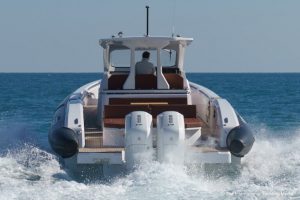
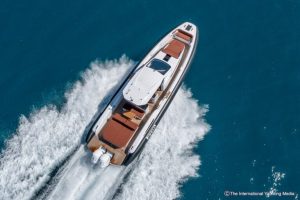
Out of the harbour I speed up, curious to get a feel for the characteristics of this twin-stepped hull designed by the famous Mannerfelt Design Team, a studio with a wealth of experience in the construction of stepped hulls. Speed increases but, even at 10/12 knots and with the trim at zero, probably the worst conditions for a maxi-rib, the boat remains flat, an undeniable sign of the system’s efficiency.
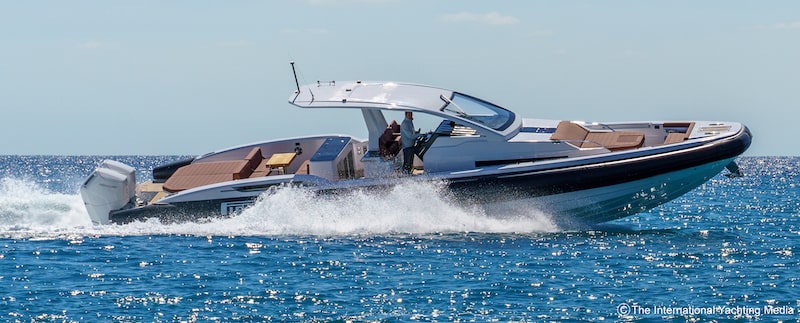
At 12 knots the Pirelli 50 gets up on plane, detaches the wake and accelerates naturally to over 20 knots, with an increase of just 500 RPM, almost as if it were developing no friction. Further increasing the RPM, the speeds increase quickly, a slight pressure on the electronic throttles and we’re up to 40 knots in no time, a very interesting cruising speed that the boat holds without any problem. Under the shelter of the large windscreen, even at this speed, the comfort is superb.
But now it’s time to get it on, 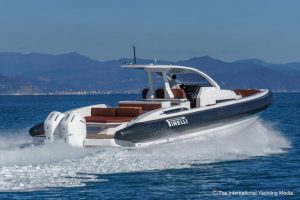 so I slow down until I stop and then pull on the throttles ahead. The counter-rotating propellers bite into the water as the acceleration pushes me towards the seat. In just over 11 seconds we pass 30 knots and in less than 20 we reach the 50-knot mark, then, trimming carefully, we record a top speed of 51.8 knots. Not bad at all for a 15-metre maxi-rib.
I turn around and look at the wake, it’s flat! The Pirelli 50 practically moves no water. The hull creates a very efficient air cushion, which supports the weight of the maxi-rib, reducing friction and cushioning the passage over the wave.
I slow down to 30 knots and then turn decisively, the boat tilts and follows the course as if it were on rails. I accelerate violently while I’m still in a turn but the Pirelli 50 doesn’t care, it uses the power to increase speed and continues on the curved course I’ve given it without widening, without a single bump.
Really a great hull, very fast, comfortable and very, very safe.
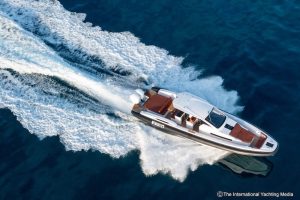
The Pirelli 50 in detail
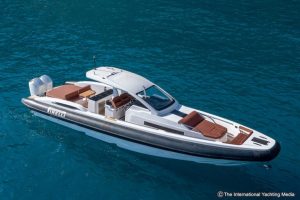 In just over 20 minutes, cruising in first class, we covered the 20 miles between Genoa Airport and Portofino. Perhaps this is exactly what the owner of a Pirelli 50 expects, fast and comfortable travel to dream destinations. And so we do, with the excuse of taking a few photos, stopping at Portofino, San Fruttuoso and then finally Santa Margherita where we stop for lunch.
At anchor, the size of the Pirelli 50 is noticeable, the boat is stable and the roll is always limited. In such conditions you can also appreciate the remarkable study of on-board circulation that the yard has developed for this model.
The Pirelli 50 takes the walkaround concept to its extreme, using all the walkways to create spaces that are ideal for their intended use. A clear example of this is the area where the eight-person dinette with opposing sofas has been masterfully created, with a service area with a central corridor that not only accommodates three fridges and a freezer, but also offers a “bar counter” overlooking this large lounge area.
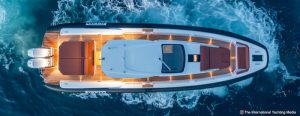
Further aft, a 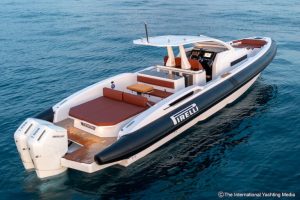 large sundeck has an additional transverse walkway which, despite the two outboards, creates a “wet area” that can be lived in with great comfort.
Thanks to the opposing sofas, the bow creates a second lounge area reminiscent of the “Portuguese bridge” layout typical of large yachts. The forward sundeck also has two comfortable chaise lounges that will certainly be some of the most popular places on the boat, even when underway.
Whether at anchor or in port, the Pirelli 50 becomes a perfect, luxurious party machine capable of entertaining a considerable number of people, who will be able to walk far and wide without ever getting in the way.
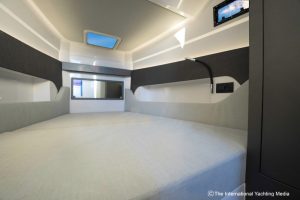
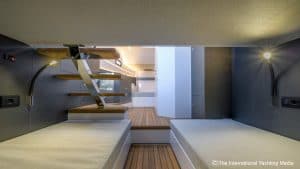
Below deck there are two cabins and a large head with separate shower which, depending on the owner’s requirements, can comfortably accommodate four people for a medium-range (fast) cruise.
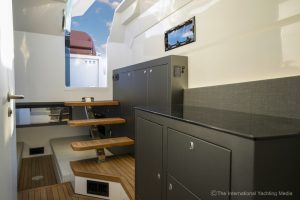
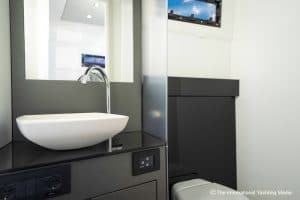
Although, in my opinion, the best use of this super maxi-rib is exactly what we tried out today. Performance, fun and adrenaline, partying at anchor and returning to port at sunset, flying over the water at 50 knots.
Emotions that only the new Pirelli 50 can give.
Test Data
| RPM | Speed in kn | l/h | L/Nm | Range in nm |
| 700 | 3.1 | 11.1 | 3.6 | 447 |
| 1000 | 4.3 | 15.4 | 3.6 | 447 |
| 1500 | 7.3 | 24.7 | 3.4 | 473 |
| 2000 | 8.7 | 34.8 | 4.0 | 400 |
| 2500 | 9.2 | 56.0 | 6.1 | 263 |
| 3000 | 11.8 | 79.1 | 6.7 | 239 |
| 3500 | 21.9 | 147.3 | 6.7 | 238 |
| 4000 | 28.2 | 190.3 | 6.7 | 237 |
| 4500 | 33.5 | 229.8 | 6.9 | 233 |
| 5000 | 37.9 | 263.5 | 7.0 | 230 |
| 5500 | 41.8 | 301.0 | 7.2 | 222 |
| 6000 | 46.7 | 348.3 | 7.5 | 215 |
| 6200 | 51.8 | 411.8 | 7.9 | 201 |
| Acceleration,speed in knots | Time in seconds |
| 0-20 | 8.4 |
| 0-30 | 11.3 |
| 0-40 | 14.7 |
| 0-50 | 19.8 |
Technical Specs
| LOA | 15.20 m |
| Max Beam | 4.70 m |
| Max Passengers Capacity | 14 |
| Fuel | 1600 l |
| Water | 400 l |
| Design & Project | Mannerfelt Design Team – TecnoRib |
The post Pirelli 50, the flagship of Tecnorib walkaround series on test appeared first on Yachting News.
]]>The post Daytona 34, 150 miles aboard an out-of-the-ordinary boat appeared first on Yachting News.
]]>Let’s face it, the Rio Yachts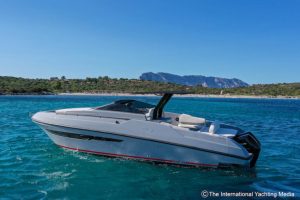 Daytona 34 is the boat of the moment. After her great success at last year’s Genoa Boat Show, sales have been brisk and all boats available for the season have been sold in the blink of an eye.
Beautiful, aggressive and surprisingly spacious, this boat manages to reproduce all the characteristics of much larger boats, while remaining within the limits that allow it to be considered as a registration-free boat.
But how will she really perform at sea?
 To answer this question, we asked the shipyard to let us carry out one of our historic long-duration trials and, in late June, with the help of a delivery to a client in Sardinia, we left Piombino for Golfo Aranci.
A good 120 miles which, with the weather and sea conditions we found, actually became 140.
It was a very hard test, with a lashing mistral and large waves. Let’s find out how it went.
150 miles aboard the new Rio Yachts Daytona 34
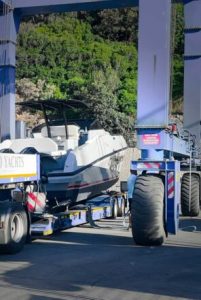
It’s early in the morning when we arrive at the port of Piombino. The travel lift is lowering the Daytona 34 and I take the opportunity to look at the hull lines. The V at the bow is accentuated and the deadrise is pronounced. It’s a choice I fully agree with and one that should guarantee above-average seaworthiness, especially in the sea conditions we’re about to encounter.
The first stretch will take us along the coast of Elba, leaving Giglio and Montecristo to the left. Here we will certainly find a strong sea, which will gradually weaken as we
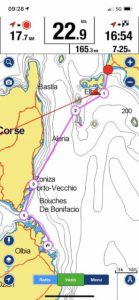 approach the Corsican coast. A second, quieter leg of our journey will take us to the beautiful and famous Bocche di Bonifacio, the toughest test for our Daytona 34, which will inevitably face the most feared stretch of
sea in the Mediterranean when the Mistral blows at over 30 knots, as it did today.
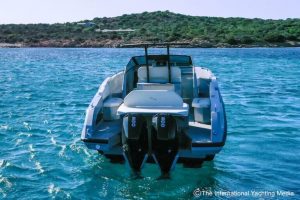
We climb on board and put our camera equipment down, where it can’t fall and get damaged, then we leave the port with the two Mercury Verado 300s idling. It’s enough tostick our noses out of the harbour to realize that we’re in for a treat, the wave is high and very strong. We push the throttles forward and, at around 13 knots, the Daytona 34 easily gets up on plane.
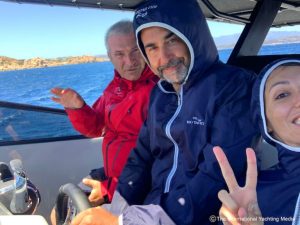 We accelerate carefully and, despite the big waves, we manage to keep a cruising speed of around 25 knots.
Our boat behaves very well. Sure, we jump from wave to wave, which is inevitable at this speed, but the landings are always soft, controlled and easy to handle. What is most amazing is the ability of this boat not to get wet, no splashes come in even on the hardest landings.
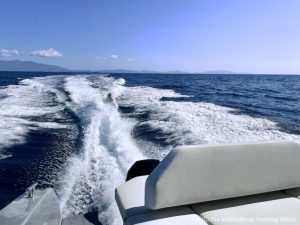 The shelter offered by the island of Elba, which we tactically approach, allows us to increase our speed. At 30 knots, the Daytona 34 flies over slightly choppy water with no apparent effort, the wake is perfect and the comfort maximum. Unfortunately it doesn’t last long and, in the blink of an eye, we are back in the open sea. The waves are making themselves felt again and now, with all the fetch they have available, they are really impressive.
We reduce speed to around 22 knots and, with renewed amazement, I watch the Daytona 34 take on these mountains of water from a height of two metres with relative ease. We proceed apace and in a couple of hours we are close to the coast and can accelerate to around 30 knots again.
We switch at the controls and I take the opportunity to go below deck. Fortunately the equipment is still intact and, yet another surprise, I don’t hear any creaking, yet we’re going fast and the sea is certainly not a board. Really good build quality!
I go back up just in time to enjoy the changing panorama as we pass (quickly) between the mainland and the Cerbicali Islands and then, in a flash, I see the Mistral coming over the water and everything changes.
Suddenly, a 30/35-knot wind comes and the water pulverizes on the surface of the sea. We slow down to 20 knots and sail smoothly along the coast as far as the Gulf of Santa Manza, where that little 3-mile feetch raises one-metre waves which, short and steep, subject our heroic Daytona 34 to a “washing machine effect” that we would have gladly avoided.
Nevertheless, 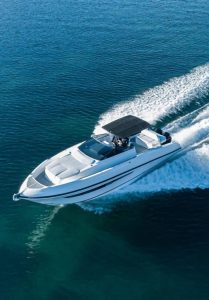 we continue with a renewed feeling of safety that truly excellent hull gives us. As we approach the Piantarella passage, the Strait of Bonifacio opens up and shows all its magnificence. The horizon is jagged with high and very steep waves, conditions that would be prohibitive for most boats.
The Daytona, instead, sails very well, with flaps and outboard trim all down, the bow low at the water, she can glide at 12-13 knots with impressive course stability while we, on the other hand, find it really hard to keep our eyes open, the amount of pulverised water coming at us is considerable.
So, we opt for a tactic that I have been using for several years to pass this stretch of sea when it is as rough as it is today. We will sail along the islands as much as possible, making the stretches without the stern sea. And this is exactly what we do, leaving
 Cavallo and Lavezzi on the starboard side, which we sail along as close as possible to the coast (so close). Once we have covered Lavezzi, we turn sharply 80 degrees to the left and head for the northern end of La Presa Island.
Here, inevitably, as soon as the turn is over, the mouths unleash all their fury on us.
We slow down as three-metre waves reach our stern. Here we play with the throttle to stay in the cable, sailing at the same speed as the wave and steering to stay on course and above all in line with the wave, we absolutely must not allow the boat to cross.
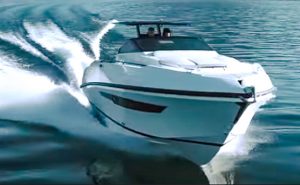
But the Daytona 34 surprises us once again, by demonstrating great responsiveness and manoeuvrability; sailing in sync with these mountains of water is not difficult with this boat.
We therefore tackle the 6 miles of rough sea that separate us from the next sheltered area. Forty minutes of passion, during which the great initial attention gives way to a gradual euphoria which, probably stimulated by the confidence instilled by this magnificent open, paints our faces with a progressively bigger smile.
Then, when we reach the shelter of Santa Maria, everything disappears and, although there are still another 15 miles to go to pass the mouths, everything returns to normal on board while our Daytona begins to glide undaunted at 25 knots, in the shelter of the archipelago of La Maddalena, arguably the most beautiful in the world.
We cover the 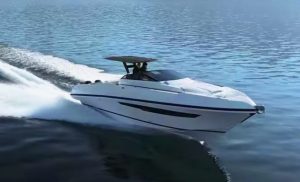 last 45 miles and go behind the Capo Coda Cavallo, our drone has trouble taking off in this wind but then it gives us a gift and allows us to portray the Daytona in this enchanting setting. Then it’s time to go back and Paola and Claudio, my tireless travel (and adventure) companions, agree to accompany me into the bowels of the Gulf of Olbia, directly to the ferry terminal.
The 40 knots on the bow now seem normal, the Daytona 34 copes with them with ease and, once again very quickly, I find myself disembarking and admiring from afar the silhouette of Rio Yachts’ latest creation as she sails away.
I take my notebook before leaving and quickly write down these few words: “What a boat, guys, what a boat…”
Rio Yachts Daytona 34 Performance
| RPM | Speed in knots | Fuel Consumption in l/h | L/Nm |
| 600 | 2.8 | 2.9 | 1.0 |
| 1,000 | 4.8 | 5.5 | 1.1 |
| 1,500 | 6.4 | 8.9 | 1.4 |
| 2,000 | 8 | 15.6 | 2.0 |
| 2,500 | 9 | 22.0 | 2.4 |
| 3,000 | 11 | 30.0 | 2.7 |
| 3,500 | 16 | 40.0 | 2.5 |
| 4,000 | 25.5 | 46.0 | 1.8 |
| 4,500 | 32 | 65.0 | 2.0 |
| 5,000 | 36.5 | 81.0 | 2.2 |
| 5,500 | 40 | 86.0 | 2.2 |
| 5,650 | 41.2 | 92.0 | 2.2 |
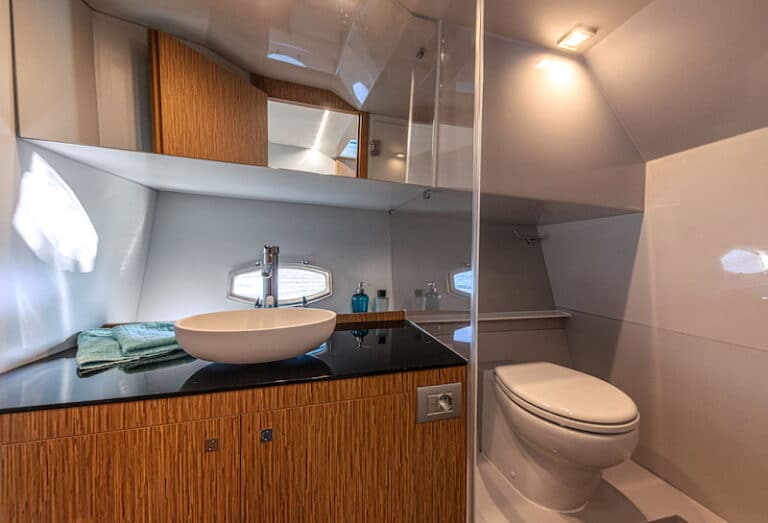
Daytona 34: Exteriors and Interiors
If you think it’s only performance that has impressed us, you’re sadly mistaken. The interiors and exteriors of this boat are another masterpiece of nautical engineering.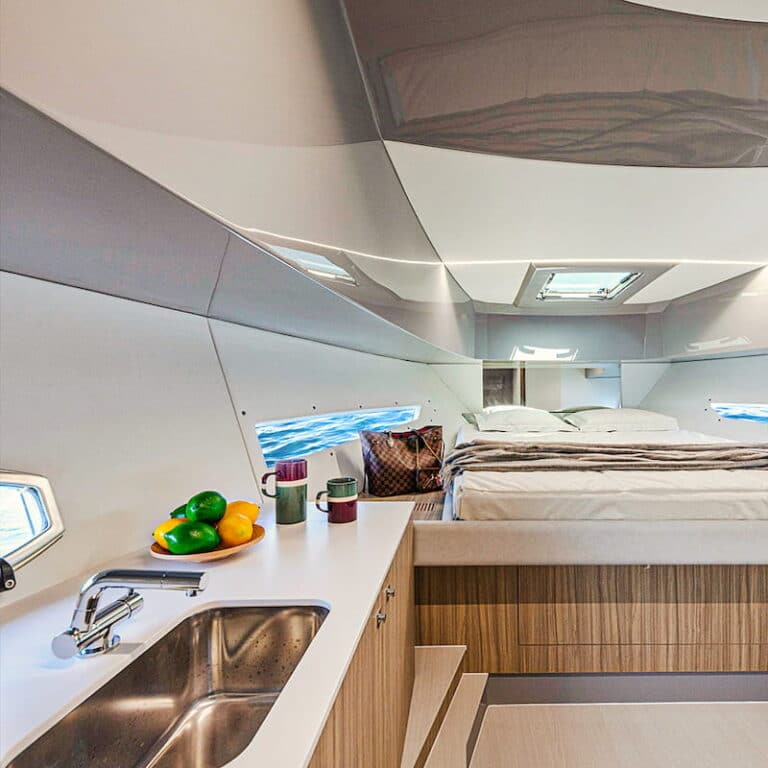 Comfort and functionality are two elements that immediately become apparent, as soon as you look into the cockpit. A central sofa (which can be converted into a sundeck), two side sofas and an external galley form a square around a foldaway table that transforms the cockpit into a very welcoming dinette. A black T-Top with a decidedly gritty shape protects the guests from the sun. Another strength of the Daytona 34 are the extremely safe and well-protected side-decks with steel handrails leading to the bow.
Here, the sundeck expands exaggeratedly to the delight of those who can’t give up sunbathing.
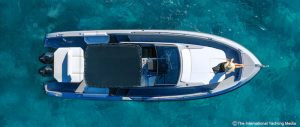
Daytona 34 is, in fact, a fully-fledged walkaround, enhanced by non-slip synthetic teak flooring (also available in wood, of course) which makes every single step on the deck soft and delicate.
To the left of the cockpit, which is quite compact and has a protective dashboard as well
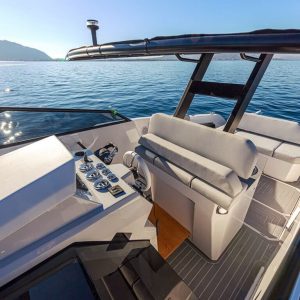
as an agile and intuitive control panel, is the descent into the lower deck, where the Daytona never ceases to give its best in terms of space and comfort.
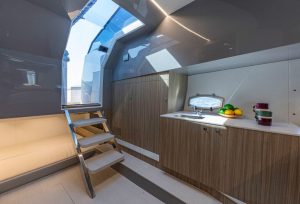
The master cabin, located in the bow and dominated in the centre by a king-sized double bed, is not only wide and deep in height, but is also incredibly bright thanks to the long lateral windows. The head, on the starboard side, includes a separate shower cubicle while aft, behind the access ladder, the VIP cabin sleeps a further two generously sized berths.
All in a neat, classy setting, where every detail is in its right place and the finishes are fine.
But the best thing is that no two Daytona will ever be the same. Customisation is extreme, so the boat can be personalised at will, with different colours and materials for the interiors and a huge choice of colours for the hull, from the softest to the boldest. It’s a boat that certainly does not go unnoticed, the one we travelled 150 miles on.
Technical specs
| LOA | 10.50 m |
| Width | 3.50 m |
| Draft | 0.56 m |
| Passengers Capacity | 12 |
| Fuel Capacity | 920 l |
| Berths | 2+2 |
| EC Category | B |
| Designer | Marino Alfani |
| Engines | 2 x Mercruiser Verado 300 hp or w x Mercruiser Verado 250 hp |
| Fuel | Petrol |
The post Daytona 34, 150 miles aboard an out-of-the-ordinary boat appeared first on Yachting News.
]]>