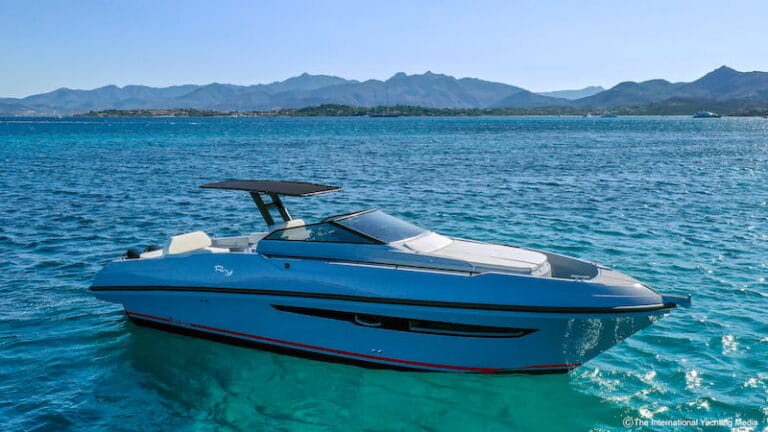
Let’s face it, the Rio Yachts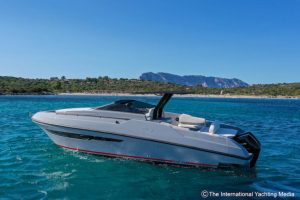 Daytona 34 is the boat of the moment. After her great success at last year’s Genoa Boat Show, sales have been brisk and all boats available for the season have been sold in the blink of an eye.
Beautiful, aggressive and surprisingly spacious, this boat manages to reproduce all the characteristics of much larger boats, while remaining within the limits that allow it to be considered as a registration-free boat.
But how will she really perform at sea?
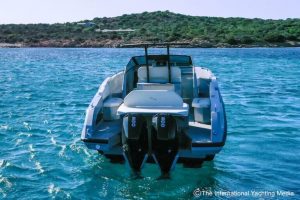 To answer this question, we asked the shipyard to let us carry out one of our historic long-duration trials and, in late June, with the help of a delivery to a client in Sardinia, we left Piombino for Golfo Aranci.
A good 120 miles which, with the weather and sea conditions we found, actually became 140.
It was a very hard test, with a lashing mistral and large waves. Let’s find out how it went.
150 miles aboard the new Rio Yachts Daytona 34
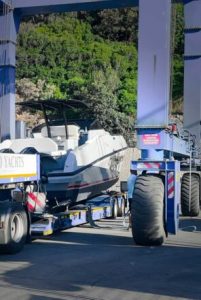
It’s early in the morning when we arrive at the port of Piombino. The travel lift is lowering the Daytona 34 and I take the opportunity to look at the hull lines. The V at the bow is accentuated and the deadrise is pronounced. It’s a choice I fully agree with and one that should guarantee above-average seaworthiness, especially in the sea conditions we’re about to encounter.
The first stretch will take us along the coast of Elba, leaving Giglio and Montecristo to the left. Here we will certainly find a strong sea, which will gradually weaken as we
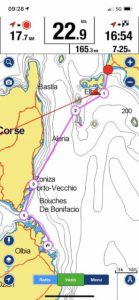 approach the Corsican coast. A second, quieter leg of our journey will take us to the beautiful and famous Bocche di Bonifacio, the toughest test for our Daytona 34, which will inevitably face the most feared stretch of
sea in the Mediterranean when the Mistral blows at over 30 knots, as it did today.
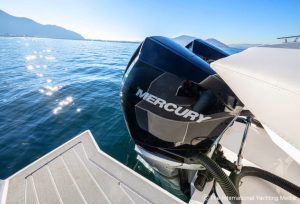
We climb on board and put our camera equipment down, where it can’t fall and get damaged, then we leave the port with the two Mercury Verado 300s idling. It’s enough tostick our noses out of the harbour to realize that we’re in for a treat, the wave is high and very strong. We push the throttles forward and, at around 13 knots, the Daytona 34 easily gets up on plane.
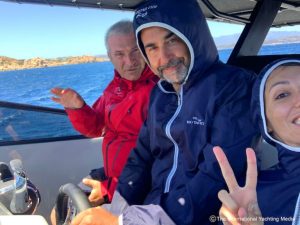 We accelerate carefully and, despite the big waves, we manage to keep a cruising speed of around 25 knots.
Our boat behaves very well. Sure, we jump from wave to wave, which is inevitable at this speed, but the landings are always soft, controlled and easy to handle. What is most amazing is the ability of this boat not to get wet, no splashes come in even on the hardest landings.
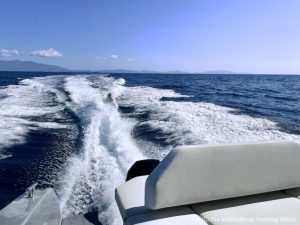 The shelter offered by the island of Elba, which we tactically approach, allows us to increase our speed. At 30 knots, the Daytona 34 flies over slightly choppy water with no apparent effort, the wake is perfect and the comfort maximum. Unfortunately it doesn’t last long and, in the blink of an eye, we are back in the open sea. The waves are making themselves felt again and now, with all the fetch they have available, they are really impressive.
We reduce speed to around 22 knots and, with renewed amazement, I watch the Daytona 34 take on these mountains of water from a height of two metres with relative ease. We proceed apace and in a couple of hours we are close to the coast and can accelerate to around 30 knots again.
We switch at the controls and I take the opportunity to go below deck. Fortunately the equipment is still intact and, yet another surprise, I don’t hear any creaking, yet we’re going fast and the sea is certainly not a board. Really good build quality!
I go back up just in time to enjoy the changing panorama as we pass (quickly) between the mainland and the Cerbicali Islands and then, in a flash, I see the Mistral coming over the water and everything changes.
Suddenly, a 30/35-knot wind comes and the water pulverizes on the surface of the sea. We slow down to 20 knots and sail smoothly along the coast as far as the Gulf of Santa Manza, where that little 3-mile feetch raises one-metre waves which, short and steep, subject our heroic Daytona 34 to a “washing machine effect” that we would have gladly avoided.
Nevertheless, 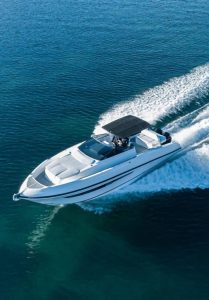 we continue with a renewed feeling of safety that truly excellent hull gives us. As we approach the Piantarella passage, the Strait of Bonifacio opens up and shows all its magnificence. The horizon is jagged with high and very steep waves, conditions that would be prohibitive for most boats.
The Daytona, instead, sails very well, with flaps and outboard trim all down, the bow low at the water, she can glide at 12-13 knots with impressive course stability while we, on the other hand, find it really hard to keep our eyes open, the amount of pulverised water coming at us is considerable.
So, we opt for a tactic that I have been using for several years to pass this stretch of sea when it is as rough as it is today. We will sail along the islands as much as possible, making the stretches without the stern sea. And this is exactly what we do, leaving
 Cavallo and Lavezzi on the starboard side, which we sail along as close as possible to the coast (so close). Once we have covered Lavezzi, we turn sharply 80 degrees to the left and head for the northern end of La Presa Island.
Here, inevitably, as soon as the turn is over, the mouths unleash all their fury on us.
We slow down as three-metre waves reach our stern. Here we play with the throttle to stay in the cable, sailing at the same speed as the wave and steering to stay on course and above all in line with the wave, we absolutely must not allow the boat to cross.
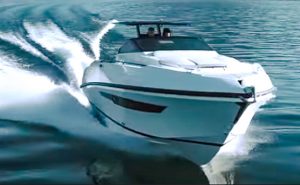
But the Daytona 34 surprises us once again, by demonstrating great responsiveness and manoeuvrability; sailing in sync with these mountains of water is not difficult with this boat.
We therefore tackle the 6 miles of rough sea that separate us from the next sheltered area. Forty minutes of passion, during which the great initial attention gives way to a gradual euphoria which, probably stimulated by the confidence instilled by this magnificent open, paints our faces with a progressively bigger smile.
Then, when we reach the shelter of Santa Maria, everything disappears and, although there are still another 15 miles to go to pass the mouths, everything returns to normal on board while our Daytona begins to glide undaunted at 25 knots, in the shelter of the archipelago of La Maddalena, arguably the most beautiful in the world.
We cover the 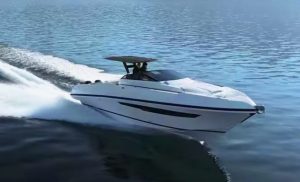 last 45 miles and go behind the Capo Coda Cavallo, our drone has trouble taking off in this wind but then it gives us a gift and allows us to portray the Daytona in this enchanting setting. Then it’s time to go back and Paola and Claudio, my tireless travel (and adventure) companions, agree to accompany me into the bowels of the Gulf of Olbia, directly to the ferry terminal.
The 40 knots on the bow now seem normal, the Daytona 34 copes with them with ease and, once again very quickly, I find myself disembarking and admiring from afar the silhouette of Rio Yachts’ latest creation as she sails away.
I take my notebook before leaving and quickly write down these few words: “What a boat, guys, what a boat…”
Rio Yachts Daytona 34 Performance
| RPM | Speed in knots | Fuel Consumption in l/h | L/Nm |
| 600 | 2.8 | 2.9 | 1.0 |
| 1,000 | 4.8 | 5.5 | 1.1 |
| 1,500 | 6.4 | 8.9 | 1.4 |
| 2,000 | 8 | 15.6 | 2.0 |
| 2,500 | 9 | 22.0 | 2.4 |
| 3,000 | 11 | 30.0 | 2.7 |
| 3,500 | 16 | 40.0 | 2.5 |
| 4,000 | 25.5 | 46.0 | 1.8 |
| 4,500 | 32 | 65.0 | 2.0 |
| 5,000 | 36.5 | 81.0 | 2.2 |
| 5,500 | 40 | 86.0 | 2.2 |
| 5,650 | 41.2 | 92.0 | 2.2 |
Daytona 34: Exteriors and Interiors
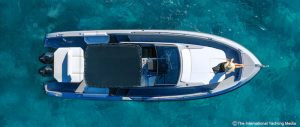
If you think it’s only performance that has impressed us, you’re sadly mistaken. The interiors and exteriors of this boat are another masterpiece of nautical engineering.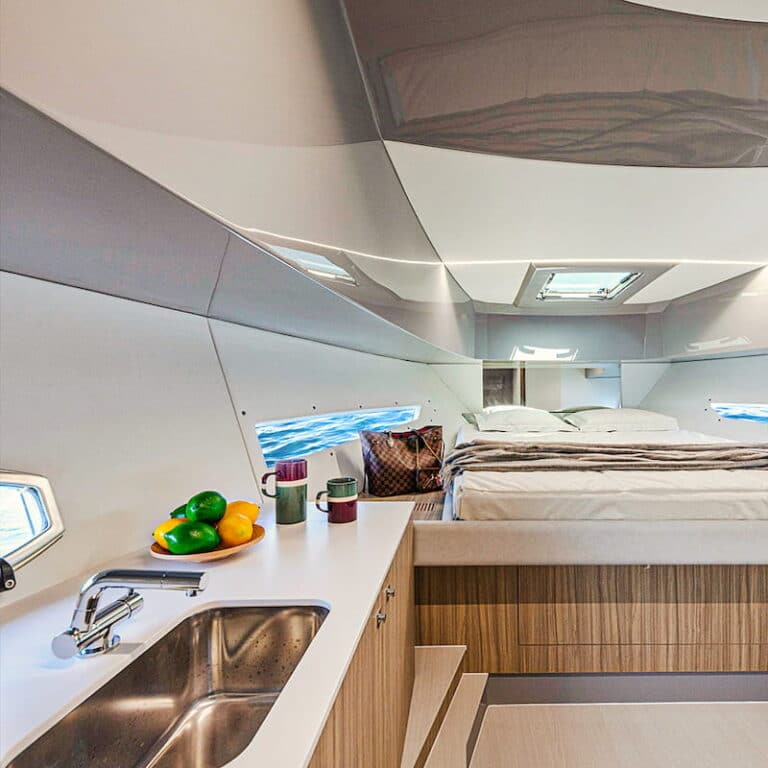 Comfort and functionality are two elements that immediately become apparent, as soon as you look into the cockpit. A central sofa (which can be converted into a sundeck), two side sofas and an external galley form a square around a foldaway table that transforms the cockpit into a very welcoming dinette. A black T-Top with a decidedly gritty shape protects the guests from the sun. Another strength of the Daytona 34 are the extremely safe and well-protected side-decks with steel handrails leading to the bow.
Here, the sundeck expands exaggeratedly to the delight of those who can’t give up sunbathing.
Daytona 34 is, in fact, a fully-fledged walkaround, enhanced by non-slip synthetic teak flooring (also available in wood, of course) which makes every single step on the deck soft and delicate.
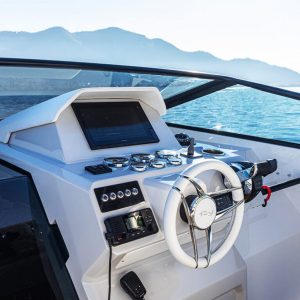
To the left of the cockpit, which is quite compact and has a protective dashboard as well
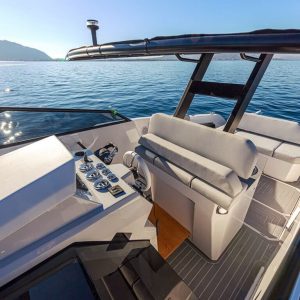
as an agile and intuitive control panel, is the descent into the lower deck, where the Daytona never ceases to give its best in terms of space and comfort.
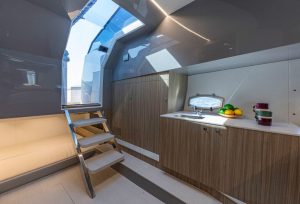
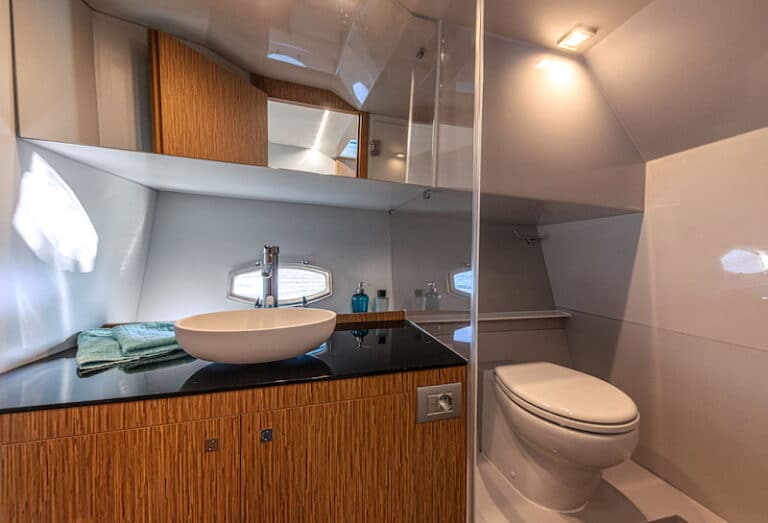
The master cabin, located in the bow and dominated in the centre by a king-sized double bed, is not only wide and deep in height, but is also incredibly bright thanks to the long lateral windows. The head, on the starboard side, includes a separate shower cubicle while aft, behind the access ladder, the VIP cabin sleeps a further two generously sized berths.
All in a neat, classy setting, where every detail is in its right place and the finishes are fine.
But the best thing is that no two Daytona will ever be the same. Customisation is extreme, so the boat can be personalised at will, with different colours and materials for the interiors and a huge choice of colours for the hull, from the softest to the boldest. It’s a boat that certainly does not go unnoticed, the one we travelled 150 miles on.
Technical specs
| LOA | 10.50 m |
| Width | 3.50 m |
| Draft | 0.56 m |
| Passengers Capacity | 12 |
| Fuel Capacity | 920 l |
| Berths | 2+2 |
| EC Category | B |
| Designer | Marino Alfani |
| Engines | 2 x Mercruiser Verado 300 hp or w x Mercruiser Verado 250 hp |
| Fuel | Petrol |